Modi calls for global unity to prevent future pandemic.
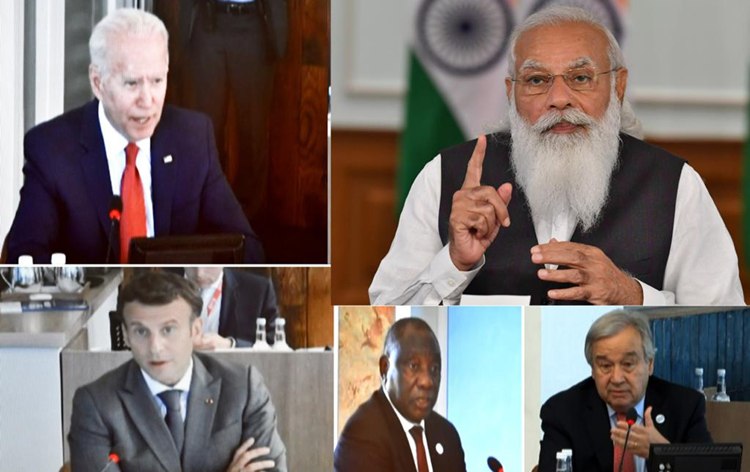

Prime Minister Narendra Modi has called for global unity, leadership and solidarity to prevent future pandemics and emphasized the special responsibility of democratic and transparent societies. Participating in the first Outreach Session of the G7 Summit via virtual mode, Mr Modi said the meeting should send out the message of ‘One Earth One Health’ for the whole world. He highlighted India’s ‘whole of society’ approach to fight the pandemic, synergising the efforts of all levels of the government, industry and civil society. 

The Prime Minister also explained India’s successful use of open source digital tools for contact tracing and vaccine management. He conveyed India’s willingness to share its experience and expertise with other developing countries.

Prime Minister Modi committed India’s support for collective endeavours to improve global health governance. He sought the G7’s support for the proposal moved at the WTO by India and South Africa, for a TRIPS waiver on COVID related technologies.  Sources said Australia and others came out strongly in support of this.

The session, titled ‘Building Back Stronger – Health’, focused on global recovery from the coronavirus pandemic and on strengthening resilience against future pandemics. The Prime Minister will participate in the final day of the G7 Summit today and will speak in two Sessions.

Renu’s Dhanjal:  Patna, Still Drowning

Patna’s recurring floods echo Phanishwar Nath Renu’s 1975 reportage. Fifty years later, the crisis exposes urban planning failures, drainage gaps and lost lessons.

Niraj Krishna   |  2 days, 19 hours ago

The Price of Profit in Satya Niketan, South Delhi

The Satya Niketan tragedy is not simply a story of one negligent landlord. It raises serious questions about unregulated construction, overcrowded student housing and the failure of civic enforcement in South Delhi.

Dinesh Dubey @ Editorial   |  2 days, 21 hours ago

The Rise of Rogue AI Agents and the Global Rush for Liability Laws

Rogue AI agents are raising new cybersecurity and accountability risks. Why governments need binding liability laws for autonomous AI systems.

Dinesh Dubey @ Editorial   |  3 days, 9 hours ago

NEPAL IN THE GRIP OF WORST FLASH FLOOD DISASTER

Nepal faces a devastating flash flood disaster linked to glacial ice and debris, with hundreds dead, thousands missing and major infrastructure badly damaged.

Alok K.Shrivastava   |  3 days, 10 hours ago

India’s Cities Are Growing Faster Than Their Infrastructure

India’s rapid urbanisation is outpacing infrastructure, governance and planning. Why cities need better housing, mobility, water management and climate resilience.

Ankita Mishra   |  3 days, 10 hours ago

Article 142:  Who Bowed—Power or Democracy?

The withdrawal of protest-related FIRs raises deeper questions about Article 142, public pressure, judicial power, institutional autonomy and the Rule of Law in India.

Niraj Krishna   |  4 days, 6 hours ago

Comments

YOU MIGHT ALSO LIKE

View More

By Niraj Krishna   |   2 days, 19 hours ago
Renu’s Dhanjal:  Patna, Still Drowning
By Alok K.Shrivastava   |   3 days, 10 hours ago
NEPAL IN THE GRIP OF WORST FLASH FLOOD DISASTER
By Ankita Mishra   |   3 days, 10 hours ago
India’s Cities Are Growing Faster Than Their Infrastructure
By Niraj Krishna   |   4 days, 6 hours ago
Article 142:  Who Bowed—Power or Democracy?