Article 142: Who Bowed—Power or Democracy?

 1 month, 2 weeks ago
Throughout the history of democratic constitutional governance, there have been numerous instances where the judiciary has subjected executive power to judicial review, the State has been reminded that it is still subject to the Rule of Law, and governments have been forced to reevaluate their decisions due to popular pressure. However, a much more important constitutional question needs to be addressed: has there ever been an instance in modern democracy where a government approached the Supreme Court and requested the use of its extraordinary constitutional jurisdiction to end criminal cases that the State itself had registered, anticipating fresh public pressure on the streets?
There is more to this subject than just quashing FIRs. It is fundamental to institutional autonomy, the Rule of Law, and the legitimacy of the State. A key tenet of constitutional democracy is seriously threatened if the outcome of criminal prosecutions starts to be decided not by legal scrutiny but by the possibility of public pressure, political conditions, or fears of a potential law-and-order scenario.
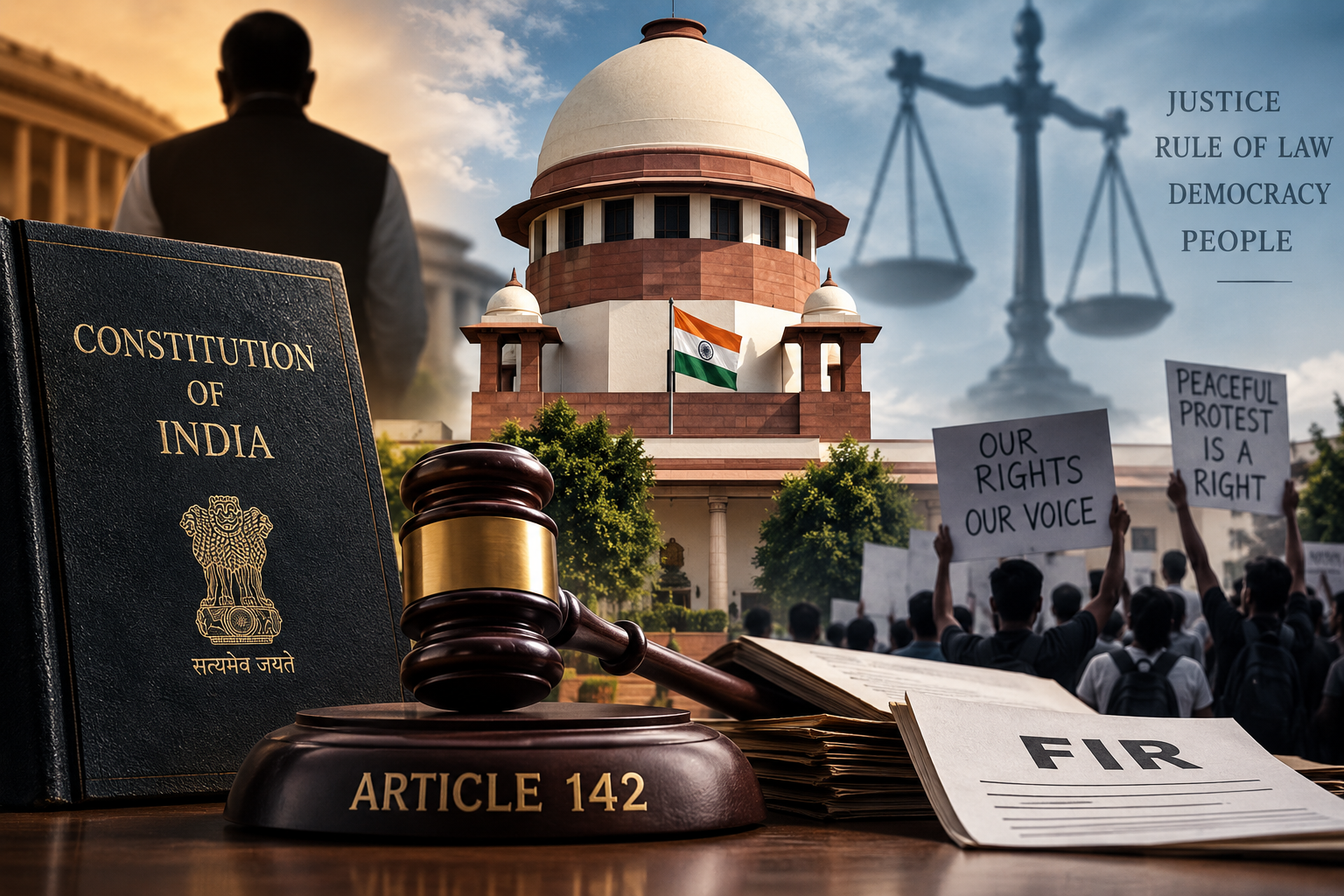
However, Article 142 presents the most glaring constitutional inconsistency in this entire scenario. This is the exact clause that gives the Supreme Court the right to take exceptional measures to guarantee "complete justice". The executive is now attempting to intervene on behalf of the same authority that was previously questioned from the highest constitutional office and even referred to as a "nuclear missile" in the context of judicial overreach. And therein is the fundamental contradiction of democracy: why try to curtail a power yesterday, only to turn to that same power for solace today?
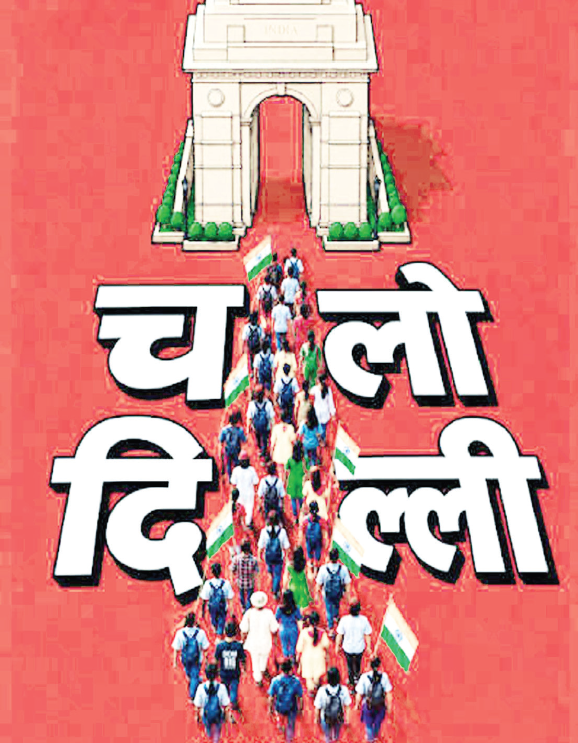
FIRs were filed against demonstrators under a number of criminal laws after the July student protests at Jantar Mantar. There were still calls for their withdrawal. On September 5, a second march was suggested in Delhi in the same order. The march was planned as a protest against the earlier FIRs' failure to be withdrawn, according to the information that is currently available.
In light of this, the episode unexpectedly took a constitutional turn. Invoking Article 142, the Union Government and the Delhi Police petitioned the Supreme Court to use its exceptional constitutional powers to stop the FIRs relating to the protest. According to reports, the appeal cited 13 FIRs, some of which allegedly contained grave criminal accusations.
Following that, the Supreme Court used its authority under Article 142 to award relief in the relevant cases while excluding accusations of grave violent crimes and permitting the ongoing judicial proceedings in such cases. The planned march on September 5 was cancelled as a result of this intervention.
However, this is exactly where the more complex constitutional issue starts. Why did the administration only feel the need to ask for court intervention when another public protest was about to take place? Why wasn't the initiative taken sooner if quashing these FIRs was actually required for reasons of justice, law, and proportionality? And does that not set a concerning precedent for the Rule of Law if the possibility of a resurgent movement affected the ruling?
Because the timing of a protest cannot control the law in a democracy. The Constitution and the Rule of Law must govern it.
Therefore, the true question is not just whether the demonstrators eventually marched or if the FIRs were withdrawn. The more profound question is whether the State took action because the streets were about to do so or because the law required it. The problem will no longer be limited to a single group of FIRs if the latter becomes the norm. It concerns who ultimately decides the direction of constitutional governance: the government, the institutions, or popular pressure.
A democratic state's institutional legitimacy in upholding the Rule of Law is its fundamental strength, not the power of its repressive apparatus. Only when a law is applied consistently, impartially, and in accordance with the law can it be respected. Under public pressure, the State is not expected to file criminal charges against a person or to drop them due to social or political pressure.
This is the exact point at which the current case presents significant constitutional issues. Why did the executive later need to use the Supreme Court's unusual constitutional jurisdiction to have the FIRs dismissed if they were, on the surface, legitimate and necessary? And why wasn't the initiative to withdraw such procedures taken sooner if they weren't legally justified?
This conflict affects not just administrative discretion but also the legitimacy of the State's power and the Rule of Law. Criminal justice cannot be handled in accordance with current demands. It must be based on the established rules of judicial scrutiny, the law, and the facts.
Because of this, the true question is not whether the FIRs have ended, but rather the legitimacy of the procedure that led to their initial registration and subsequent termination. Even though the FIRs were withdrawn, the State's authority is still in doubt.
The Indian Constitution's Article 142 gives the Supreme Court unprecedented authority to guarantee "complete justice". In situations where standard legal remedies might not be adequate to achieve the goals of justice, it allows the court to step in. However, a long-running constitutional dispute about where to draw the line between judicial activism and judicial overreach has continued because of the scope of this jurisdiction.
The statement made by previous vice president Jagdeep Dhankhar, who compared Article 142 to a "nuclear missile" in the hands of the court, is especially noteworthy in this regard. His main worry was that the use of such extraordinary power may infringe on the legislative and executive branches' constitutionally established boundaries.
Ironically, the executive itself seems to be requesting Article 142 intervention from the Supreme Court in order to address one of its own major administrative difficulties. This is where the more fundamental constitutional dilemma arises: Should Article 142's legality and acceptability be determined by whether or not its application benefits the powerful or obstructs them?
Without a doubt, the Supreme Court has constitutional authority under Article 142, and its use must be guided by judicial discretion and the idea of "complete justice". However, political authority cannot assess constitutional institutions based on practicality. The Constitution is not a political convenience document. Its abilities are obligations rather than privileges. And only when constitutional values take precedence over the interests of power can those powers be respected.
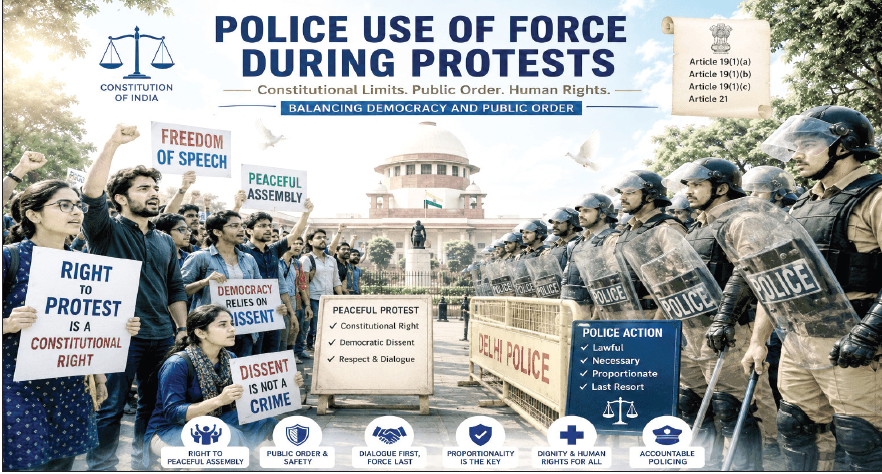
This is when the episode's most important constitutional question emerges. Freedom of expression and nonviolent protest are essential citizens' rights in a democracy. A democratic system will inevitably see questions from students, criticism from young people, and popular opposition to governmental decisions. However, rights also come with constitutional obligations; the right to protest cannot take the place of the rule of law.
Similarly, the State is supposed to enforce criminal law based on the values of justice, equality, and legal propriety rather than the quantity of demonstrators, political pressure, or the predicted public response.
An FIR can be quashed through the proper legal process if it is illegal, malicious, or initially unsustainable. A key component of the concept of justice is shielding an innocent person from criminal prosecution. On the other hand, the impartiality of the Rule of Law and the institutional credibility of the State are seriously called into question if criminal prosecutions are dropped just because they might generate widespread protest.
Democracy is when a government communicates with its people; good governance is when an unfair action is corrected. However, letting public pressure dictate how the law is applied would create a very unsettling precedent for democratic institutions. Because every organisation may start to view pressure as a constitutional right if it is able to change the direction of law today. The government is undoubtedly answerable to the people in a democracy, but both the people and the government are equally responsible before the law.
The demand can be for the withdrawal of a formal complaint today, the suspension of an investigation tomorrow, a stay of an arrest the next day, and ultimately the modification of a court decision. Making demands is a democratic right; it is not democracy to let the pressure of such demands drive the Rule of Law. Because there is no precise constitutional boundary for the politics of pressure. The impartiality of the legal system and institutional autonomy are unavoidably called into question as soon as the State starts tying the application of the law to public pressure.
Sharp conflicts between popular movements and governmental authority may be seen throughout India's democratic history. A notable example of how student dissatisfaction developed into a larger people's movement is the Gujarat Navnirman Movement of 1974. Jayaprakash Narayan's Bihar Movement thereafter had a huge impact on the direction of national politics. The State did not hesitate to use strict legal restrictions, make arrests, and pursue criminal prosecutions.
The political, constitutional, and social environments of 1974 and 2026 are unquestionably different. Therefore, it would be unfair and meaningless to compare the two mechanically. However, the fundamental question of what should guide the State's judgments has not changed.
Criminal proceedings, their withdrawal, or court intervention must be based on the law, the facts, and established procedure, not on political estimates of expected public pressure, according to the rule of law. Popular movements hold governments responsible in democracies, but they shouldn't control how the law is administered. The Constitution must be in charge of it.
A government becoming politically vulnerable can be a transient political development, but a much more serious institutional crisis is indicated by the public's declining trust in constitutional institutions. When citizens start to think that justice can be obtained through public pressure or the sheer force of the streets rather than through due legal process, or when the state starts to feel that the resolution of a legal action must be sought not by subjecting it to judicial scrutiny but by responding to the pressures of political circumstances, the situation becomes extremely troubling.
In order to guarantee that each institution operates within its constitutional jurisdiction, legal obligations, and institutional limitations, the Constitution precisely created a balance of power among the Executive, the Legislature, and the Judiciary. The judiciary's job is to interpret the law and uphold justice, the government's job is to govern in accordance with the law, and individuals have the freedom to peacefully and legally voice opposition.
The legitimacy and authority of institutions themselves are seriously questioned when political expediency, public pressure, and the limits of the legal system start to blend together. Democracy does not need the street to submit to the state or the state to bow down to the street. It implies that in the end, both must submit to the Constitution.
It is not necessary to support or oppose the pupils on this question. It also makes no assumptions about the legality of the FIRs filed against them. In the interest of justice and the rule of law, criminal actions against any student that were motivated by malice, disproportionate in character, or in violation of established legal norms should be withdrawn. No citizen's future may be ruined just because they took part in a democratic protest.
However, another equally crucial question in a constitutional democracy is when the government came to understand this legal wisdom. When were the FIRs filed? Or only after fresh political pressure was generated by the prospect of another large-scale demonstration on September 5.
The problem extends well beyond the withdrawal of FIRs if the latter argument is more accurate. Then, the fundamental question is whether the State made its choice based on evidence and the law or on public pressure.
A crucial component of democratic accountability is a government's ability to respond to its citizens. However, it might be an indication of institutional weakness when legal procedures seem to change in reaction to political pressure. Similarly, Article 142, which was never meant to be a tool for settling political disputes, gives the Supreme Court exceptional constitutional authority to guarantee "complete justice".
Therefore, whether the government, the students, or the court prevailed is not the true question. Whether our institutions are making judgements within the parameters of their constitutional mission is the true question.
Because elections are not enough to sustain democracy. It is equally dependent on judicial independence, the rule of law, and institutional legitimacy. Furthermore, no extraordinary constitutional power, no matter how strong, can rebuild the lost public trust when institutional authority starts to disintegrate.








[[comment.comment_text]]