Renu’s Dhanjal: Patna, Still Drowning
 2 weeks, 6 days ago
Floods are not an unanticipated disaster for Bihar. They are an old historical current that comes back year after year, shifting its direction but never really going away. Patna has lived under the shadow of water for ages, surrounded on three sides by the Ganga, the Son, and the Punpun. The city has faced catastrophic floods on numerous occasions, from the pages of history to the concerns of the present. This situation was not created overnight. In Bihar, floods are not a brand-new tale that appears every monsoon; rather, they are a long-standing warning that history has written and rewritten, one that we read, forget, and then watch hopelessly for the waters to subside.
It is thought that Gautama Buddha predicted Pataliputra's fate some 2,500 years ago. In the Mahaparinibbana Sutta, Buddha warned of three threats: fire, water, and internal strife, even as he discussed the city's potential to develop into a great metropolis and thriving center of business. Water appears to be the most persistent of these predictions for Bihar's future.
Between 570 and 575 CE, seventeen days and seventeen nites of unrelenting rain turned the Ganga and the Son into a terrible sea, causing a disastrous flood in Pataliputra, according to the Jain classic Tithogali Pannai. Centuries went by. Dynasties vanished. The city's name, its leaders, and even its location were all altered. However, the fear of water persisted.
Devastating floods in 1843, 1861, 1870, 1879, 1897, 1901, and 1923 are documented in the Patna District Gazetteer, each of which bears witness to a tragedy that has persisted for centuries.
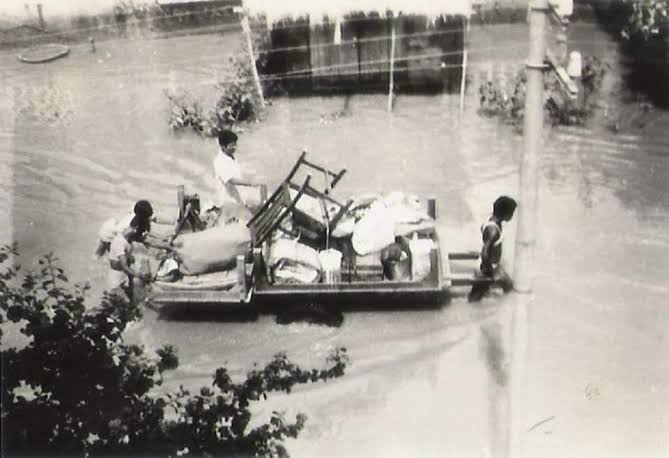
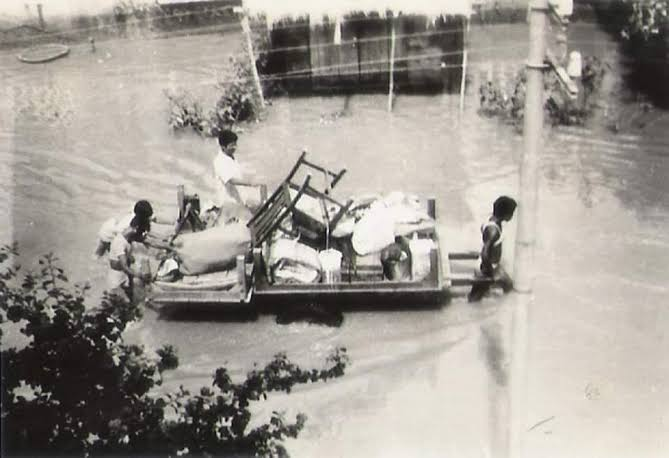
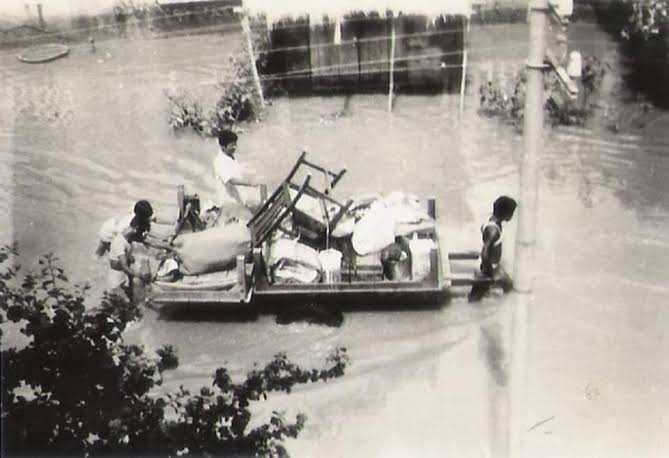
The floods of 1967 and 1975 are still very well ingrained in Patna's collective memory, even after independence. In particular, the city was so completely submerged by the August 25, 1975, storm that even two-story homes vanished under the water. The renowned Hindi author Phanishwar Nath Renu was one of those caught in that disaster.
Rinjal Dhanjal, his well-known reportage, is much more than just a description of a flood. It is a living record of Patna drowning and of people trying to stay human when a whole city is submerged.
Renu saw the 1975 flood in Patna as more than just a natural calamity. He saw a whole city in those waters: panicked people, a nervous government, hands hurrying to help, eyes observing the sight, and humanity obstinately refusing to perish even in the face of disaster.
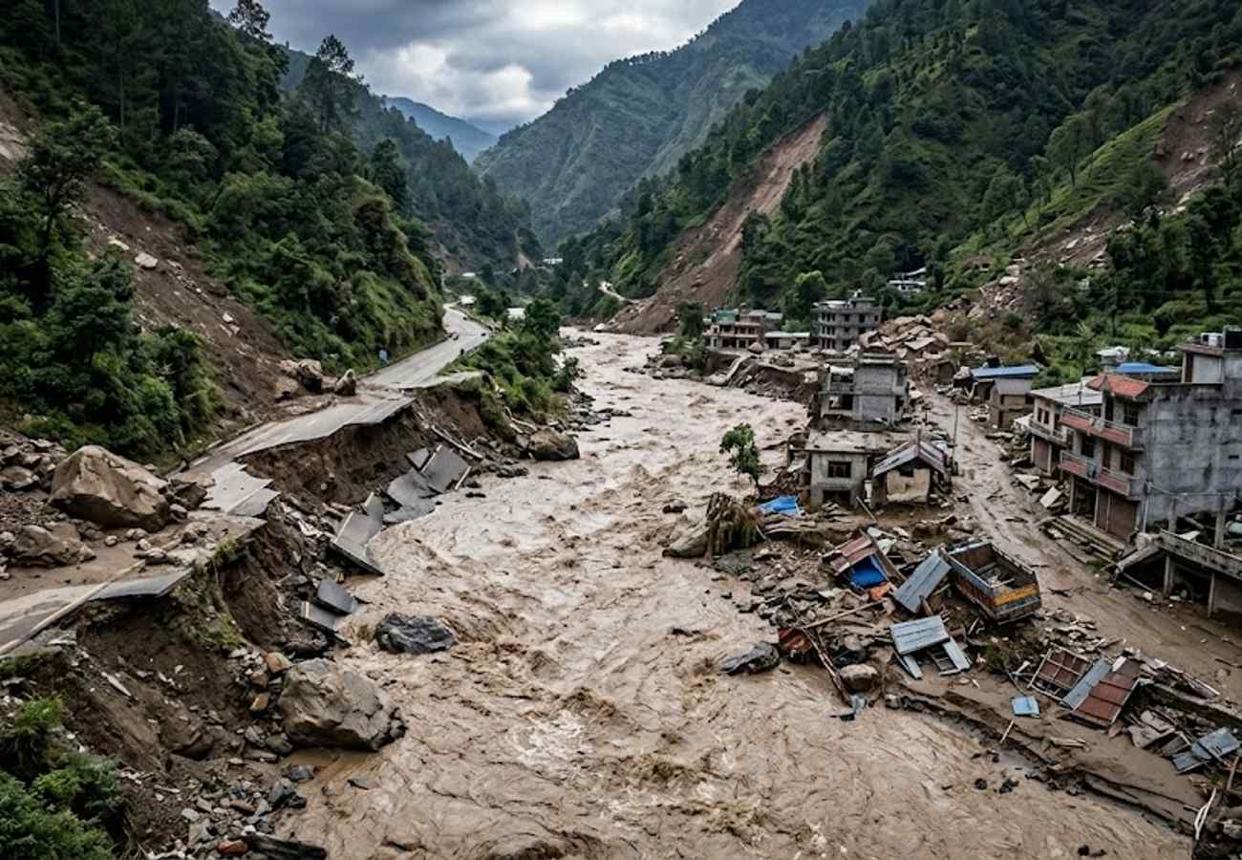
This was not a new experience for Renu. After eighteen hours of nonstop rain in 1967, the Punpun's waters had reached areas like Rajendranagar and Kankarbagh. Western Patna, from Boring Road and Srikrishnapuri to Pataliputra Colony and Nehrunagar, was completely buried when the waters reappeared in 1975. The Chief Minister's home and Raj Bhavan were accessible by water. Even Golghar was encircled by an infinite body of water.
Neither poverty nor power were acknowledged by the flood. It didn't spare the man dozing off on the sidewalk and didn't know the Chief Minister's address. Patna had united into a single city prior to the water, sharing a common disaster.
From the protection of a far-off coast, Renu did not see this destruction. He joined the flood of scooters, tractors, horse carts, bicycles, rickshaws, and individuals making their way home on foot. Being stuck on the second floor for days was more than just a personal experience; it became a reflection of the city's future as a whole. Because of this, his statement, "I have lived through the flood, as an urban man," becomes crucial to comprehending his perspective.
Thus, Rinjal Dhanjal is more than just an account of flooding. It is a record of the time when humanity is put to the test by calamity. Renu did not see Patna from outside the water in 1975 while stranded on the second floor for days. From under the sea, he could see it. Maybe that's why Renu's Patna has never really perished. It still floats in our conscience and memory, uncomfortably, restlessly, and persistently.
Phanishwar Nath Renu witnessed more than just a Patna inundated in water in 1975; he saw the human being trapped inside that drowning city—its terror, curiosity, worry, and oddly enduring tendency to make even catastrophe into a spectacle. People kept questioning, "How far has the water reached?" as the water continued to rise. The psychological profile of a whole city could be found in that seemingly straightforward query.
Renu's query is no longer a literary recollection when Patna confronts water once more in 2026. It turns into a query aimed at the present.
People went outside to look at the sea fifty years ago. They go out to record it today. The word that the water had reached a specific area would then be brought home from a familiar neighborhood; in the modern era, the same information is quickly displayed on our mobile screens via live videos, drone footage, and social media posts. The greatest connection between Renu's period and ours, however, is that while we are still observing the water spreading, we are not giving the reasons behind it the same level of attention.
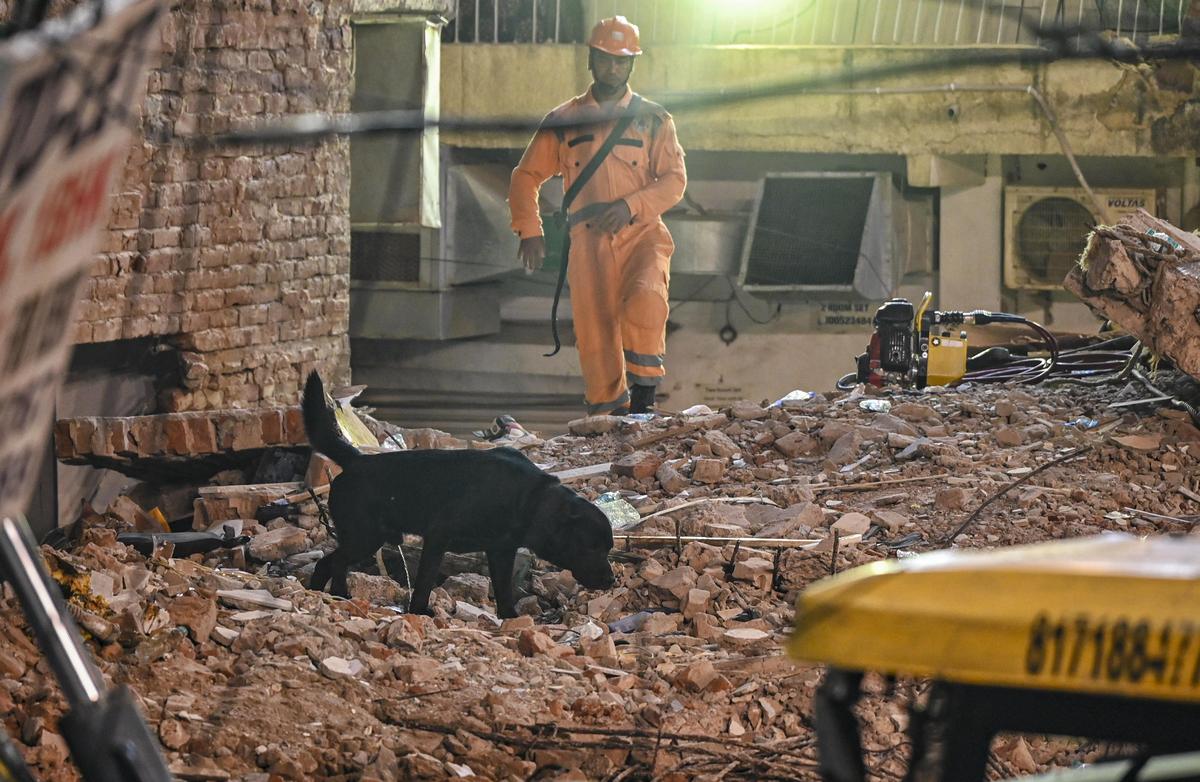
Water was an incident in Renu's Patna. Every year, it reappears in our Patna as a threat. The city was shocked by the water's entrance back then, and it is already aware that it might return now. We have digital communication, cellphone notifications, river level monitoring, and weather forecasts. The NDRF and SDRF are two of our organized rescue systems. Nearly 700 government boats and dozens of rescue and aid workers have been sent to address the situation in 2026.
All of this shows how our institutional and technological capabilities have grown. But that's exactly where Renu's point gets even more awkward: why haven't we given the city any space for the water to flow if we already know it will arrive? The years 1975 and 2026 meet here.
Rain is a natural occurrence. An expanding river is also a natural phenomenon. However, uncontrolled urban growth, encroachment, vanishing streams, malfunctioning drainage systems, and our tendency to ignore every calamity after it has happened are not natural phenomena. We are responsible for these disasters. Even while floods are natural, not all of the damage they wreak is.
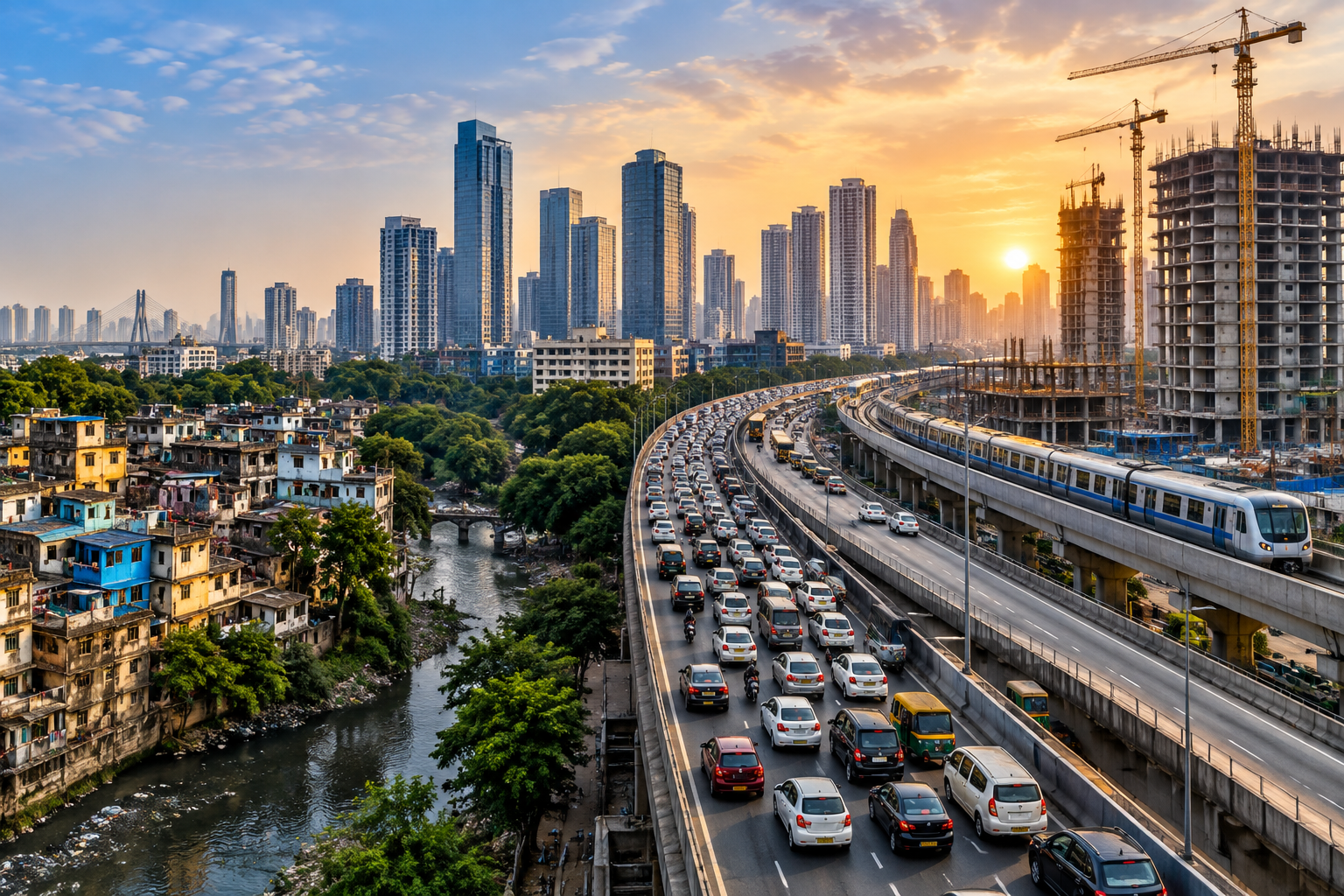
The water that Renu witnessed flowing through Patna is no longer just a river, a downpour, or a natural disaster. It also highlights the shortcomings of our urban vision today. Over the past fifty years, Patna has grown significantly, but has its drainage system grown along with it? Although new colonies have emerged, have the natural waterways been safeguarded? The number of roads and structures has increased, but has the land where water could settle, breathe, and find its way been preserved?
Patna still has to answer the eerily familiar question, "How far has the water reached?" despite fifty years of technological advancement. Because of this, Phanishwar Nath Renu is incredibly timely. His 1975 flood report was an X-ray of a city in distress, not just a story of a drowning Patna.
Renu had realized that a flood permeates every aspect of civilization, not only homes and streets. Administrative readiness, civic sensibility, opportunism, inequality, and collective conscience are all stripped away. Therefore, the question is not just how much rain fell or how high the river rose as Patna struggles with water once more in 2026. What we've learned in fifty years is the true question.
"How far has the water come?" was a common question in Renu's day. "How did the water get this far?" is a question we should address today. Renu becomes our contemporary at this point. His writing was a means of interpreting the present rather than just a record of the past. Because even though the landscape has changed, the crisis's architecture seems unsettlingly unaltered.
People watched the water's approach from the water's edge in 1975. They record that same advance in 2026 while standing behind their phones. throngs flocked to see the river back then, and now there are throngs watching, sharing, uploading, and becoming viral. However, there is one thing that all situations have in common: our tendency to view disasters as spectacles.
Maybe Renu would have recorded more than just how far the water had risen if he were still living today. He might have inquired as to how far the city had come in fifty years and how much room it still had for water. He might not have just wrote that Patna was drowning if he had seen the city now. What exactly is drowning in this water, he would have wondered? Just streets, houses, and marketplaces—or even our concept of growth, which has forgotten the connection between a river and the city that built alongside it?
Because of this, Patna's drowning in 2026 is more than just a recurrence of what happened in 1975. It is also our collective memory's failure. Renu is fifty years away from the present, but the vocabulary of a city defenseless in front of water is essentially unaltered. The question, "How far has the water come?" was then posed, which is the only distinction. Renu's memories seemed to be asking us today, "What did you learn in fifty years?"
Patna's current task is not only to prevent floods but also to comprehend them. We must choose whether to keep battling water every year or, at last, challenge the whole development model that has led us to this point. If Renu were here, he may ask, "Water finds its way every year, but will Patna ever find its own?"
Our biggest irony is found there. Our ability to combat calamities has improved, but maybe not our ability to learn from the urban errors that lead to them. While relief and rescue efforts have increased, prevention has not been put at the center of development.
As a result, the significance of Rinjal Dhanjal has grown even more profound in modern times. For us, water continues to be a conundrum. We call it life, but we are afraid of it. We restrict its passage while claiming to defend it. When it is little, we plan, and when it is plentiful, we declare disaster. On the other hand, water never forgets its place. Yes, we do. A river never forgets where it once flowed. It reappears, sometimes in silence, sometimes as a disaster, and it poses one question to us as we stand in front of the new structures built upon its former walkways.
Renu used words to save a city that was about to sink. Preserving those words in our collective memory is today's task. Because a city's biggest mistake is not that floods occur, but rather that it fails to learn from each one. The flood was documented by Renu. Now it's our turn to document our own errors.



[[comment.comment_text]]