CBI–ED and the Crisis of Institutional Credibility

 7 months, 1 week ago
Elections alone are not enough to maintain democracy; the legitimacy of its institutions is also essential. The judiciary preserves constitutional bounds, the executive carries out the law, and parliament establishes laws. However, the perceived objectivity of investigating agencies is the subtle force that unites these foundations. Justice itself begins to tremble when confidence in the investigative process starts to decline.
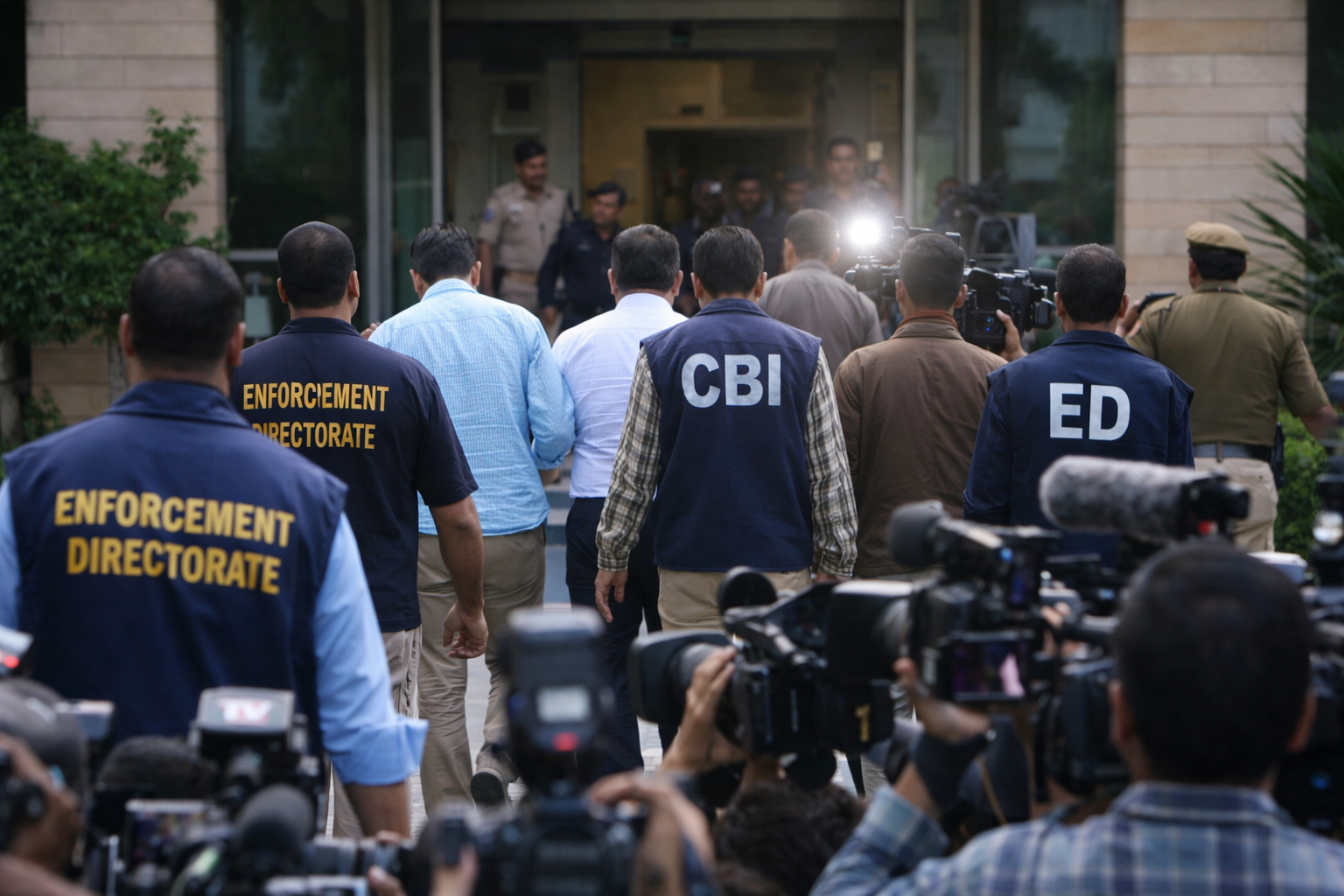
In India, the Enforcement Directorate and the Central Bureau of Investigation are quickly thrust into the public eye by significant political or economic disputes. The focus of prime-time debates and headlines is on arrests and raids. However, when protracted investigations terminate in court due to a lack of evidence, the harm goes beyond a single unsuccessful prosecution; it undermines institutional faith.
In the widely debated Delhi excise policy case, Arvind Kejriwal and 23 leaders of the Aam Aadmi Party were ultimately acquitted by the court for lack of evidence. The verdict was not merely a procedural conclusion; it was the culmination of a prolonged public spectacle marked by arrests, fierce political accusations, and waves of moral outrage. What remained afterward was not triumph or defeat, but an unsettling introspection about process and proof.
The Central Bureau of Investigation was originally constituted to probe corruption and serious crimes. The Enforcement Directorate, similarly, investigates violations related to foreign exchange management and money laundering. Both agencies wield expansive powers—search, seizure, arrest, and even attachment of property. Such authority is not incidental; it is formidable, and deliberately so.
But the Indian Constitution cautions against the concentration of power. It designs a system of checks and balances to ensure that no institution becomes unrestrained. Investigative agencies operate under the executive, yet their function intersects directly with the justice delivery system. This dual character makes their autonomy not merely desirable but indispensable.
Accountability and power must coexist. Although the executive is granted authority by the Constitution, it is subject to judicial supervision and the due process discipline. The fundamental tenets of Indian democracy are procedural justice and equality before the law. The democratic balance starts to shift when investigative powers are used in ways that raise suspicions of bias.
A troubling trend has emerged in recent years. Allegations erupted on television screens in a number of high-profile cases before the courts had a chance to consider them. Before trials had started, media narratives solidified into public verdicts, raids were televised live, and detentions dragged on. However, several of these cases seemed to lose prosecutorial vigour when they were examined by the courts. The cacophony of charges subsided into the quiet of inadequate proof.
The more fundamental question is whether the process itself fosters trust rather than whether specific people are guilty or innocent. When questions about an investigation's fairness surface, they spread beyond a particular case and start to cast doubt on institutions' validity. The integrity of restraint, not the spectacle of activity, is what sustains democracy.
This is a significant institutional problem rather than a small procedural error. Why did the charges fall apart under court scrutiny if they were so serious? And why make an arrest so quickly if the evidence was so shaky? Justice runs the risk of coming across as impetuous rather than principled when enforcement takes precedence over evidence.
It is clear that jail is the exception and bail is the rule in Indian criminal jurisprudence. Only in extreme cases may one's freedom be restricted because an arrest starts a judicial process rather than a declaration of guilt. However, when detention is extended, charge sheets are postponed, and trials drag on interminably, the procedure itself starts to feel like punishment. Public life is suspended, reputations are damaged, and even a final acquittal cannot make up for the time lost.
At this point, a serious worry arises: is process being used as a weapon to punish? Laws are there to establish responsibility, not to fabricate accusations for show. People lose faith in justice when the need for an arrest takes precedence over the reliability of the evidence. Justice in a democracy must be shown to be just, limited, and consistent with due process, in addition to being administered.
Investigative agencies have been repeatedly warned by the Supreme Court of India to stay within the bounds of the constitution, emphasising that the process is a test of justice and loyalty to the rule of law rather than a ceremonial exercise. Its stark caution against becoming a "caged parrot" was an institutional censure that sprang from worries about executive power, not just rhetoric.
However, popular mistrust persists. It's possible that institutional design—opaque appointments, perceived political influence, and lax parliamentary oversight—is the root of the issue rather than specific people. Judicial orders by themselves are insufficient to rebuild trust when institutional loyalty is in doubt. Trust must be shown; it cannot be mandated. Whether investigative institutions will develop into genuinely autonomous stewards of justice or remain resonant as tools of power rather than defenders of constitutional integrity is the central question of our day.
Perception can be just as potent as evidence in a democracy. Even if every move seems to be legitimate, the moral claim of impartiality starts to dissolve when citizens feel that the opposition is subjected to a disproportionate amount of investigative intensity while those in authority are spared. The distinction between moral and legal legitimacy occurs at this nuanced point. If an act's timing, focus, and force appear to be in line with political trends, it may be considered suspicious even when it complies with the letter of the law. Democracy is sustained by public trust as much as procedural correctness.
The Indian Constitution was carefully drafted to prevent the consolidation of power by establishing a framework of moderation and balance. Safeguards like transparent appointments, fixed tenures, and legislative supervision are crucial—not optional—when investigative agencies function under the government. Reform becomes a democratic need rather than a governance issue if these processes are shallow or untrustworthy.
Raids and arrests take place under constant camera scrutiny in today's media-driven environment, and accusations are quickly and drastically magnified. However, when same assertions are refuted in court, the correction seldom receives the same level of attention. The public's perspective is shaped by this disparity, which permits accusations to pass for verdicts. The fundamental tenet of justice—that each person is innocent unless proven guilty—is subtly compromised. Even after the legal record has been cleared, sensational media and combative briefings can do reputational harm that no subsequent acquittal can completely undo.
It is here that the crisis of public trust begins to take root. The gravest danger to a democracy arises not merely from wrongdoing, but from the perception that institutions are no longer impartial. If citizens come to believe that investigative agencies function as extensions of political strategy, respect for the rule of law gradually gives way to cynicism and distrust. Such a condition is perilous for any democratic order.
Trust is not built solely on conviction rates; it is forged through transparency, procedural fairness, and visible balance. If arrest is treated as a measure of last resort, if chargesheets are grounded in solid evidence, if political neutrality is demonstrably upheld, and if courts ensure timely adjudication, institutional credibility can be gradually restored.
Reform needs to shift from rhetoric to structural change. Investigative agencies would be strengthened rather than weakened by independent, multi-party monitoring, open and participatory nominations, explicit arrest criteria, and prosecution responsibility. Public trust, not unbridled power, is the source of true institutional strength. Additionally, fairness, balance, and obvious integrity foster trust.
Being a guardian entails more than just exercising power; it also entails defending the religion that upholds the republic. Agencies must be devoted to constitutional morality rather than ephemeral political power if they are to continue to be seen as legitimate stewards of justice. Although governments and alliances may change, democracy itself starts to falter when institutions become unstable.
More institutional reflection and less rhetoric are needed in the country now. While accusations may make news, justice is upheld only by evidence. Although quick arrests may give the impression of strength, long-lasting legitimacy is created by the openness and equity of due process. Any investigative agency's real strength is found in the breadth of its moral credibility rather than the sharpness of its statutes. Furthermore, credibility is something that must be gained with integrity, consistency, and restraint.
History is an inflexible arbiter. It looks at character; it doesn't listen to noise. The main question that will remain when the function of these institutions is evaluated in the years to come is whether they upheld the spirit of the Constitution or if they were only there to serve the interests of power. Their behaviour today holds the key to the solution since it shapes their memories for tomorrow.







[[comment.comment_text]]