The Illusion of Absolute Speech: How Anonymity Cannot Be a License forAbuse

 2 hours ago
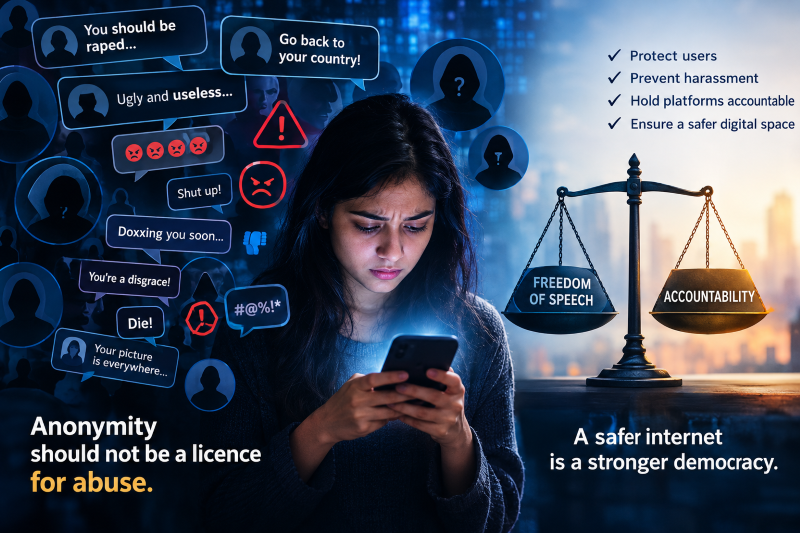
Freedom of speech has always been considered as the backbone of many modern democracies. However, it has taken a turn which is dangerous in the current digital ecosystem. The tool which was supposed to shield citizens from tyrannical rulers, censorship, and suppression of expression has mutated. It is now used by digital mobs to harass anyone exercising their right. On social media, one often finds oneself wading through vitriol in search of intelligent conversation. Be it vile abuse, rape threats targeted at women, homophobic rants, or even targeted smear campaigns - the digital space is rife with people misusing their right to freedom of speech.
To re-establish the balance in the digital public square, it is critical to deconstruct the illusion of absolute freedom of speech, tackle the scourge of consequence free trolling, and build a robust system of accountability.
What freedom of speech actually means
Freedom of expression, both in terms of the universal human rights instruments and in the constitution of our own country, is the fundamental right that allows an individual to give expression to their belief, convictions, and thoughts. It is a right that allows one to question the State, critique society, and share ideas.
However, as the judiciary has time and again ruled, every freedom has its limitations. Freedom of speech as well is not an absolute right; it comes with several caveats. One may not use it to defame or falsely accuse others, to spread information or messages that could cause harm or disturb public order. A famous Latin adage 'the freedom to swing my fist ends at your nose' sums it up best.
However, the same does not apply for anonymous users. The online space provides these keyboard warriors with a cloak of invisibility that emboldens them to harass, troll, and intimidate others. These people, who are not accountable in real-life with their identity out in the open, find their anonymity as a tool to unleash their wrath on innocent people.
The digital coliseum - weaponizing anonymity and keyboard warriors
The digital space promised equality of all voices. However, it has turned into a digital coliseum where the mob mentality prevails.
The main catalyst of the situation is the availability of anonymity. Many online users who resort to trolling do so using fake handle, pictures, and location details. They feel empowered to share offensive content because even if they get caught, the punishment will not outweigh what they gain from sharing such material online (notoriety). Thus, they use the online space as a platform to air their dirty laundry and target others.
A lot of times, the abuse meted out to others on social media takes a disproportionate toll on the targeted users. For instance:
1. Women who dare to speak out on social media are often targeted with vile abuse and non-consensual pictures. Threats of sexual violence and harassment are also not uncommon.
2. Independent thinkers who go against the grain are often targeted by people who have a mob mentality. Such users resort to doxxing as a way to attack the criticizers.
If the online space, which is supposed to be a public square, becomes a hostile environment to engage in dialogues and self-expression, it defeats the very essence of free speech. That is why in many cases users who are harassed and threatened take down their profiles on social media or self-censor their expression in fear of the anonymous digital mob.
Movie boards vs. the open digital space - the censorship conundrum
When such issues were raised in the past, some people actually asked the question - if there are censorship boards which decide whether a movie is fit to be watched by the public or not, why cannot similar bodies be appointed for social media?
I think that a blanket censorship of all comments and posts on social media would not exactly be the best decision. The fundamental right to freedom of speech and expression is sacrosanct and should not be tampered with. Forcing any system of pre-clearance of comments by any censorship board even a private one would create a chilling effect on content creation by users. Additionally, anybodywhich has the power to pre-screen digital content has the potential to abuse the power to stifle the criticism of any particular group or person. Thus, such a move by itself would have far-reaching adverse effects.
The best way to tackle the issue is to ensure that the users are held liable for trolling, abuse, and targeted threats on social media. For instance, the Safe Harbor rules, which currently exempt technology companies from the liability for user generated content, must be reworked. If any entity's algorithm knowingly promotes content without taking down threats, harassment, and other forms of bullying even after a service request, it must be held liable.
What steps can the government and judiciary take?
The government cannot stand as a silent spectator as its citizens continue to get threatened and harassed online. It is time that the legislature drafted new laws, and the judiciary used its tools to bring the digital trolls to justice.
Some of the steps the government and the judiciary must take:
1. Re-working the safe harbor rules to hold technology companies liable and accountable.
2. Creating a digital identity verification system which ensures that users cannot continue to stay anonymous on social media.
3. Creating fast track courts to try such cases.
A lot of cybercrime cases, especially those which do not involve financial fraud, are handled in cyber courts which have a very long processing time. By creating fast track courts specifically to deal with threats, harassment, and similar offenses, appropriate punitive measures can be applied against offenders.
What social media platforms can do?
The social media platforms have a moral responsibility to prevent their platform from being misused to harass and threaten people.
Some of the steps they can also employ for the same are:
1. Creating friction for 'burner' accounts (accounts created with fake details that disappear after a certain period).
2. Using artificial intelligence to identify contextually sensitive words and expressions.
3. Creating shields that let users hide abusive comment sections.
4. Creating tools to block entire groups of users (such as those who use certain abusive words).
5. Creating pop-up warnings for users who want to send an abusive reply.
Taking back the digital public square
While it is tempting to argue that absolute free speech on social media platforms is sacrosanct, when it comes to the systematic silencing, harassment and intimidation of others; a digital world where the vulnerable self-censor out of fear, is neither a free nor a fair society. Anonymity enables keyboard warriors to indulge in all sorts of malicious activities; with real life repercussions.
Luckily, the legal system is beginning to catch up. From around the world, governments and courts are starting to understand the need to enforce accountability rather than reacting to content as it comes up.
In India, for instance, the Digital India Act proposed by the government would replace the current 2000 IT Act and impose an online duty of care to make social media companies responsible for preventing any foreseeable harm to users such as cyberbullying. Not only that, recent amendments like the February 2026 IT Rules have removed the "safe harbor' protections for social media companies who do not act 'expeditiously' to take down unlawful content. This requires companies to have a mechanism in place, to remove any objectionable content within 3 hours of notification and 2 hours for severe violations like non-consensual sharing of intimate images. Thus, not only would these laws hold social media companies accountable, they would also require that they take a more active role in protecting users from malicious and other harmful activities online.
Of course, legislation on its own would not solve the problem. Taking back our digital public square will be a multi-pronged effort requiring not only that Governments and judiciaries take enforcement action against malicious individuals and groups taking advantage of anonymity; but also that organisations change their 'business model' to place user safety and dignity above views and profits.
Lastly, society has a role to play by not staying 'neutral' and taking advantage of blocking and reporting functions. While protecting free speech, laws and regulations should create a safer digital space for everyone to engage without fear of the anonymous mob.
(Author, a law graduate from Delhi University, is a columnist and blogger on legal and constitutional issues.)





[[comment.comment_text]]