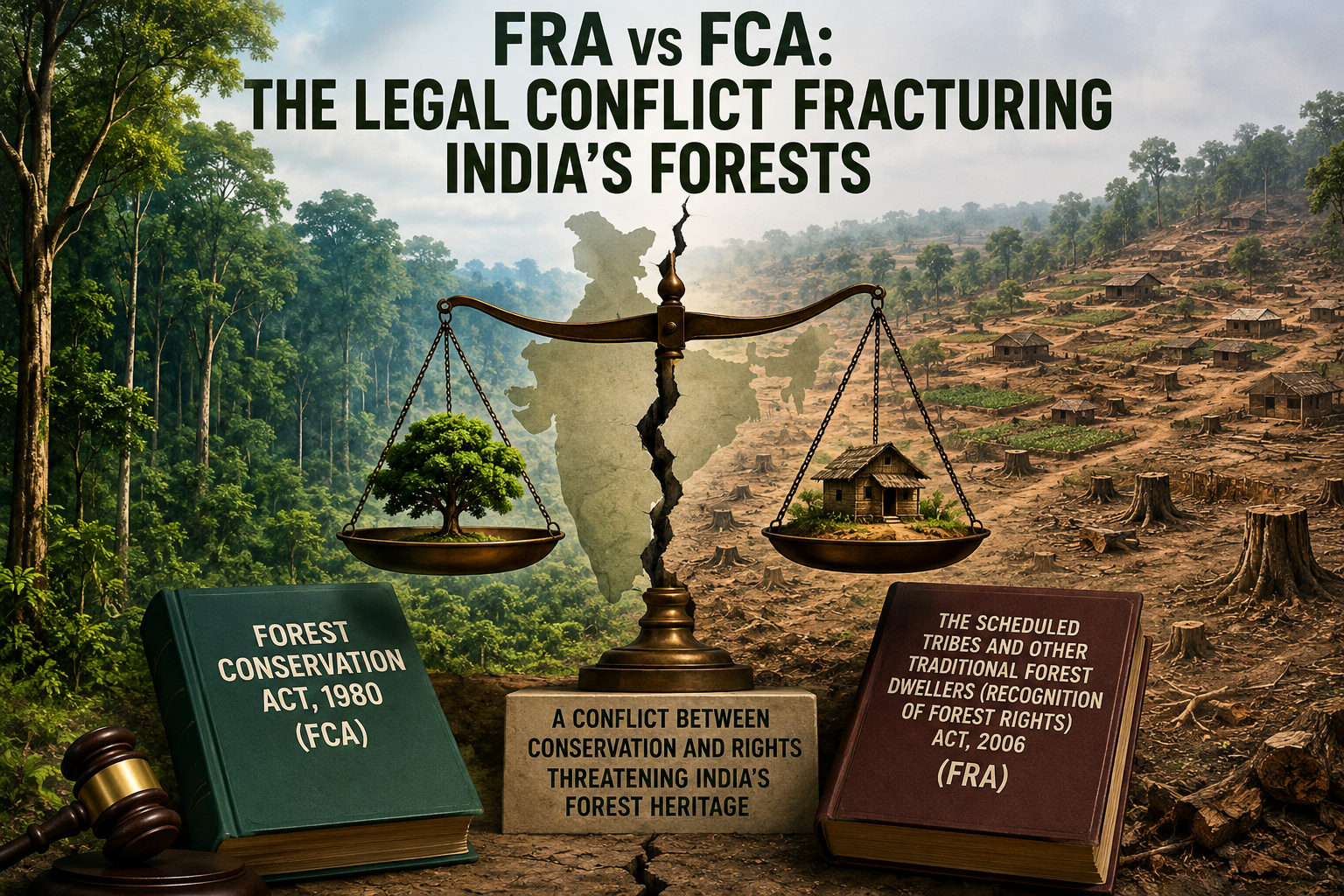
The Utopian Harmony: How the Legal Conflict Between the FRA and FCA is Fracturing India’s Forests

 1 month, 4 weeks ago
India’s forest jurisprudence stands on a fractured foundation. On one side stands the Forest (Conservation) Act (FCA) of 1980, designed as a centralized, restrictive shield to protect ecosystems from fragmentation. On the other stands the Scheduled Tribes and Other Traditional Forest Dwellers (Recognition of Forest Rights) Act of 2006 (FRA), a piece of social welfare legislation designed to rectify 'historical injustices' by vesting land tenure. While constitutional courts and human rights groups often paint these two frameworks as complementary, the operational reality on the ground tells a radically different story. Through the authoritative lens of retired senior forest administrators, such as Mr. B.K. Singh, IFS (Retired Principal Chief Conservator of Forests, Karnataka), this article explores how the FRA’s broad scope, combined with institutional loopholes and shifting judicial stances, has created a structural bypass that compromises the integrity of India's Reserved Forests.
The Vision of Complementarity vs. Operational Reality
In legal theory, the FCA and FRA are described as a dual-key security framework. The FCA handles macro-protection by requiring Central Government clearance before forest land can be diverted for non-forestry use. The FRA provides micro-management by empowering local communities to protect their interior ecosystems under Section 5.
However, calling this relationship "complementary" is highly utopian. It relies on an assumption of perfect institutional honesty that rarely matches ground-level execution. The fundamental objectives of these acts are pulled in opposite directions: the FCA aims to restrict the human footprint, minimize fragmentation, and centralize environmental control, whereas the FRA seeks to distribute land titles, decentralize governance to the Gram Sabha, and fulfill welfare mandates.
When a welfare law possesses a non-obstante clause (Section 13) that allows it to override prior environmental statutes, it ceases to supplement the old law. Instead, it creates a mechanism to bypass it entirely, converting state-protected ecological zones into individual agricultural settlements without any centralized review.
The Core Vulnerability: "All Citizens" and the 75-Year Rule
The most significant point of friction involves the legal scope of the FRA. While public discourse frames the Act as a tribal-only measure, Section 2(o) extends rights to Other Traditional Forest Dwellers (OTFD). This opens the gate to any non-tribal citizen of India, provided they primarily reside in and depend on the forest for their bona fide livelihood, and can prove their family has occupied that land for three generations (75 years) prior to December 13, 2005. This means their lineage must track back to 1930.
In his book 'Forest Rights Act – Accelerated Deforestation', Mr. B.K. Singh highlights the operational challenges this definition creates for forest guards. Because most historic forest dwellers lack written, colonial-era land records tracing back to 1930, proving a 75-year continuous presence is difficult. To overcome this lack of documentation, the Ministry of Tribal Affairs relaxed evidentiary rules, allowing local oral testimonies, elder statements, and traditional boundary markers to serve as valid proof.
Forest administrators argue that this procedural relaxation has transformed a well-meaning clause into a major policy loophole. Local village committees, driven by regional political populism or local real-estate interests, regularly treat recent non-tribal encroachers as long-term traditional dwellers, processing modern clearings under rules originally written for historical conservationists.
| Forest Dwelling Scheduled Tribes (FDST) | Other Traditional Forest Dwellers (OTFD) |
| Must belong to an officially recognized Scheduled Tribe under Article 342 within that specific state. | Applies to any non-ST citizen of India (including Dalits, traditional farmers, and pastoralists). |
| Must prove occupation and active forest dependency prior to the cut-off date of December 13, 2005. | Must prove primary residence and dependency for at least three generations (defined strictly as 75 years) prior to 2005. |
The Anatomy of Mass Fragmentation: The Sagar Division Case
The ecological impact of this administrative gap is clearly visible in the Sagar forest division of Karnataka. In a single contiguous Reserved Forest block spanning 12,250 acres, approximately 2,000 individual claims were cleared at the village level, with each applicant receiving an average of 5.00 acres. This process regularized close to 8,000 acres of forest land, leaving only steep, uncultivable hilltops untouched.
This situation highlights the flaws in the argument that the FRA causes only minor, manageable fragmentation. Leaving only the steep ridges untouched while regularizing flat valley floors breaks down the continuous wilderness. Wildlife species do not live exclusively on crests; they depend on valleys for seasonal migration, foraging, and access to water. Forcing wildlife into fragmented patches directly accelerates human-wildlife conflict along the new agricultural borders.
Furthermore, the Malnad region serves as a vital catchment area for major rivers like the Sharavathi. Clearing 65% of a forest canopy removes the root networks that anchor the soil and regulate water absorption. Without this canopy, heavy monsoon rains wash away topsoil, silting up downstream reservoirs and leaving the remaining hill slopes vulnerable to landslides.
Section 4(6) of the FRA states that land recognition must be restricted to the area actually occupied under cultivation, up to a maximum cap of 4 hectares. In a natural, historical forest dwelling ecosystem, traditional family plots vary in size and are rarely arranged symmetrically. When a village committee approves thousands of uniform 5-acre plots, it strongly suggests a structured land allocation initiative rather than the careful recording of pre-existing historical occupancy.
The Eviction Freeze and Constitutional Stays
The friction between these laws is further intensified by the statutory protections built into the verification process. Section 4(5) of the FRA prohibits the eviction or removal of any forest dweller until the entire multi-tiered recognition and verification process is complete. This verification process moves through three distinct bureaucratic levels: the Gram Sabha at the village level, the Sub-Divisional Committee (SDC), and the District Level Committee (DLC).
Because an applicant cannot be removed while an appeal is active, claimants can deliberately prolong the process across these levels. Even if the District Level Committee eventually issues a final rejection, the claimant can move their case into the higher judiciary. By invoking Article 226 in State High Courts or Article 32 in the Supreme Court, rejected claimants can argue that displacement violates their fundamental Article 21 (Right to Life and Livelihood) and Article 14 (Right to Equality) protections. While these constitutional remedies are vital to prevent arbitrary evictions of vulnerable families, they can also be used strategically to delay enforcement. A claimant can maintain an unlawful plot inside a Reserved Forest for years using interim stay orders, complicating the Forest Department's efforts to protect territorial boundaries.
The 'Nyaya Panchayat' Paradigm: Judicial Inconsistency
This complex legal environment is further complicated by shifting stances within the higher judiciary. A prominent example occurred during the landmark 2019 hearings of Wildlife First v. Union of India, where the Supreme Court's decisions shifted rapidly between consecutive sessions.
On February 13, 2019, reflecting concerns over long-standing illegal encroachments, the Court ordered 21 state governments to evict over 11 lakh forest dwellers whose FRA claims had been formally rejected. Yet, just two weeks later on February 28, following widespread public protests and an intervention by the Ministry of Tribal Affairs, the same bench froze its own order. The Court acknowledged that the underlying rejection data supplied by the states was administratively unreliable and lacked clear evidence of due process.
This sudden reversal mirrors the ad-hoc dispute resolution of a village Nyaya Panchayat rather than the predictable jurisprudence expected of a constitutional court. By issuing a sweeping eviction order based on raw percentages and then immediately withdrawing it under political pressure, the Court left both parties in a difficult position. Forest officers were left without a clear mandate to protect compromised zones, while genuine tribal families remained stuck in a prolonged state of legal uncertainty.
Conclusion: Restoring Balance Through Policy Correction
The current legal framework demonstrates that treating the FCA and FRA as naturally complementary ignores the structural realities of field-level enforcement. When local administrative bodies can grant large blocks of Reserved Forest land without centralized oversight, long-term environmental conservation is frequently compromised by short-term political incentives.
To address these vulnerabilities and protect India's remaining contiguous ecosystems, the legal framework requires structural adjustment:
Restrict Scope to Scheduled Tribes: The benefits of the FRA should be limited strictly to Forest Dwelling Scheduled Tribes (FDST). Eliminating the highly manipulated 'Other Traditional Forest Dweller' (OTFD) category would remove the primary legal loophole used to regularize recent non-tribal encroachments under the guise of historical rights.
Reintroduce Central Oversight: In alignment with the core principles of the FCA, any final regularization of forest land should require prior review or veto clearance from a centralized, independent environmental authority. Leaving final approval solely to District Level Committees exposes protected lands to regional political pressures.
Mandatory Digital Verification: Village-level claims should not be evaluated based on oral testimony alone. The judiciary and tribal departments must mandate the use of independent, historical satellite data from agencies like the National Remote Sensing Centre (NRSC) to verify that any claimed plot was under continuous cultivation prior to the 2005 cut-off date.
The preamble of the FRA correctly identifies the need to undo historical injustices faced by India's indigenous communities. However, an unmanaged welfare framework that allows large-scale fragmentation risks creating a modern ecological injustice. Without introducing centralized checks and balance mechanisms, well-intentioned social legislation can inadvertently compromise the very forest ecosystems that tribal and traditional communities rely on for their long-term survival.
(The author, a former Deputy Conservator of Forests Karnataka, is a known expert on environment and forestry.)









[[comment.comment_text]]