Carbon Credits: The New Asset For Our Capital Markets

 3 weeks, 1 day ago
India’s emerging carbon market could turn pollution reduction into a new financial opportunity for industry and investors. For decades, reducing carbon emissions was treated largely as an environmental obligation. That is changing rapidly. Carbon is increasingly acquiring a financial value, and the market emerging around it could become an important new component of the global financial system.
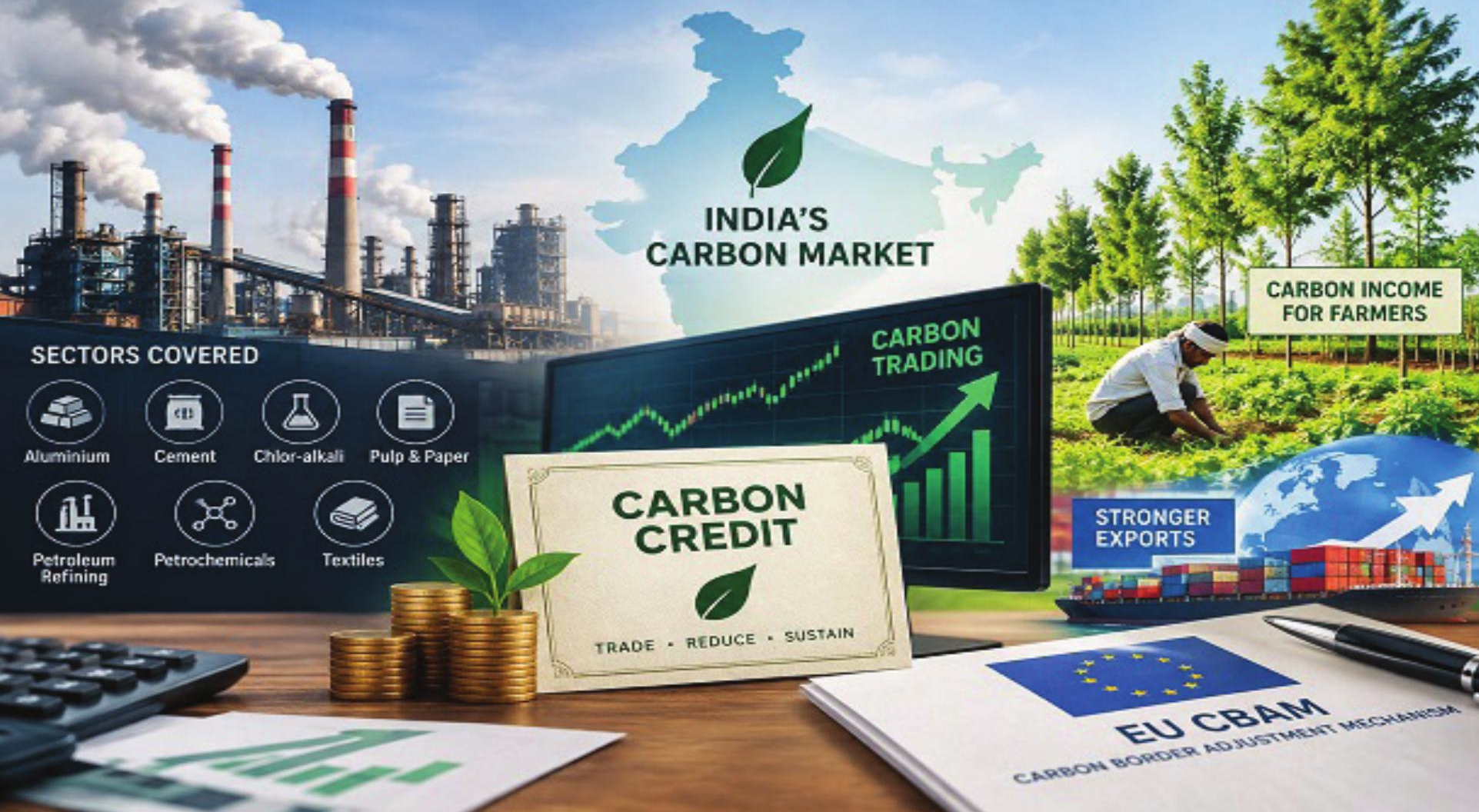
India, too, is preparing to enter this emerging market. Its Carbon Credit Trading Scheme (CCTS) seeks to create a regulated framework under which companies that reduce their greenhouse-gas emissions can earn carbon credits, while those unable to meet prescribed emission targets can acquire credits to meet their obligations.
The development is significant not merely for environmental policy but also for India's capital markets. If the system develops as envisaged, carbon credits could become a new class of tradable environmental assets, creating opportunities for businesses, financial institutions, technology companies, investors and a range of specialised service providers.
A carbon credit generally represents one metric tonne of carbon-dioxide equivalent whose emissions have been reduced, avoided or removed under an approved mechanism. The basic principle is straightforward: companies that reduce emissions beyond prescribed requirements can potentially generate credits, while companies facing compliance requirements can acquire them.
From environmental regulation to a market mechanism
The idea of putting a price on carbon is not new. Economists have long argued that market mechanisms can reduce pollution at lower overall compliance costs than relying exclusively on uniform regulatory requirements and penalties. The concept received international recognition with the Kyoto Protocol of 1997, which introduced three market-based mechanisms: International Emissions Trading, the Clean Development Mechanism and Joint Implementation. These mechanisms allowed countries and eligible entities to use emissions reductions and credits as part of their efforts to meet climate commitments.
The next major step came in 2005 with the launch of the European Union Emissions Trading System (EU ETS), one of the world's largest carbon markets. It operates broadly on a "cap-and-trade" principle. A limit is placed on emissions from covered sectors, while companies receive or purchase allowances. Those that emit less than their permitted levels can sell surplus allowances, while those exceeding their limits need to acquire additional allowances or face penalties. The experience of the EU helped demonstrate how environmental objectives could be linked with economic incentives. Carbon markets subsequently emerged in several jurisdictions, including California, New Zealand, South Korea and China.
India enters the carbon market
India's carbon market is still at an early stage, but the creation of the CCTS represents an important shift in policy. The objective is to establish a regulated mechanism for the generation, issuance and trading of Carbon Credit Certificates (CCCs). Rather than viewing emission reduction simply as a cost imposed on industry, the emerging framework seeks to give it an economic value.
This could change the way Indian companies approach decarbonisation. Investment in energy efficiency, renewable energy, cleaner production processes, waste management and other emission-reduction activities could potentially create an additional financial return through carbon credits. For businesses, therefore, reducing emissions may increasingly become both an environmental responsibility and an economic strategy.
Who could benefit?
The impact of a functioning carbon market could extend well beyond large industrial companies. Cement, steel and aluminium companies, among other energy-intensive industries, could benefit from adopting cleaner production technologies and reducing their dependence on high-carbon fuels. Renewable-energy companies involved in solar, wind and biomass projects could potentially generate carbon credits where their projects meet the applicable requirements and emission reductions are independently verified.
Waste-management companies represent another potential area of opportunity. Better management of landfill waste can reduce methane emissions, while rehabilitation of existing landfills and conversion of waste into useful resources can create environmental as well as economic benefits. Forestry and nature-based projects could also participate where they can demonstrate measurable and verifiable carbon absorption or removal.
The emerging market could create opportunities for technology companies developing digital systems to measure, monitor and manage emissions. Companies specialising in carbon projects could identify and develop ventures capable of generating eligible credits. There could also be growing demand for consultants and independent verification agencies. Their role would be particularly important because the credibility of a carbon market depends on accurate measurement and verification of claimed emission reductions.
Building the regulatory architecture
A carbon market cannot function effectively without a credible institutional framework. India's CCTS therefore involves several government and regulatory bodies. The Bureau of Energy Efficiency (BEE) has a central role in administering and developing the Indian carbon market. Its responsibilities include identifying sectors with emission-reduction potential, establishing requirements and procedures, accrediting verification agencies and overseeing the processes associated with carbon-credit certificates.
The Grid Controller of India (Grid-India) operates the Indian Carbon Market Registry, which maintains digital records of participating entities and their carbon-credit holdings and transactions. The Central Electricity Regulatory Commission (CERC) has a regulatory role in the trading of carbon credits. It oversees the relevant trading framework and approves business rules for power exchanges involved in carbon-credit trading.
Independent Accredited Carbon Verification Agencies (ACVAs) are another critical element. They are expected to verify whether claimed emission reductions have actually occurred and whether projects meet prescribed standards. Without credible verification, the market could face problems of inaccurate claims or low-quality credits. The National Steering Committee for Indian Carbon Market (NSCICM) provides another layer of institutional oversight and makes recommendations concerning market procedures, emission targets, issuance of credits and related rules.
A new opportunity—but also a test of credibility
For India's financial ecosystem, carbon credits could eventually become more than instruments for regulatory compliance. Their tradability creates the possibility of a new environmental asset class linked to the transition towards a low-carbon economy. But the success of the market will depend heavily on its credibility. Carbon credits must represent genuine and measurable emission reductions. Transparent measurement, reliable data, independent verification and clear trading rules will be essential.
There is also a broader economic opportunity. A functioning carbon market can encourage investment in cleaner technologies, renewable energy, energy efficiency, circular-economy solutions and innovative waste-management systems. It can create demand for new financial, technological and professional services while encouraging industries to factor the cost of carbon into business decisions. India has set a goal of achieving net-zero emissions by 2070. The carbon market will not, by itself, deliver that objective. But by attaching an economic value to emission reduction, it can potentially align environmental objectives with commercial incentives.
The transition from a system in which carbon reduction is primarily a regulatory obligation to one in which it also carries a market value marks an important development. If India can build a transparent, well-regulated and credible carbon market, carbon credits could emerge as a significant instrument of sustainable finance—and potentially as a new frontier for India's capital markets.
(Dr Aparna Mathur teaches financial management at Christ University, Ghaziabad)










[[comment.comment_text]]