Adverse Effects of El-Nino on Wildlife

 an hour ago
El-Nino effects current situation in India is serious – World Meteorological Organization (WMO) said in October, 2026 that prevailing El Niño is firmly established and strengthening rapidly, with near 100% chance it will persist through April 2027 , potentially one of the strongest since 1950.
This year's southwest monsoon already ended with a deficit - India received only 87.4% of the long period average, and in some reports a 12.6% deficit. IMD expects below-normal rain Oct-Dec as well and the worst affected states are south India and the Rajasthan which are forced to face drought
Adverse Effects of El Nino:
The drought is an effect of El Nino-created by shortfall of rainfall below the normal and its adverse effects are as follows on humans, forests and wildlife.
*1. Humans:
Farmers, fishers, shepherds hit hardest - drought and extreme heat conditions. Pulses, oilseeds see lower acreage/yield, dairy faces fodder shortage.
Water stress: Maharashtra has already imposed 10% water cut from Oct 16 due to low reservoir storage
Health: Heat exposure for outdoor workers, reduced productivity and there is prediction of human deaths of about 6,000 or more due to heat during next summer in India
Power: Low reservoirs constrain hydropower while cooling demand rises - peak demand touched 270.8 GW in May 2026 will be very high of 10% or more than the previous year’s high.
*2. Forests:
High risk of forest fires and early starts of fire season due to low soil moisture and high temperatures. Death of large forest trees, reduced forest regeneration and altered phenology of tree and other vegetation-affecting the fodder resources. Delayed fruit production and increased water stress in plants affecting the regeneration of the vegetation in the next season too.
*3. Wildlife:
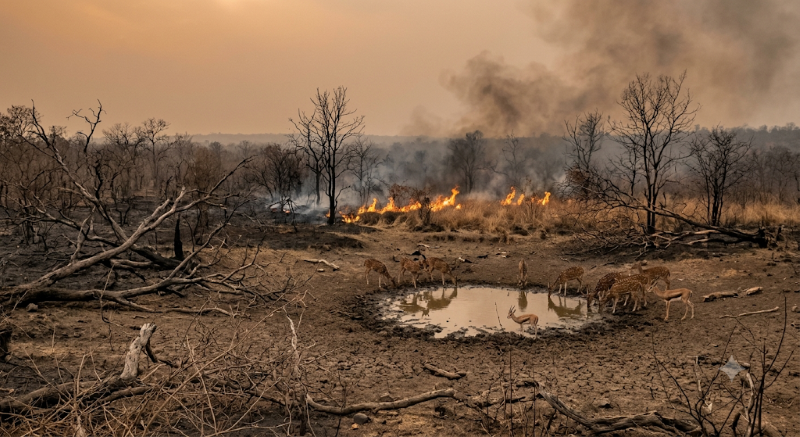
Forest streams and waterholes will dry up 2-3 months early (by Dec-Jan instead of March-April), forcing animals to concentrate in forest fringes causing more “human-wildlife conflicts” Physiological stress, changes in animal behaviour, reproduction and migration
In oceans: widespread coral bleaching and mortality, marine heat-waves in northern Indian Ocean in 2027 hitting oil sardines (fish production) and other species- when human deaths are feared, deaths of wild animals will be unaccountable in the coming summer unless some miracle is blessed.
As of October, 2026 six states ie Karnataka, Maharashtra, Telangana, Andhra Pradesh, Rajasthan and Gujarat have declared many their taluks as drought affected areas; the Keralam, Tamil Nadu and Madhya Pradesh are in the line….
The states which have declared as drought affected have started drought relief measures under ‘State Distress Relief Fund’ (SDRF)- to meet drinking water for people and fodder to cattle and compensation for crop loses and they demand for NDRF assistance from the Union Government for relief operations. The relief measures are all oriented for the welfare of the humans and their cattle in the drought hit areas and not for the wildlife-other forms of lives equally important in the ecosystem.
Problems for wildlife during this El Nino:
Wildlife includes vegetation as well as wild animals in nature.
Forest: we have already listed the ills affecting the forests during droughts, which no management can nurse but the forest fires have to be controlled; forest fires affect and decimate the forests, its wealth, regeneration and species composition and the wild animals in it.
Wildlife: Wildlife are conserved in Protected Areas (PAs), which are the forests or waste lands or water bodies or seas set aside for protection/conservation of wildlife without human interference. They are classified as ‘national park’ (NP), ‘wildlife sanctuary’ (WLS), ‘conservation reserves’ (CosR), ‘community reserve’ (Com R) and many are put under overlapping schemes of the union government like the ‘Project Tiger’ as ‘tiger reserve’ (TR) or under the ‘Project Elephant’ as ‘elephant reserve’ (ER).
In the changed situations like this year’s EL Nino and the feared drought from December to April 2027 say 5 months, the PAs, TRs and ERs will have to work for fire control and also to ensure drinking water for the wild animals; this type of situation may force to arrange even for feed for the herbivores too in some dry zones.
Fire Protection: Fire is a decimation factor for forests and wildlife; all lives of smaller forms among flora to animals, reptiles, amphibians, birds and insects all will perish in fires as they cannot escape. Fire protection in forests and PAs is very important. Fire protection means making arrangements to see that the fire hazardous material in forests is reduced in advance and fire lines are formed and fire traced before the onset of dry spell in advance to ensure that in case of accidental fires, such fires are checked and controlled.
Net work of fire line: The wind during summer in India blows from NE to SW. When fire occurs the whirlwind develops automatically and fire runs westward with wind by sweeping dried forest and will gradually spread north & south in the shape of a bulb. To prevent the spreading of fires set by miscreants; straight fire lines of 15-20 wide of N-S have to be formed to check the fire running to west at strategic intervals; and to prevent fire from spreading to north and south -straight fire lines of 10 m wide E-W to be created. The existing fire lines should be made straight at strategic intervals.
Fire Breaks: Provision of straight line fire breaks of 50 m wide N-S should be planned in the middle of the fire hazardous zone of the PA or at an interval of 10 km of PA’s E-W length or width to check worst fires during very hot & windy season. The fire break is a combination of 2 fire lines with a fire line of 10 m wide and then a parallel fire line of 5 m wide to its East by leaving 35 m in between to allow it to burn by leaving fire from both sides while tracing these fire lines. The 50 m wide fire breaks will stop devastating fires of the worst situations. E.g: It is practiced in the Bandipur TR
Important Note- If the wildfire overtakes the efforts to check it- counter fire should be resorted from N-S fire lines- in its absence, by clearing a new N-S fire line against the fire. No fire should be allowed to continue overnight. It should be extinguished during night by engaging more men and even fire brigade at any cost. Sweeping the line of extinguished fire early in the morning is more important by the experienced and honest staff to ensure no fire rekindles during the next day. No VIPs or senior officers on tours should be encouraged during fire seasons.
Water to wild animals:
Water is most important for the wild animals for survival during pinch periods. The herbivores can survive in the forests if water is available and fire does not occur by foraging dry grass, fallen fruits, flowers, leaves and barks. The water availability within the radius of 2 km from any point for the small animals is an essential requirement as per the principles of wildlife management. The young ones, reptiles, small arboreal animals and insects need water within their cruising distance, if not they will perish in the severe heat of the drought in the leafless forests.
In severe droughts- the dried up water holes should be refilled by deploying water tankers from the available sources or by sinking bore wells to lift by using solar powered pumps. Smaller RCC water troughs to hold 1000 ltr near dried water holes –below ground level to be created and filled with water for small animals & birds- a must. Eg; It is being done in the Mudumalai TR of TN and Bandipur TR of Karnataka
RCC water troughs of 1000 ltrs should be constructed in all the bore wells of the farmers and water filled daily by convincing farmers for the small wildlife and the birds in the humans habitations. It should be followed in all the parks of the towns and cities.
Fodder to wildlife: The fodder is also important after water, the ungulates like black bucks & others in the very dry zone during the worst drought nce…. In such a situation fodder and water have to be supplied to herbivores is a point to be kept E.g. During the severe drought of 1975, in the Velavadar NP of Gujarat, about 600 black bucks used to congregate around the forest rest house were fed with water and fodder till the onset of monsoon to sustain the drought.
Creation of Shades: in most parched zones, small animals die due to Sun stroke-in such areas the PA management needs to create shade pendals for animals near artificial water holes run by the PA. E.g: Daroji Bears safari-Karnataka
NDRF: The NDRF is to provide relief for the people especially in rural areas. The forests and the wildlife suffer very badly during droughts with deleterious effects. The NDRF funds should be made available for the forestry and wildlife wings for the following works.
1. Creation of water holes: Ponds of 1,000 m3 capacity in the forests & PAs in the marshy lands where water last long during summer should be created in forests and in PAs.
2. Encroachment is a problem for forests: NDRF funds to be availed for digging cattle proof trench (CPT) of (1.50+1.00)/2 m x 1.25m deep along the D. line of the forests abutting farm lands by putting the excavated stuff towards the forest area to plant agave and trees on the mound.
3. Creation of UGWR Pits: The NDRF funds should be available for forests to create underground water recharge (UGWR) trenches in the forest and PAs of dry zone of size 4m x 1m x1m along the contour @ 4 m interval in zigzag and trenches left open to intercept the run-off and recharge the UGWR in all the rains. The mounds should be sown with seeds of grass and tree spp after rains.
(Author is a Retired Indian Forest Service Officer, Karnataka- a Writer and a columnist on Wildlife, Forests and Environment,)









[[comment.comment_text]]