Delhi PG Crisis: Rising Rents, Student Safety and the Satya Niketan Collapse

 1 month, 2 weeks ago
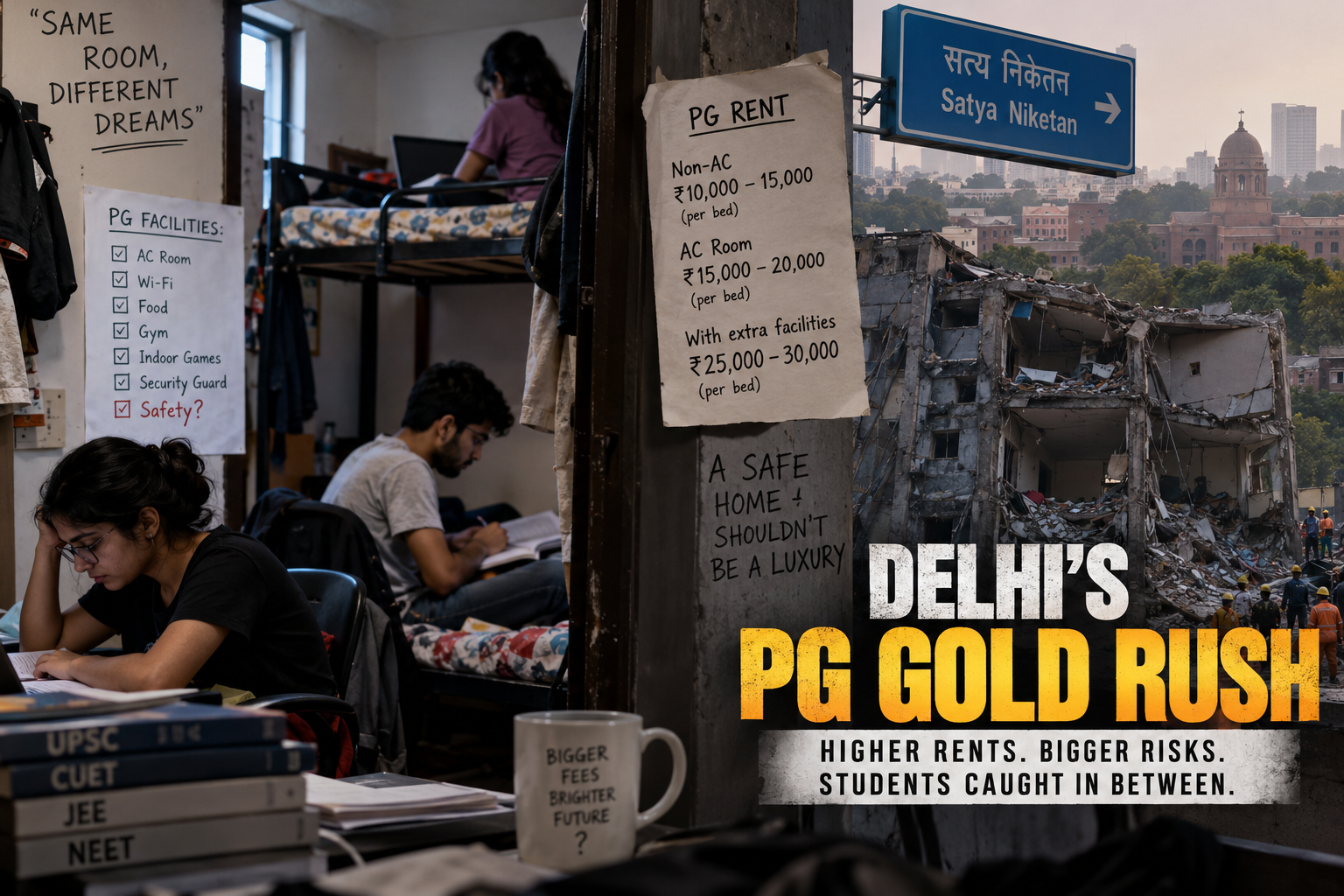
Students are paying ₹12,000, ₹20,000 and sometimes ₹30,000 a month for a bed near their colleges. Yet the collapse of a student PG in Satya Niketan shows how little of that money may translate into something more basic than Wi-Fi and air-conditioning: a safe roof.
Delhi’s private paying-guest market has grown because the city has a simple mismatch that has never been adequately addressed: there are far more students looking for accommodation than there are affordable institutional hostel beds. The University of Delhi itself acknowledges that hostel accommodation is limited and cannot be guaranteed to every applicant. Its own student-resources information says the university has 20 hostels for outstation students, while individual hostels illustrate how small the capacity can be: D.S. Kothari Hostel has 99 seats, the North Eastern Students’ House for Women has 101, and the Under Graduate Hostel for Girls has 344 rooms. These figures are not presented as a complete measure of Delhi’s entire student-housing capacity, but they demonstrate the basic structural problem—large student demand is being met by a relatively limited formal hostel system. ([EOC DU][1]) The result is predictable. Students who cannot secure university accommodation move into the private market, particularly around North and South Campus, Mukherjee Nagar, Karol Bagh, Rajendra Nagar, Laxmi Nagar and Satya Niketan. What should ideally be a temporary solution to a housing shortage has consequently become a substantial commercial industry, and the student—often young, new to the city and financially dependent on family—is the customer with the weakest bargaining power.
The Satya Niketan building collapse on September 6 has exposed the most serious weakness in this model. The five-storey building, reportedly around 40 to 50 years old, housed a student PG known as Hostel Daze. Reports said the accommodation had around 15 rooms, with two or three students sharing each room. One local resident told the media that students were paying approximately ₹12,000 per bed. Other reports put the accommodation at around 75 beds. Construction or repair work was reportedly underway in the basement before the collapse, while questions were also raised about water accumulation and the condition of the foundation. These details are still subject to investigation, and it would be irresponsible to declare a final cause before the authorities complete their inquiry. But the numbers alone tell us something important. If 75 beds were being offered in a single five-storey building, even a simple calculation at ₹12,000 per bed would put the potential monthly gross rental collection at around ₹9 lakh. At ₹15,000 per bed, the figure would be ₹11.25 lakh; at ₹20,000, it would reach ₹15 lakh. These are illustrative calculations, not evidence of the actual revenue of the property, but they demonstrate the extraordinary economic incentive behind high-density student accommodation. The question that follows is unavoidable: when a property can generate several lakhs of rupees every month from student occupancy, how much of that commercial value is being invested back into structural maintenance and safety? ([The Times of India][2])
That is the point at which the discussion about Delhi’s PG market needs to move beyond the familiar complaint that "rent is too high". High rent is certainly a problem, particularly for families sending their children to Delhi from states where household incomes may be substantially lower than the capital’s cost of living. But rent alone is not the central issue. The deeper problem is that the student is paying a premium in a market where the most important component of the transaction—structural safety—is difficult for the customer to verify. A student can inspect a bed, test the air-conditioner, ask for the Wi-Fi password, look at the bathroom and negotiate whether meals are included. What the student cannot realistically determine is whether the building is structurally sound, whether its present use is legally permitted, whether additional floors or rooms have been created in accordance with approved plans, whether the electrical load is safe, whether fire-safety requirements are being followed or whether construction work in a basement is affecting the structure above. The student therefore buys what is visible and trusts what is invisible. That imbalance of information is precisely why the state has to regulate this market more aggressively than an ordinary room-rental arrangement.
The economics of a typical PG explain why that regulation cannot be left to goodwill. Consider a room with three beds. If each student pays ₹12,000 a month, the room generates ₹36,000. At ₹15,000, it generates ₹45,000. At ₹20,000, it produces ₹60,000. If a property contains 15 such rooms, the gross monthly calculation becomes substantial even before additional charges for food, electricity, maintenance or other services are considered. Again, these are hypothetical calculations, not claims about any particular property. But they reveal the underlying incentive structure: the commercial value of a PG increases directly with the number of paying occupants that can be accommodated. The physical capacity of the building, however, does not increase with the number of beds. A 100-square-foot room remains 100 square feet whether one student pays for it or three students do. A staircase remains the same width. An emergency exit remains the same size. The structural load-bearing capacity of the building remains a physical constraint. This is where the business model can become dangerous. If regulation is weak, the operator has a financial incentive to maximise occupancy, while the student has a financial and academic incentive to accept overcrowding because alternative accommodation may be scarce.
The Satya Niketan case makes that calculation particularly stark. The building reportedly had around 15 rooms, with two to three students sharing each room, and students were paying around ₹12,000 per bed. That means the reported rent itself was not trivial. At the lower end of two students per room, 15 rooms would mean 30 beds and an illustrative monthly rent of ₹3.6 lakh. At three students per room, 45 beds would mean ₹5.4 lakh. Yet reports also described the property as a 75-bed PG, which indicates that occupancy arrangements may have been more complex than the room count alone suggests. The discrepancy itself is worth noting because it highlights why occupancy data should be transparent. How many people is a building legally permitted to accommodate, how many actually live there, and how many beds are being commercially rented? These should not be questions answered only after a disaster. ([The Times of India][2])
The problem is not confined to one building or one neighbourhood. Satya Niketan is a particularly revealing example because it sits close to Delhi University’s South Campus and has developed into a dense ecosystem of PGs, hostels, eateries and student services. Local accounts reported that many houses in the area have been converted into student PGs and that owners often live elsewhere. One resident quoted in the Times of India alleged that many properties had effectively been converted into PGs while rent was collected remotely. Such claims need to be independently verified before being treated as established fact, but they point toward an important governance question: when the residential character of an entire neighbourhood changes because houses are being converted into high-occupancy student accommodation, does the regulatory system change with it? If dozens of students are living in buildings originally designed for ordinary residential use, the issue is no longer simply about tenancy. It becomes an urban-planning, fire-safety, infrastructure and public-health question. ([The Times of India][2])
Delhi has already seen how dangerous building alterations can become. The Indian Express reported that a similar building-collapse incident in Satya Niketan in 2022 killed two people and injured others, and that the then South Delhi Municipal Corporation had said the building had been flagged over alleged illegal structural alterations before the collapse. ([Hindustan Times][3]) That history makes the current incident even harder to dismiss as an unforeseeable accident. If authorities have previously encountered concerns about structural alterations in the same locality, then the obvious policy question is whether lessons were incorporated into a systematic inspection programme. A city cannot repeatedly discover the same risk only after people are buried under concrete.
There is also a basic consumer-rights issue here. A student paying ₹12,000 for a bed is spending ₹1.44 lakh a year in rent. At ₹15,000, the annual rent becomes ₹1.8 lakh. At ₹20,000, it becomes ₹2.4 lakh. At ₹25,000, the figure reaches ₹3 lakh, and at ₹30,000 it becomes ₹3.6 lakh—before accounting for deposits, food, electricity, transport, study material and other living expenses. For a family supporting a student in another city, this is not pocket money. It can represent a substantial part of the annual cost of education. When that much money changes hands, it is reasonable to expect transparency about what is being purchased. Yet students often receive detailed information about amenities and remarkably little information about structural safety. The market has become very efficient at selling comfort; it remains disturbingly opaque about risk.
The irony is that the PG industry does not necessarily need to become cheaper before it becomes safer. Those are separate questions. A private operator can legitimately charge a premium for a better location, larger room, air-conditioning, meals or additional services. The problem arises when safety becomes an invisible cost that the operator can avoid while the student bears the consequences. Structural inspection, electrical maintenance, fire-safety equipment, emergency exits and periodic repairs cost money. In a competitive market where customers primarily compare rent and amenities, an operator who spends heavily on invisible safety may actually be at a commercial disadvantage against one who spends more on visible features. That is precisely why safety standards cannot be left to market competition. The market can decide the price of a room; it cannot be allowed to decide the price of safety.
The authorities therefore need to establish a clear regulatory architecture for private student accommodation. Every PG should have a verifiable registration status, a declared maximum occupancy and a clear record of the building's approved use. Structural safety assessments should be mandatory at defined intervals for older or high-occupancy buildings. Fire-safety compliance should be checked rather than merely declared. Major alterations, particularly in basements and load-bearing areas, should trigger mandatory inspection. The number of beds per room should be regulated, and there should be meaningful penalties for operators who exceed permitted occupancy. Most importantly, the information should be available to students before they sign an agreement or pay a deposit. A QR-coded public database showing registration, inspection date, permitted occupancy and basic safety status would be far more useful than another round of post-disaster announcements.
Delhi University and other educational institutions also have a role. The university itself states that hostel accommodation is limited and that students cannot be guaranteed a hostel seat. That reality is precisely why the institution should help students navigate the private housing market. ([Library and Information Science][4]) Colleges could maintain lists of verified accommodations, provide basic safety checklists and establish channels for reporting serious housing concerns. This does not mean that universities should become responsible for every private landlord. It means recognising a simple fact: if the formal hostel system cannot house every student, then students inevitably enter the private accommodation market, and their safety cannot be treated as entirely outside the educational system.
There is also a case for publishing a genuine student-housing safety index for major educational clusters. Areas such as North Campus, South Campus and Mukherjee Nagar should not have to wait for a collapse before officials know which buildings are being used as PGs. A ward-level database could record the number of registered PGs, approved occupancy, age of buildings, fire-safety compliance, structural inspection status and complaints. Buildings with repeated violations should face intensified inspections. Properties operating without registration should not be allowed to continue simply because students are already living there. And where an immediate safety risk is identified, the authorities should have a mechanism to relocate students temporarily rather than simply seal a property and leave young people scrambling for accommodation overnight.
The hardest question, however, is whether Delhi has the political and administrative will to confront the economics behind this market. Thousands of students need rooms. Property owners have properties. Operators have a ready customer base. Brokers have commissions to earn. Families have little choice during admission season. It is therefore an ecosystem with powerful financial incentives. Regulation will inevitably create costs for operators, and some properties may no longer be commercially viable if they have to comply with occupancy, structural and fire-safety norms. That is not a reason to avoid regulation. It is evidence of why regulation is necessary. If a business model works only because it avoids the cost of making the building safe, then the model—not the safety requirement—is the problem.
The Satya Niketan tragedy should therefore be measured not by the number of arrests, inspections or political statements that follow it, but by whether Delhi changes the way it regulates student accommodation. The immediate rescue operation is necessarily about saving lives. The next stage must be about preventing the next rescue operation. That requires a city-wide audit of student PGs, transparent occupancy records, structural assessments of older buildings, strict scrutiny of ongoing construction, stronger fire-safety enforcement and a system through which students can verify a property's safety status before moving in. Student organisations are already demanding such a safety audit in the wake of the collapse, underlining how the incident has widened the debate beyond one building. ([The New Indian Express][5])
Delhi's PG market is not going to disappear, nor should it. The city needs private student accommodation because the formal hostel system does not have enough capacity. But necessity cannot become an excuse for regulatory surrender. The numbers tell the story clearly: a bed can generate ₹1.4 lakh to ₹3.6 lakh or more in annual rent depending on the monthly charge; dozens of beds in one property can translate into several lakhs of rupees in monthly collections; and a single five-storey building in Satya Niketan was reportedly being used as a 75-bed student accommodation. Those numbers represent a substantial business. A business of that scale cannot be governed as an informal arrangement between a landlord and a few tenants. It needs registration, inspection, accountability and enforceable safety standards. ([Gulf News][6])
The central issue is therefore not whether Delhi's students are paying too much. It is whether they are being asked to pay too much for too little accountability. A student paying ₹12,000 a month is paying ₹1.44 lakh a year. Someone paying ₹20,000 is paying ₹2.4 lakh. Someone paying ₹30,000 is paying ₹3.6 lakh. At those prices, "safe accommodation" should not be marketed as an additional facility. It should be the starting point of the transaction.
The Satya Niketan collapse has exposed the most uncomfortable truth about Delhi's PG economy: the student may pay for the room, but the risk is often his to bear. That arrangement has to end. A PG is a business, but it is a business built around human beings who sleep inside the property every night. The first obligation of that business must therefore be to keep those people safe. Everything else—air-conditioning, Wi-Fi, gym, gaming room, food and fancy interiors—comes later.











[[comment.comment_text]]