Breathing Space

 5 months, 3 weeks ago
A City Formalised, But Not Yet Fixed
Delhi has reached a point where its administrative decisions are beginning to collide with its physical reality. The recent move to regularise more than 1,500 unauthorised colonies—bringing nearly 10 lakh properties and an estimated 40–45 lakh residents into the formal urban framework—has been widely welcomed. It offers long-awaited legitimacy to millions who have lived for decades in legal uncertainty. It promises access to services, documentation, and inclusion in the city’s official planning system.
But regularisation, by itself, does not build a city. It does not widen roads, lay pipes, or reduce the crushing density that defines these settlements. If anything, it exposes the scale of the challenge more sharply. The question that now emerges is not whether these colonies should be recognised—they already have been—but whether the city is prepared to sustain them.
Modern Delhi is no longer expanding in a predictable outward pattern. It is compressing inward. Entire municipal wards are operating at densities exceeding 30,000 persons per square kilometre, levels at which conventional planning assumptions begin to fail. The logic of horizontal infrastructure—laying wider roads, extending sewer lines, building larger depots—collides with a built environment that simply has no space left to accommodate it.
This is where the contradiction becomes visible. The Master Plan continues to mandate six-metre-wide roads for fire safety and infrastructure provisioning. Yet, in many of these colonies, the actual lane width is closer to eight feet. To meet the regulation would require demolition at a scale that is neither politically feasible nor socially acceptable. To ignore it is to leave millions trapped in a regulatory vacuum—formally recognised, yet functionally underserved.
This is not merely a planning failure; it is a structural mismatch. The city is trying to impose a geometry that no longer exists. And in doing so, it has created a condition that might best be described as “managed decay”—a state where systems exist, but do not function reliably, and where residents are left to bridge the gap between policy and reality.
The Hidden Cost of Everyday Survival
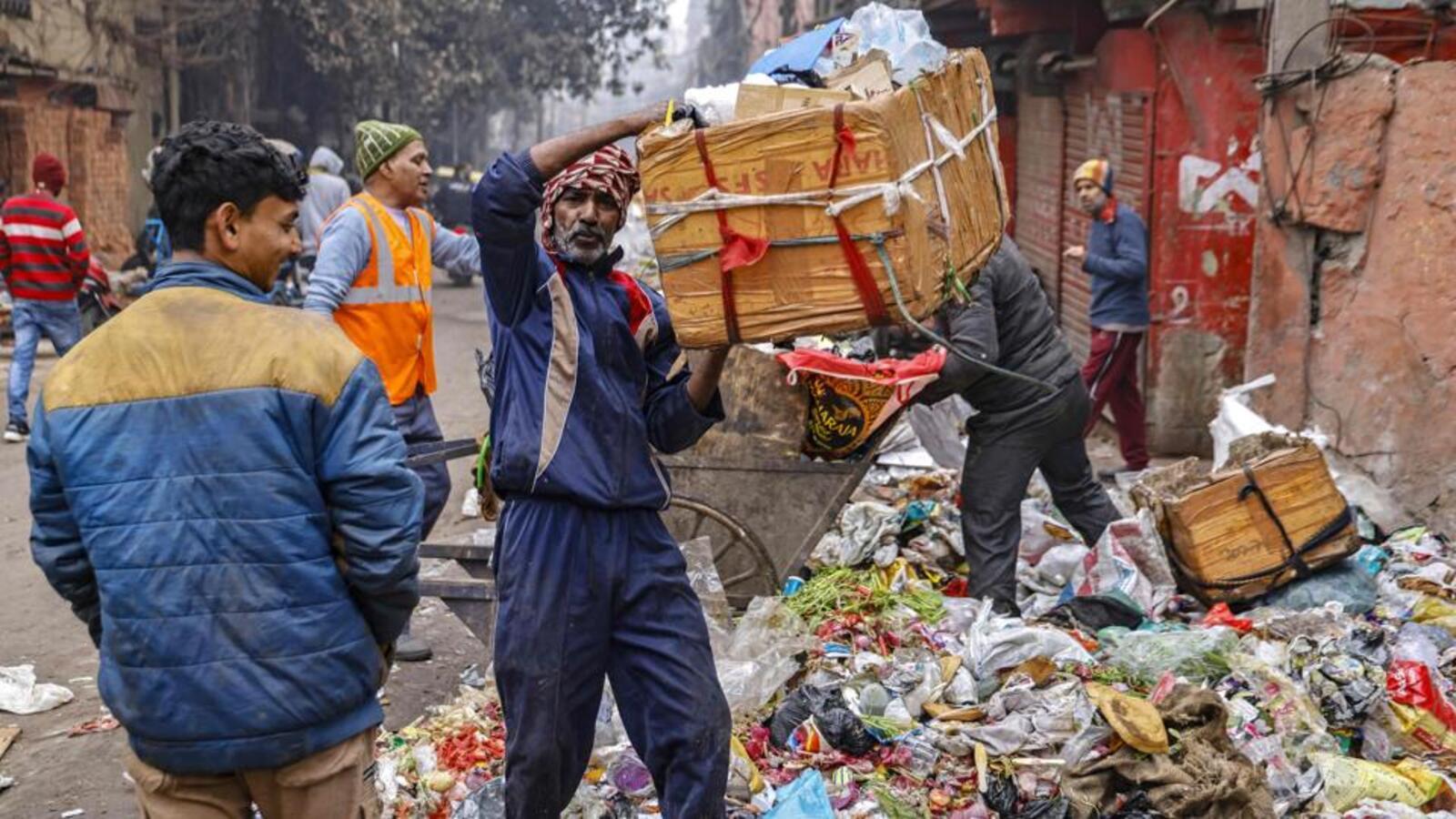
For those living in these dense neighbourhoods, the consequences of this mismatch are not abstract. They are lived daily, often quietly, and almost always at a cost. When infrastructure does not reach reliably, people create their own systems to compensate. Water tankers replace inconsistent supply. Diesel generators step in for unstable electricity. Informal waste arrangements fill the gaps left by municipal systems that cannot navigate narrow lanes.
These are not temporary adjustments; they are permanent coping mechanisms. And they come at a price—what can be called a “survival tax.” In many middle-income clusters, households collectively spend between ₹2,000 and ₹8,000 each month on supplementary services that should, in principle, be publicly provided. This cost is rarely captured in official statistics, yet it represents a significant economic burden, particularly for families already operating within tight margins.
The problem is not always the absence of infrastructure, but its distance. Delhi’s service systems are largely centralised. Waste depots, maintenance yards, and utility hubs are often located far from the neighbourhoods they are meant to serve. On paper, coverage may appear adequate. In practice, the time taken to move equipment and personnel into dense, congested corridors turns service delivery into a logistical challenge.
This “response distance problem” transforms geography into inefficiency. A clogged drain that could be cleared in minutes becomes a prolonged disruption because access is delayed. Waste collection points overflow not because there is no system, but because the system cannot reach them in time. Infrastructure, in this sense, is not failing entirely—it is arriving too late.
The environmental consequences of this delay are equally severe. In narrow, densely built corridors, pollutants do not disperse easily. Dust particles become trapped between buildings, creating what urban planners call “smog canyons.” Road dust alone can contribute between 25% and 40% of particulate matter during dry periods. Add to this the emissions from diesel generators and idling vehicles, and the result is a micro-environment where exposure levels remain consistently high.
City-wide monitoring systems, designed to track pollution at a broader scale, often miss these hyper-local variations. For residents, the difference between a reading at a central monitoring station and the air they actually breathe can be significant. The system, once again, exists—but it does not fully see.
From Expansion to Injection: A Different Way to Build
If Delhi’s problem is not capacity but positioning, then its solution cannot be more of the same. Extending horizontal systems into spaces where they cannot function is no longer viable. The city needs a different approach—one that works within its constraints rather than against them.
This is where the idea of “surgical urbanism” begins to take shape. Instead of large, disruptive interventions, it focuses on precise, localised solutions that address specific operational gaps. The Life Support Tower (LST) emerges from this logic—not as an architectural experiment, but as an infrastructure response to a mathematical problem.
The premise is straightforward: if infrastructure cannot effectively reach dense neighbourhoods, it must be placed within them. The LST is designed as a compact, vertical node that integrates multiple urban services into a single footprint of roughly 200 to 400 square yards. Within this limited space, it brings together systems that are otherwise scattered and operationally distant.
Below ground, it houses decentralised wastewater treatment units—modular systems capable of processing sewage locally and recycling water for non-potable use. This reduces dependence on distant treatment plants and creates a closed-loop system within the neighbourhood itself. Above ground, it functions as a service hub, stabilising power supply, managing waste aggregation, and supporting local mobility.
What makes this approach significant is not any single technology, but the way these systems are integrated. Water, energy, waste, and environmental management are no longer treated as separate functions. They are nested within a single operational framework, allowing them to interact and reinforce each other.
For instance, treated water can be reused for dust suppression. Heat generated by electrical systems can support environmental control mechanisms. Waste aggregation becomes more predictable because it is managed at the point of generation. The neighbourhood, in effect, becomes a host for its own infrastructure, rather than a passive recipient.
This shift—from receiving services to hosting them—changes the dynamics of urban management. It reduces response distances, improves reliability, and creates a level of operational presence that centralised systems struggle to achieve.
Importantly, the concept does not rely on untested ideas. Variations of decentralised, neighbourhood-level infrastructure already exist in cities such as Singapore and Tokyo, where proximity is treated as a critical factor in service delivery. The LST adapts these principles to Delhi’s specific conditions, combining them into a single, scalable model.
A City That Works Where It Stands
The challenge, however, is not only technical. It is institutional and psychological. Cities are often reluctant to move away from familiar models, even when those models no longer work. The idea of building vertically integrated infrastructure within residential neighbourhoods may appear unconventional, but the alternative—continuing with systems that cannot adapt—is far more problematic.
The LST offers a way to bridge this gap without requiring a complete overhaul of existing frameworks. By aligning with established regulatory categories—such as substations or utility nodes—it can move through familiar approval processes. By using modular construction techniques, it can be deployed rapidly, minimising disruption in already congested areas.
Equally important is the governance model. Rather than placing the entire burden on public agencies, the system can operate through a hybrid framework. The government retains ownership and sets standards, while private operators manage specific services under performance-based contracts. This allows for efficiency without compromising accountability.
The economic argument is equally persuasive. While the initial investment may appear significant, the long-term savings—both for the state and for residents—are substantial. Reducing dependence on tankers, generators, and informal systems lowers costs at multiple levels. More importantly, it restores predictability, which is often more valuable than access alone.
Yet, the real test of such an idea lies in implementation. Pilot projects—carefully designed and evaluated—are essential. Deploying a small number of towers across different types of neighbourhoods can provide the evidence needed to refine the model and build confidence. It allows policymakers to move beyond theory and assess real-world impact.
What is at stake here is not just a new type of infrastructure, but a shift in how cities respond to density. Delhi is no longer a city that can rely on expansion. It must learn to function within its limits, to sustain life within a fixed and increasingly crowded footprint.
This requires a change in mindset—from planning for an idealised city to engineering for the one that exists. It requires recognising that density is not a temporary problem, but a permanent condition. And it requires accepting that solutions must be as compact, adaptable, and resilient as the environments they are meant to serve.
From Managed Decay to Engineered Resilience
Delhi stands at a decisive juncture where administrative inclusion has outpaced infrastructural readiness. The regularisation of unauthorised colonies has formally integrated millions into the city’s legal and planning framework, but it has also exposed a deeper systemic gap: recognition has not been matched by reliable service delivery. Water networks remain inconsistent, waste systems struggle with last-mile access, and emergency response is constrained by physical geometry. What has emerged is not a failure of intent, but a failure of fit—between how the city is planned and how it actually exists.
For years, Delhi has managed this mismatch through incremental fixes—temporary pipelines, ad hoc road repairs, decentralised workarounds by residents themselves. This is what can be described as “managed decay”: a condition where systems continue to operate, but only through constant patching, improvisation, and hidden costs. Such an approach may sustain the city in the short term, but it cannot support long-term urban stability, particularly as density intensifies and environmental stress increases.
The present moment, therefore, demands a shift from reactive governance to anticipatory design. Instead of extending infrastructure outward in a city that has no room left to expand, Delhi must begin to embed infrastructure within its most stressed geographies. This is where concepts like the Life Support Tower (LST) become relevant—not as a standalone solution, but as a prototype for a new planning logic. By concentrating water treatment, waste management, energy stabilisation, and environmental controls within neighbourhood-scale vertical nodes, such models address the fundamental issue of proximity. They reduce response times, improve reliability, and minimise dependence on distant, overburdened systems.
However, the real value of such an approach lies beyond the technology itself. It signals a transition in urban thinking—from scale to precision, from expansion to integration, and from centralisation to distributed resilience. For Delhi, this could mean adopting a layered infrastructure strategy: retaining large, city-wide systems for bulk supply, while complementing them with localised, high-efficiency nodes that ensure last-mile functionality.
To move in this direction, three priorities become essential. First, pilot-based implementation—deploying small, well-monitored projects across different neighbourhood typologies to generate evidence and refine models. Second, regulatory flexibility—adapting existing planning norms to accommodate compact, multi-utility structures within dense urban fabrics. And third, institutional coordination—ensuring that agencies responsible for water, power, waste, and urban development operate within an integrated framework rather than in silos.
Ultimately, the question before Delhi is not whether it can build more infrastructure, but whether it can build differently. In a city where land is scarce and demand is constant, efficiency will matter more than expansion. Resilience will depend not on the size of systems, but on their ability to function under pressure.
Delhi has reached the limits of incrementalism. The transition from managed decay to engineered resilience will require not just new projects, but a new mindset—one that accepts density as a permanent condition and designs for it accordingly. The tools, technologies, and policy frameworks to enable this shift already exist. What remains is the willingness to act with clarity, urgency, and strategic intent.






[[comment.comment_text]]