‘The Frog in the Pond’: A Sensitive, Informative and Environmentally Conscious World of Children’s Literature

 an hour ago
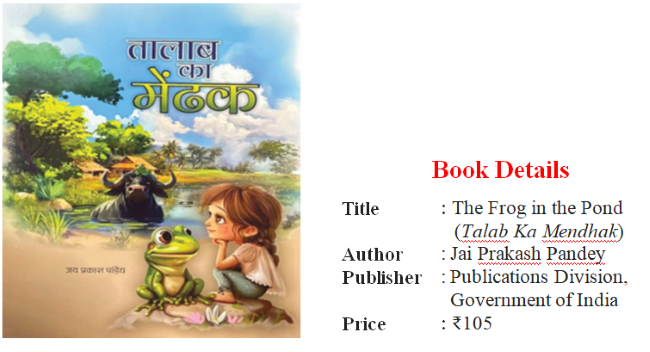
Jai Prakash Pandey’s collection of children’s stories, “Talab ka Mendhak”(The Frog in the Pond) brings together narratives that connect children’s natural curiosity, imagination and sense of wonder with nature, the environment, the nation, society, culture, science and human values. The greatest strength of the book lies in the author’s ability to encourage children to think for themselves rather than merely offering them moral lessons. Through stories, conversations, characters and incidents, he creates opportunities for young readers to explore ideas and develop their own understanding.
The collection includes a variety of stories, such as ‘Chidiya aur Kachhuwa’ (The Bird and the Tortoise) ‘Jasoos Uncle’ (Detective Uncle) Pasua and Nomcha’, ‘Talab ka Medhak’ (The Frog in the Pond) ‘Puri ki Rail Yatra’ (A Train Journey to Puri) and ‘’Pratiyogita’ (The Competition). Their narrative world travels from the seas of Lakshadweep to the imagined landscapes of metropolitan cities, from the memories of old roadside trees to the geographical and cultural diversity of India experienced through a railway journey.
The distinctive feature of the book lies in its thematic diversity. While entertainment and moral instruction are generally the principal elements of children’s stories, this collection goes beyond them by incorporating knowledge and contemporary social concerns. In ‘Chidiya aur Kachhuwa’ (The Bird and the Tortoise), children are introduced to the fascinating world of marine ecology through references to Lakshadweep, marine life, mangroves and coral reefs. The friendship between Biswas and Meethi lends warmth to the narrative and awakens a sense of curiosity about the ocean. The advice not to touch coral reefs becomes a natural lesson in environmental conservation. Here, nature is not merely a passive backdrop but an active participant in the story.
‘Pasua and Nomcha’ deepens the environmental consciousness of the collection. By associating the peepal and neem trees with human emotions and experiences, the author introduces children to the important question of balancing development with environmental protection. Through the memories of these trees, the story traces a journey from the time of Independence to road widening, tree felling, pollution and reforestation. The long-standing relationship between trees, human beings and birds, and the gradual breakdown of this relationship due to modern development, creates a powerful emotional impact. The particular strength of this story is that environmental protection is not reduced to the slogan of ‘Save Trees’. Instead, trees are presented as centres of life, memory, shade, shelter and social relationships.
The title story, ‘Talaab ka Mendhak’ (The Frog in the Pond) is comparatively more serious and poignant. The story begins with the friendship between Matru and Mukta but gradually reveals the environmental consequences of road construction and so-called development. The dumping of debris and chemicals into the pond, the death of aquatic creatures, road accidents involving animals, disruption of the natural catchment area, the drying up of the pond and, ultimately, Matru’s death are incidents that encourage children to reflect on the cost of development.
The conclusion is particularly moving because Matru’s death ceases to be merely the death of a frog. It becomes symbolic of that part of nature which human beings tend to neglect in the name of development. Weaving such an explicit environmental concern into a children’s narrative is one of the notable achievements of this collection.
‘Puri ki Rail Yatra’ (A Train Journey to Puri) is an excellent illustration of the informative dimension of the book. Through Navya’s journey, children learn about the Indian Railways, train names, rivers, goods trains, the sea, the Jagannath Temple, the Rath Yatra and various aspects of Indian culture. Navya, who constantly asks questions, represents the natural curiosity of a child’s mind. Her conversations with her grandparents and parents prevent knowledge from becoming a burden of dry information. The journey is not simply about travelling from one place to another; it becomes a means of discovering and understanding India. The story has the potential to stimulate children’s interest in travel, geography, history and cultural heritage.
‘Pratiyogita’ (The Competition) presents a different social perspective through a comparison of rural and urban life. Shyamu and Vivek come from two distinct socio-cultural backgrounds, but music brings them together. An important aspect of the story is that the author does not declare either way of life entirely superior to the other. While cities enjoy modern facilities, villages possess the richness of nature, folk music and community life. Through Kajri, folk melodies, birdsong and Shyamu’s ability to learn from nature, the author conveys that talent is not necessarily a product of material resources. In this sense, the story nurtures values of equality, friendship and respect for diversity among children.
‘Jasoos Uncle’ (Detective Uncle) offers an interesting exploration of the imaginative world of children. Margarita transforms ordinary incidents around her into mysterious and exciting adventures through the power of her imagination. The story captures the natural tendency of children to construct their own worlds from incomplete information. Her growing interest in news and international developments is also noteworthy. The narrative helps young readers understand that curiosity is the starting point of knowledge.
From a literary perspective, the principal strength of the book is its narrative simplicity. The author makes extensive use of dialogue, which lends the stories a lively and conversational quality, making them accessible to children. The personification of animals, birds and trees adds to their appeal. The descriptions of nature are vivid and visual: the waves of the sea, coral reefs, the shade of trees, village orchards, the gentle flow of rivers and the landscapes passing by outside a train window create striking images in the reader’s imagination. The use of colloquial expressions, everyday language and child-friendly narration makes the stories feel natural and engaging. The occasional inclusion of poetic lines also helps young readers connect with the narratives.
However, from the standpoint of literary criticism, it may be observed that some stories contain an abundance of incidents and information, while at certain points the underlying message becomes somewhat explicit. There is also scope for editorial refinement in language and spelling in a few places. Greater attention to language editing, factual verification and tighter dialogue in a subsequent edition could further enhance the literary impact of the book. Nevertheless, these limitations do not diminish its fundamental objective of connecting young minds with knowledge, sensitivity and responsibility through storytelling.
The book has multidimensional value for children. It develops environmental sensitivity, explains the importance of biodiversity and water bodies, introduces readers to Indian culture and heritage, highlights the diversity of rural and urban life, and encourages the habit of asking questions. Parents and teachers can use it not merely for reading but also as a basis for discussions and learning activities.
For instance, after reading ‘The Frog in the Pond’, children could discuss local water bodies and their conservation. ‘Pasua and Nomcha’ could inspire tree-planting activities or the preparation of a list of locally found trees. ‘A Train Journey to Puri’ could lead to an exercise involving the map of India, while ‘The Competition’ could initiate discussions on folk and classical music. In this way, the book has the potential to transform reading into active learning.
Overall, The Frog in the Pond serves as a meaningful bridge between entertainment, imagination, knowledge and sensitivity. Its greatest achievement is that it does not merely teach children how to become ‘good children’; rather, it encourages them to observe the world around them, ask questions and develop a sense of responsibility towards it.
From the sea to the pond, from trees to trains, from villages to cities, and from folk music to modern education, the book offers an opportunity to view India’s diversity through the eyes of children. Its environmental narratives are particularly relevant in the present times, as future generations will have to understand and negotiate the relationship between development and nature.
With some further refinement of language and greater narrative compactness, this collection could secure an even more significant place in children’s literature. Nevertheless, owing to its purpose, thematic diversity, understanding of child psychology, environmental consciousness and combination of knowledge with entertainment, The Frog in the Pond is a useful and engaging book for children, parents and teachers alike.
In conclusion, this book does more than tell children stories. It teaches them to befriend nature, appreciate diversity, question the world around them and reflect on the direction of development. This is its greatest literary and educational contribution. Most importantly, the collection has the potential to give wings to the imagination of children across all sections of society, whether from urban or rural backgrounds.
About the Author
Mr. Jai Prakash Pandey, originally from Pratapgarh district of Uttar Pradesh, is an officer of the Indian Railway Personnel Service (IRPS). Besides holding various administrative positions in the Lucknow, Moradabad and Firozpur Railway Divisions, he has also served as Principal of the prestigious Oak Grove School in Mussoorie, one of the oldest government-run residential schools in the country. He has served as Joint Director General in the Directorate General of Civil Aviation (DGCA), Government of India; as Additional Secretary in the Union Public Service Commission (UPSC); and as Director in the Ministry of Education, Government of India.
During his tenure in the Ministry of Education, he played an important role in the formulation and implementation of the National Education Policy. He also made significant contributions to the National Achievement Survey, the establishment of the National Assessment Centre and the formulation of the PM SHRI Schools Scheme.
Mr Pandey is an active writer across several literary genres, including poetry, short stories, travelogues, education and editorial writing on contemporary issues. He regularly participates in poetry gatherings and presents his work through Doordarshan and All India Radio. His poetry has been broadcast by Doordarshan Patna and All India Radio stations at Najibabad, Dehradun and Delhi. A writer as well as an educationist, he remains actively engaged in initiatives relating to education. He regularly contributes articles on education, administration and social issues to several newspapers and periodicals, including The Tribune, Dainik Jagran, Garhwal Post and Dainik Bhaskar.
Other Published Books
Dariya Ke Do Paat – Poetry Collection (Neel Narayan Prakashan, New Delhi)
Door Need Ke Pakshi – Short Story Collection (Prabhat Prakashan, New Delhi)
Pagdandi Mein Pahaad – Travelogue (National Book Trust)
Neeli Rajkumari – Children’s Stories (Advik Prakashan)
Talab Ka Mendhak – Children’s Stories (Publications Division, Government of India)
Literary Awards and Honours
All India Railway Hindi Award, 2012
Dr. B. R. Ambedkar Literary Honour, 2016
Maithili Sharan Gupt Award, 2017 (awarded by the Ministry of Railways for a poetry collection)
Bhagwati Prasad Devpura Smriti Samman, 2026 (Sahitya Mandal, Nathdwara)
About the Reviewer
(Kumar Narendra Singh, a former JNU researcher from the School of Social Sciences, is a senior journalist and commentator. He has written three books on politics, society and culture of Bihar.)







[[comment.comment_text]]