Congress was founded by a British officer to suppress the 1857 movement: Manohar Lal

 1 day, 11 hours ago
New Delhi. Union Minister for Urban Affairs and Power Manohar Lal said that the Congress was founded by a British officer to suppress the Second Freedom Movement of 1857 in the country. During that period, people following the ideology of the Sangh were working for all organisations, including the Congress, for the freedom movement.
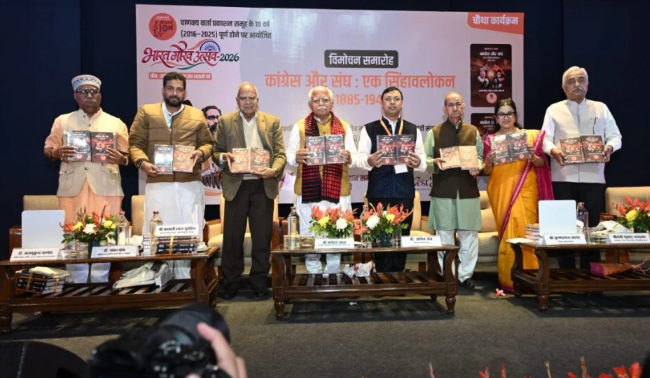
Mr. Khattar was speaking on Thursday at the launch of the book “Congress and Sangh: Ek Sinhavalokan” (two volumes), written by historian Krishnanand Sagar, at the Prime Minister’s Museum in New Delhi.
The book launch ceremony was held under the “Bharat Gaurav Utsav-2026” organised by the Chanakya Varta Publication Group, as part of the Sangh Centenary Book Series.
Mr. Khattar said that the book ‘Congress and Sangh: Ek Sinhavalokan’ launched today is in fact history written factually. He congratulated the author, Krishnanand Sagar, for it. He also thanked the publisher of the book and the editor of Chanakya Varta, Dr. Amit Jain, who published such an informative book.
He said that the Sangh is the largest organisation in the world, working selflessly and with dedication for nation and society building. It is the result of 100 years of service of the Rashtriya Swayamsevak Sangh that today the country stands tall and self-reliant. The world is eager to have Prime Minister Narendra Modi by its side. He called upon everyone to work for a developed India with good values.
The president of the function, Banwari Lal Purohit, former Governor of Assam, Tamil Nadu and Punjab, described the book as readable and full of exploratory information, and congratulated Dr. Amit Jain on the completion of ten years of Chanakya Varta Publication.
After honouring the guests on the dais, the author of the book, Krishnanand Sagar, gave information about the book, after which the book was released by the guests on the dais.
Special guest Dr. Balmukund Pandey, National Organisation Secretary, Akhil Bharatiya Itihas Sankalan Yojana, delivered an informative and historical address. Dr. Shankar Ghosh, Minister for Tourism and Parliamentary Affairs, Government of West Bengal, also gave a concise speech.









[[comment.comment_text]]