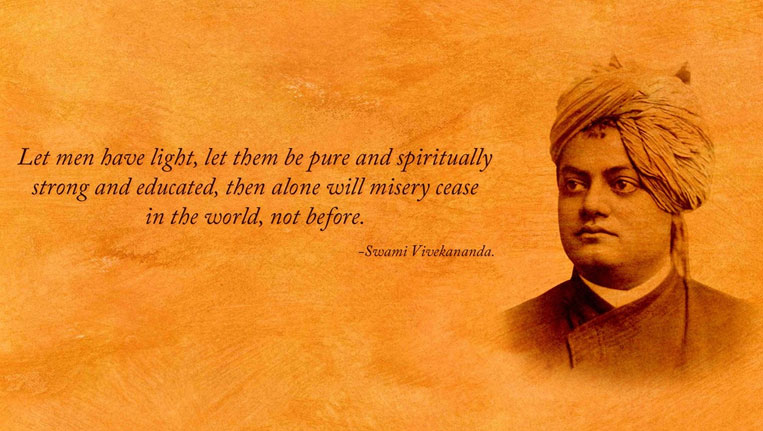
Swami Vivekananda: Strength, Spirituality, and National Awakening

 9 months ago
There are moments in the history of a nation when silence becomes dangerous—when people forget who they are, what they carry within, and why they exist. India once lived through such a moment. Burdened by colonial rule, social divisions, and deep poverty, the country had begun to doubt itself. It was at this fragile hour that a young monk rose—not with weapons, not with politics, but with words that burned like fire and healed like light. His name was Swami Vivekananda.
He did not merely speak to the world; he awakened a sleeping civilization. He reminded India of its forgotten strength and told humanity that spirituality and strength could walk together. Even today, more than a century later, his voice still echoes—clear, fearless, and full of hope.
Swami Vivekananda was born on 12 January 1863 in Kolkata, then known as Calcutta. His birth name was Narendranath Datta and he belonged to a renowned Kayastha family, known for its tradition of learning, public service, and intellectual excellence. From the very beginning, Narendranath showed signs of a rare and powerful personality. He was curious, energetic, and unafraid to ask difficult questions.
His father, Vishwanath Datta, was a successful lawyer with a modern outlook. He encouraged independent thinking and rational ideas. His mother, Bhuvaneshwari Devi, was deeply religious, compassionate, and strong-willed. From her, Narendranath inherited spiritual depth, emotional strength, and moral courage. From his father, he gained logic, confidence, and clarity of thought.
As a child, Narendranath loved music, literature, and physical activity. He had a sharp memory and a commanding voice. Yet behind his bright personality lived a restless mind. He was not satisfied with blind belief. One question troubled him deeply:“Does God really exist?”
Narendranath studied at the Scottish Church College, where he was introduced to Western philosophy, science, and logic. Thinkers like Kant, Hegel, and Spencer influenced him deeply. While others accepted religious ideas through tradition, he wanted proof—something real, something experienced.
He met many spiritual teachers and scholars, asking each one the same question:
“Have you seen God?”
Most gave philosophical answers. None convinced him. His mind stood at a crossroads—between reason and faith. This inner struggle shaped his future, preparing him for a meeting that would change his life forever.
Narendranath’s life took a dramatic turn when he met Sri Ramakrishna Paramahamsa, a simple temple priest with extraordinary spiritual realization. When Narendranath asked his familiar question, Ramakrishna answered without hesitation: “Yes, I have seen God. I see Him as clearly as I see you—only more intensely.”
Those words struck Narendranath like lightning. For the first time, he met someone who spoke not from books, but from experience. Slowly, despite doubts and resistance, Narendranath accepted Ramakrishna as his spiritual teacher.
Ramakrishna did not force ideas upon him. Instead, he guided him gently, allowing his questioning mind to grow into wisdom. Under his guidance, Narendranath realized that spirituality was not escape from life, but a deeper way of living it.
After Ramakrishna’s passing, Narendranath took the vows of renunciation and became Swami Vivekananda. But his renunciation was different. It was not withdrawal from the world—it was a commitment to serve it.
He traveled across India on foot, witnessing the harsh realities of his country. He saw hunger, illness, and deep social inequality. He saw people crushed not only by poverty, but by loss of self-respect. These experiences shook him deeply.
Swami Vivekananda understood that India’s greatest problem was not lack of religion—but lack of confidence. People had forgotten their own strength.
Vivekananda realized that India needed a new message—one that combined spirituality with strength, compassion with courage. He believed that service to humanity was the highest form of worship.
His famous words reflected this belief: “They alone live who live for others.”
To him, spirituality meant action. It meant lifting the poor, educating the ignorant, and giving dignity to the weak.
In 1893, Swami Vivekananda traveled to the United States to attend the World’s Parliament of Religions in Chicago. He had no official invitation, little money, and no support. Yet destiny carried him forward.
When he stood on the stage and began with the words, “Sisters and Brothers of America,”
the entire hall rose in applause. In that moment, a monk from India captured the heart of the West
For nearly two minutes, the audience stood to honor him. Those words carried warmth, respect, and universal brotherhood—something the world was longing to hear.
In his speech, Vivekananda spoke about religious harmony, tolerance, and unity. He explained that all religions are different paths leading to the same truth. He rejected hatred and violence in the name of faith and called for mutual respect among cultures and beliefs.
He proudly presented India as a land that teaches acceptance, not conflict. At a time when India was seen as weak under colonial rule, Vivekananda showed the world a confident, spiritual, and thoughtful nation.
The Chicago speech did not just make Vivekananda famous—it restored India’s dignity on the global stage. It marked the moment when the world began to listen to India, not as a colony, but as a teacher of wisdom.
That day, India regained its voice on the world stage.
After Chicago, Vivekananda traveled widely across America and Europe, delivering lectures on Vedanta, yoga, and Indian philosophy. He challenged stereotypes and showed the world that India was not weak—it was wise.
He explained that true spirituality does not reject the world but strengthens the human spirit to face it bravely. Western audiences admired his clarity, courage, and deep compassion.
Through him, the West discovered India as a teacher—not a follower.
Before leaving India for the West, Swami Vivekananda spent three days in deep meditation on a rock off the coast of Kanyakumari in Tamil Nadu, where the Indian Ocean, Arabian Sea, and Bay of Bengal meet. Sitting alone on this rock, he reflected on the suffering of India and envisioned her spiritual and national awakening. Today, this sacred place is known as the Vivekananda Rock Memorial, standing as a symbol of his vision, sacrifice, and unwavering faith in India’s future. It continues to inspire millions who visit it from across the world.
When Swami Vivekananda returned to India in 1897, he was welcomed as a hero. But he remained humble. His focus was clear—service.
He founded the Ramakrishna Mission, an organization dedicated to education, healthcare, relief work, and spiritual growth. Its guiding principle was simple yet powerful: “Service to man is service to God.”
The mission worked among the poor, the sick, and the forgotten. Vivekananda believed that God lived in every human being, especially in the suffering.
Swami Vivekananda had deep faith in young people. He believed they were the builders of the nation’s future. His words continue to inspire generations:
“Arise, awake, and stop not till the goal is reached.”
He taught that weakness is the greatest sin. Strength—physical, mental, and moral—was the foundation of character. He urged youth to be fearless, disciplined, and compassionate.
For Vivekananda, religion was not about rituals—it was about realization. His nationalism was not narrow; it was rooted in universal human values. He believed India’s mission was to serve the world through wisdom and compassion.
His ideas later inspired leaders like Mahatma Gandhi, Subhas Chandra Bose, and countless social reformers.
Swami Vivekananda left his physical body on 4 July 1902, at the age of just 39. His life was short, but its impact was endless.
Today, his birthday is celebrated as National Youth Day in India. His teachings continue to guide educators, leaders, and seekers across the globe.
In a world filled with stress, division, and confusion, Vivekananda’s message feels more relevant than ever. He reminds us to believe in ourselves, respect others, and serve humanity with love.
Swami Vivekananda is not confined to history books. He lives in every voice that speaks truth, every hand that serves the needy, and every mind that dares to dream.
He taught us that within each human being lies infinite strength. All we need is faith—in ourselves, in humanity, and in the higher purpose of life.
As long as India seeks its soul, Swami Vivekananda will remain its guiding light.




[[comment.comment_text]]