Russia, Iran, and EU denounce “naked aggression” by the U.S. forces against Venezuela

 9 months, 1 week ago
Even as Russia, Iran, and some other countries today condemned the United States “naked aggression” against Venezuela and capture of President Nicolas Maduro and his wife during an overnight operation, India declined to speak strongly against the action saying that it is for the people of Venezuela to decide.
While the European Union and several countries across the world urged restraint, de-escalation and respect for international law after the United States military action against all norma of international law, the Ministry of External Affairs said in a statement that India is closely following events in Venezuela and it is for the people to decide what needs to be done without even mentioning the US military action.
United States President Donald Trump has said the US has carried out a “large scale strike” against Venezuela and “captured” the country’s leader, President Nicolas Maduro.
Trump announced the operation on Truth Social shortly after 4.30 am ET, hours after explosions and low-flying aircraft were reported over Caracas. Maduro, Trump said, “has been, along with his wife, captured and flown out of the Country. This operation was done in conjunction with US Law Enforcement. Details to follow.” He said the strikes were carried out “successfully” and said a news conference would follow later in the day.
The Modi government is being perceived as standing with the US and Israel than categorically being on the sides of the global South. Russia has condemned but India is refraining to condemn the US action.The United States launched a “large-scale strike” on Venezuela early Saturday and claimed that President Nicolás Maduro had been captured and flown out of the country, a dramatic escalation in Washington’s months-long pressure campaign against the South American nation.
Military action in Venezuela and threats to militarily intervene in Iran are tell tale signs of the ‘Return of Ugly American’.
Trump, backed by the massive Military-Industrial complex and the big business, is working to boost the profits of the powerful manufacturing weapon systems and war machines.
Venezuela’s government immediately accused the United States of attacking civilian and military installations, calling it an “imperialist attack” and urging supporters to take to the streets. It was not immediately clear who was in charge of the country, and Maduro’s whereabouts were unknown beyond Trump’s claim.
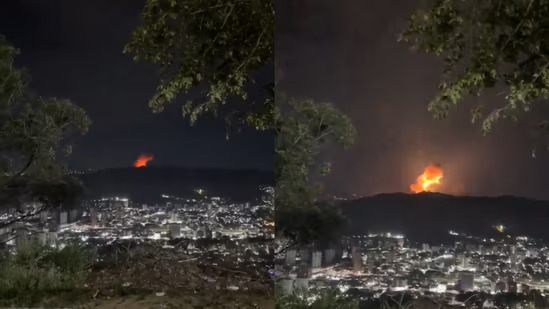
At least seven explosions were heard in Caracas in the early hours of Saturday as low-flying aircraft swept through the capital. Reuters witnesses reported seeing black smoke rising over parts of the city from around 2 am (0600 GMT), with blasts and aircraft visible for roughly 90 minutes.
Smoke rose from the hangar of a military base in Caracas, while another military installation lost power. Parts of the city were left without electricity hours later, though traffic continued to move in several areas.
Videos verified by the Associated Press showed tracers and smoke clouding the night sky over Caracas and an unidentified coastal city, with repeated muted explosions lighting up surrounding hills. Other footage showed cars moving on highways as blasts illuminated the landscape behind them.
While armed civilians and members of a pro-government militia appeared on the streets in some ruling party strongholds, other neighbourhoods remained largely deserted hours after the strikes.The Federal Aviation Administration banned US commercial and private flights in Venezuelan airspace and over nearby Curaçao, citing “safety-of-flight risks associated with ongoing military activity”.
Despite Trump’s announcement, there was no immediate detailed briefing from the White House or the Pentagon. The Pentagon referred queries to the White House, while US Southern Command did not respond. Trump was at his private club in Palm Beach, Florida, and offered no further comment on social media beyond his initial post.
Reuters later quoted a US official, speaking on condition of anonymity, as saying the United States carried out strikes inside Venezuela, without providing details on targets or objectives.
The attack comes after nearly five months of escalating pressure by the Trump administration on Maduro, who has been charged with narco-terrorism in the United States. Since August, Washington has ordered a major military buildup off Venezuela’s northern coast, including the deployment of an aircraft carrier, warships and advanced fighter jets, the largest US military presence in the region in generations.
Since early September, the US military has been attacking boats in the Caribbean Sea and eastern Pacific that it alleges were carrying drugs. As of Friday, US figures showed 35 boat strikes and at least 115 people killed. Trump has justified the operations as necessary to stem the flow of drugs into the US, saying Washington is engaged in an “armed conflict” with drug cartels.
Last week, Trump said the US had struck an area in Venezuela where boats were loaded with drugs, marking the first known land operations on Venezuelan soil during the current pressure campaign. Other media outlets have reported that the CIA was behind those operations.
Alongside military action, Washington has expanded sanctions, seized sanctioned oil tankers and sought what Trump has described as a “blockade” of Venezuelan oil, measures aimed at tightening economic pressure on Caracas. Trump has repeatedly threatened land strikes and has privately urged Maduro to leave the country, according to Reuters. Earlier this week, he said it would be “smart” for Maduro to step aside.
Saturday’s strikes and Trump’s claim that Maduro has been captured represent the sharpest escalation yet in the US campaign against Venezuela’s leadership. Key uncertainties remain: whether Maduro is indeed in US custody, who is exercising authority in Caracas, the full scale of damage and casualties, and whether further military action will follow.
The developments come just a day after Venezuela said it was open to negotiating an agreement with the US to combat drug trafficking. Maduro also said in a pre-recorded interview aired this week that Washington was seeking regime change and access to Venezuela’s vast oil reserves.
Venezuela rejected what it called US “military aggression” and accused Washington of trying to seize the country’s oil and mineral resources. The government said the US “will not succeed” in taking those resources and urged the international community to denounce what it described as a violation of international law.
In a statement, the government said Maduro had “ordered all national defense plans to be implemented” and declared “a state of external disturbance”, granting the authorities expanded emergency powers and a greater role for the armed forces.
Colombia’s President Gustavo Petro said on social media that Caracas was being bombed and called for an emergency meeting of the UN Security Council. He later published what he claimed was a list of bombed sites, including the Cuartel de la Montaña barracks in Caracas, which houses the mausoleum of Hugo Chávez, a central symbol of Chavismo, the political movement that has governed Venezuela since 1999.
Iran’s Foreign Ministry condemned the strikes, and Iranian state television broadcast images of explosions in Caracas. Cuba, a close ally of Maduro and a long-time US adversary, also criticised the attack.
As clarity emerges, the events of early Saturday are likely to reshape not just Venezuela’s internal politics, but also regional stability and U.S. relations across Latin America.


[[comment.comment_text]]