The Prize, the President, and the Protest
 an hour ago
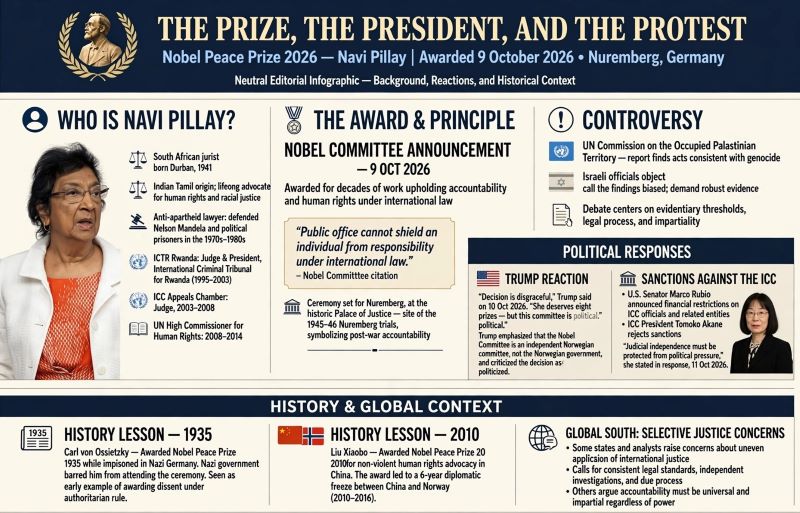
The world does not need another reminder that power can silence the weak. It needs an answer to a harder question: who holds the powerful accountable when institutions established to deliver justice become targets of retaliation? On 9 October 2026, the Norwegian Nobel Committee awarded the Peace Prize to Navi Pillay, the South African jurist, for promoting peace and international law. Within hours, the Trump administration imposed sanctions on the International Criminal Court (ICC), where Pillay had served, while President Donald Trump called the Nobel decision “disgraceful and embarrassing” and said it left an “indelible stain” on Norway.
The timing highlights a fundamental question: does international law restrain everyone equally, or is it a privilege extended by powerful states when convenient?
A Life Dedicated to Justice
Born in Durban in 1941 to a family of Indian Tamil origin, Pillay grew up under apartheid, where racial discrimination was embedded in law. As a lawyer, she defended Nelson Mandela and other anti-apartheid activists, including political prisoners on Robben Island. She later served as a judge and president of the International Criminal Tribunal for Rwanda, sat on the ICC Appeals Chamber from 2003 to 2008, and was UN High Commissioner for Human Rights from 2008 to 2014.
The Nobel Committee recognised her contribution to accountability for war crimes, crimes against humanity and genocide. Speaking from Nuremberg, where Nazi leaders were tried, Pillay dedicated the award to survivors of international crimes. The setting reinforced a fundamental principle: public office cannot shield anyone from responsibility for grave violations.
The Controversy Surrounding Pillay
Pillay’s record is not without controversy. She chaired the UN commission of inquiry on the occupied Palestinian territory and Israel, which concluded that genocide was occurring in Gaza. Israel and its supporters rejected the finding, alleging bias, while Prime Minister Benjamin Netanyahu said the award showed that the Nobel Committee had lost its moral compass.
Such objections deserve scrutiny. Investigators are not beyond criticism, and their conclusions must be assessed against evidence and legal standards. A commission of inquiry is not a court, and a judicial determination of genocide requires rigorous examination. An honest account must also acknowledge the killing of civilians and hostage-taking during the Hamas-led attack of 7 October 2023.
But allegations of bias do not, by themselves, rebut evidence. Political discomfort cannot justify abandoning investigations into alleged international crimes. The essential question is whether the same standards apply to all parties, regardless of their power or political alliances.
A President’s Reaction
Trump said he had never heard of Pillay, called her a “mystery person” and declared the prize “forever discredited”. He warned, “we will not forget, Norway,” while insisting that he deserved not one Nobel Peace Prize but eight.
Trump has openly campaigned for the award, and his supporters cite diplomatic initiatives they believe merit recognition. Critics question his record on Iran, territorial ambitions, immigration and multilateral institutions. Debate over Nobel decisions is legitimate, but criticism must be distinguished from intimidation.
Pillay received prolonged applause in Nuremberg and jokingly suggested she might share the prize with Trump if the audience continued clapping. His response was markedly different. The Nobel Peace Prize is awarded by an independent committee, not Norway’s government. Norwegian Prime Minister Jonas Gahr Støre has reaffirmed that independence. A president’s disappointment cannot determine an award’s legitimacy, nor should a country be threatened because its institutions make an unwelcome choice.
Sanctions Against the Court
The sanctions are more consequential than the rhetoric because they threaten the functioning of international justice. Secretary of State Marco Rubio announced measures restricting the ICC’s access to the American financial system and extending pressure to those working with it. Washington’s message was uncompromising: either the court ends what the administration regards as threats, or the United States will seek to cripple it. ICC President Tomoko Akane rejected the measures, while Pillay described them as unacceptable and warned that staff members felt threatened.
Washington’s objections warrant examination. The United States is not a party to the Rome Statute and disputes the court’s jurisdiction over nationals of non-member states. It also objects to arrest warrants issued against Israeli officials, including Netanyahu, and previously opposed the ICC’s investigation into American forces in Afghanistan.
These disputes deserve serious legal scrutiny. But disagreement over jurisdiction does not establish that a court is acting unlawfully. Challenging jurisdiction through legal argument is fundamentally different from undermining an institution through financial pressure.
The consequences could be severe. Banks might close accounts, insurers withdraw cover and technology providers suspend services, even where exemptions exist. Uncertainty can paralyse operations, leaving investigators, judges and witnesses without essential resources. An institution may survive formally while losing its ability to deliver justice.
Lessons from History
The Nobel Peace Prize has repeatedly angered powerful governments. In 1935, it went to German journalist and pacifist Carl von Ossietzky, imprisoned by the Nazi regime. Hitler’s government subsequently prohibited Germans from accepting Nobel Prizes. In 2010, jailed Chinese dissident Liu Xiaobo received the award, triggering a prolonged diplomatic freeze between Beijing and Norway.
The present episode is particularly unsettling because retaliation comes from a democracy that has long portrayed itself as a defender of the rules-based international order. Independent institutions matter most when their decisions inconvenience those in power.
The Global South and Selective Justice
Across Africa, Asia and Latin America, this confrontation may reinforce suspicions that international law constrains weaker states more readily than powerful ones. Colonialism, racial discrimination and foreign intervention have shaped these societies’ experiences of global governance. Sanctioning a court over politically unwelcome actions risks deepening distrust.
Yet selective justice should prompt demands for consistency, not the abandonment of law. Pillay’s journey from apartheid South Africa to international judicial institutions illustrates the importance of accountability. International bodies must earn legitimacy through transparent procedures, judicial independence and impartial standards. Their shortcomings require reform and scrutiny, not intimidation.
Governments can defend independent judicial processes while insisting on jurisdictional limits and due process. They can challenge flawed investigations with evidence, minimise the collateral damage of sanctions and apply consistent standards to allies and adversaries. Democracies have a particular responsibility to tolerate scrutiny and accept decisions they dislike.
The Final Test
The 2026 Nobel Peace Prize has exposed a fault line in the international order: whether law is a universal standard or an instrument respected only when it serves national interests. Neither unquestioning faith in international institutions nor automatic suspicion of powerful governments offers an adequate answer. Both must meet standards of evidence, transparency and accountability.
Pillay’s award does not settle the debate over international justice. It sharpens it. The ultimate test of any legal order is not whether the powerful praise it when it serves them, but whether they respect it when it constrains them.
If that principle fails, the consequences will extend beyond one president, one laureate or one Nobel Prize. They will reach everyone whose rights depend on justice prevailing over political convenience. That is the wake-up call the world cannot afford to ignore.
(Author, a Kashmiri sociologist, is a writer, -researcher, and columnist. His research Interests Include Kashmir Affairs, South Asian Politics, Human Rights, and Public Policy issues.)









[[comment.comment_text]]