Israel Heads to Polls Divided Over October 7 Failures and Netanyahu’s Leadership

 2 hours ago
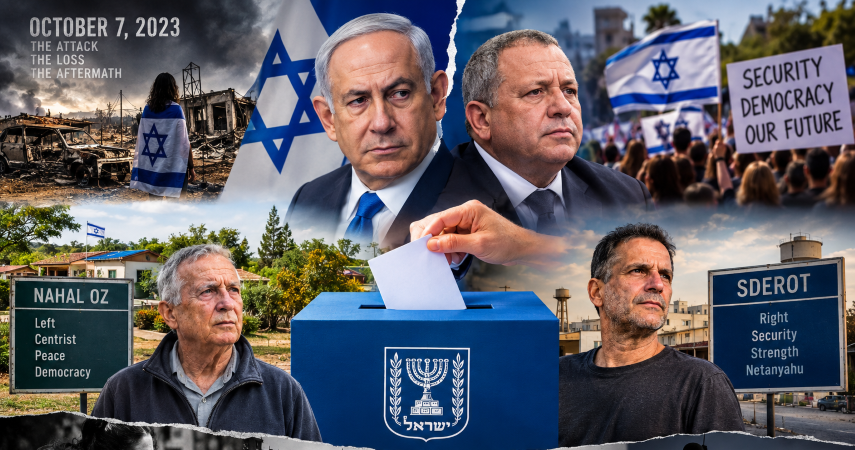
Israel is heading into a crucial election on October 27, with the trauma of the October 7, 2023, Hamas-led attack continuing to shape its political landscape. The anniversary of the deadliest assault in the country’s history briefly brought Israelis together in remembrance, but the unity has done little to bridge deep divisions over who should be held responsible for the security failures that preceded the attack. Instead of triggering a political earthquake, the tragedy has reinforced existing loyalties and widened the country’s ideological divide.
The divisions are particularly visible in communities near the Gaza border, where the attack claimed lives, shattered families and exposed serious weaknesses in Israel’s security apparatus. As reports pour in from Israel, in a liberal kibbutz barely half a mile from Gaza, residents are rebuilding their lives after being evacuated during the war. Yet the return of normality has not erased their anger at Prime Minister Benjamin Netanyahu and his government, whom many blame for the policies and failures that left the country vulnerable.
Daniel Rahamim, a 72-year-old community spokesman who survived the attack with his family, believes that Israel cannot afford to abandon the prospect of peace. Many residents of Nahal Oz, which overwhelmingly supported centrist and left-leaning parties in the 2022 election, are expected to oppose Netanyahu again. For Rahamim, the issue extends beyond the handling of Gaza to the government’s attempts to curb judicial powers and its dependence on ultra-Orthodox political allies. He fears that Israel could gradually abandon its liberal democratic character in favour of a more religiously conservative and authoritarian system.
Barely eight miles away, however, the working-class town of Sderot presents a sharply different political picture. The town witnessed fierce fighting during the Hamas-led assault, yet Netanyahu retains considerable support among residents. Many believe that the country’s security chiefs failed to recognise and respond to the threat, arguing that responsibility rests primarily with the military and intelligence establishment rather than the prime minister. For supporters such as Shlomi Aragon, 55, a victory for Netanyahu’s opponents would endanger Israel’s future. The contrast between Sderot and Nahal Oz illustrates how communities that experienced the same tragedy have drawn opposing political conclusions from it.
The October 7 attack killed approximately 1,200 people, mostly civilians, according to Israeli authorities, while 251 people were taken hostage. Israel’s subsequent military campaign devastated much of the Gaza Strip, killing more than 74,000 people, including thousands of children, according to Gaza health officials, who do not distinguish between civilians and combatants. The consequences of the attack and the ensuing war have transformed Israel’s security environment and intensified international scrutiny of its policies. Nevertheless, the election is about more than the immediate legacy of October 7.
For Netanyahu’s critics, the vote represents an opportunity to challenge a government they believe has weakened Israel’s democratic institutions and damaged its international standing. His right-wing coalition, widely regarded as the most hard-line and religiously conservative in the country’s history, has faced sustained opposition over its efforts to restrict judicial powers. Critics argue that the government’s domestic agenda has undermined institutional checks and balances at a time when public confidence in the state’s ability to provide security has already been badly shaken.
At the centre of the electoral debate are the decisions and omissions that preceded the Hamas assault. Netanyahu’s governments pursued policies intended to maintain a degree of calm in Hamas-controlled Gaza, but the attack exposed the dangers of that approach. Military and intelligence failures compounded the problem, allowing thousands of militants to cross the border and overwhelm communities, military installations and a music festival. The question of political accountability remains unresolved, with opponents demanding answers about the government’s preparedness while Netanyahu’s camp insists that security agencies failed to meet their responsibilities.
The consequences of October 7 have also extended far beyond Gaza. Conflicts involving Israel, Hezbollah in Lebanon and Iran have widened the regional confrontation, while Israeli military operations have extended into neighbouring territories. Although Israel has inflicted significant damage on its adversaries, they have not been completely defeated, despite Netanyahu’s promises of total victory. A recent survey by the Institute for National Security Studies at Tel Aviv University found that a majority of Israelis fear another attack on the scale of October 7. This anxiety has strengthened demands for security, but it has not produced a corresponding consensus on the leadership needed to deliver it.
Political analysts had expected the scale of the national catastrophe to bring about a fundamental realignment of Israeli politics. Tamar Hermann, a professor of political science and an expert in public opinion at the Israel Democracy Institute, said many initially anticipated an electoral earthquake. Instead, voters have largely retreated into familiar political camps, interpreting the same events through established ideological loyalties. The central question remains whether Netanyahu should continue in office, alongside a broader debate over the balance between Israel’s Jewish identity and its democratic principles.
The election is expected to be closely contested, with Netanyahu facing a formidable challenge from centrist Gadi Eisenkot, a former military chief. Opinion surveys suggest a divided electorate and no clear path for either side to form the next government without difficult political negotiations. Netanyahu’s supporters argue that his administration has demonstrated a willingness to use force against threats beyond Israel’s borders, while his critics question whether military action alone can guarantee lasting security. The possibility of another inconclusive electoral outcome underscores the depth of the political impasse.
Despite their differences, Israelis across much of the political spectrum share a determination to prevent another October 7. Even Rahamim, who advocates negotiations with moderate Palestinian leaders, insists that Hamas must be destroyed. Yet he also argues that Israel has an obligation to future generations to seek an eventual political accommodation. His position captures the dilemma confronting the country: the desire for security and retribution coexists with the recognition that military force cannot, by itself, resolve the underlying conflict.
As Israelis prepare to vote, the fundamental question is whether the October 7 tragedy will eventually produce meaningful political accountability or remain another episode absorbed into the country’s longstanding divisions. The election will test not only Netanyahu’s hold on power but also public confidence in Israel’s democratic institutions, security leadership and strategic direction. For communities such as Nahal Oz and Sderot, the stakes are deeply personal. Both have experienced the consequences of the same attack, yet their contrasting political choices reveal how far Israel remains from a shared understanding of what went wrong and how the country should move forward.
(Author, a senior trilingual journalist, is an editorial adviser to TEW.)








[[comment.comment_text]]