Green Threads of Growth

 3 months, 1 week ago
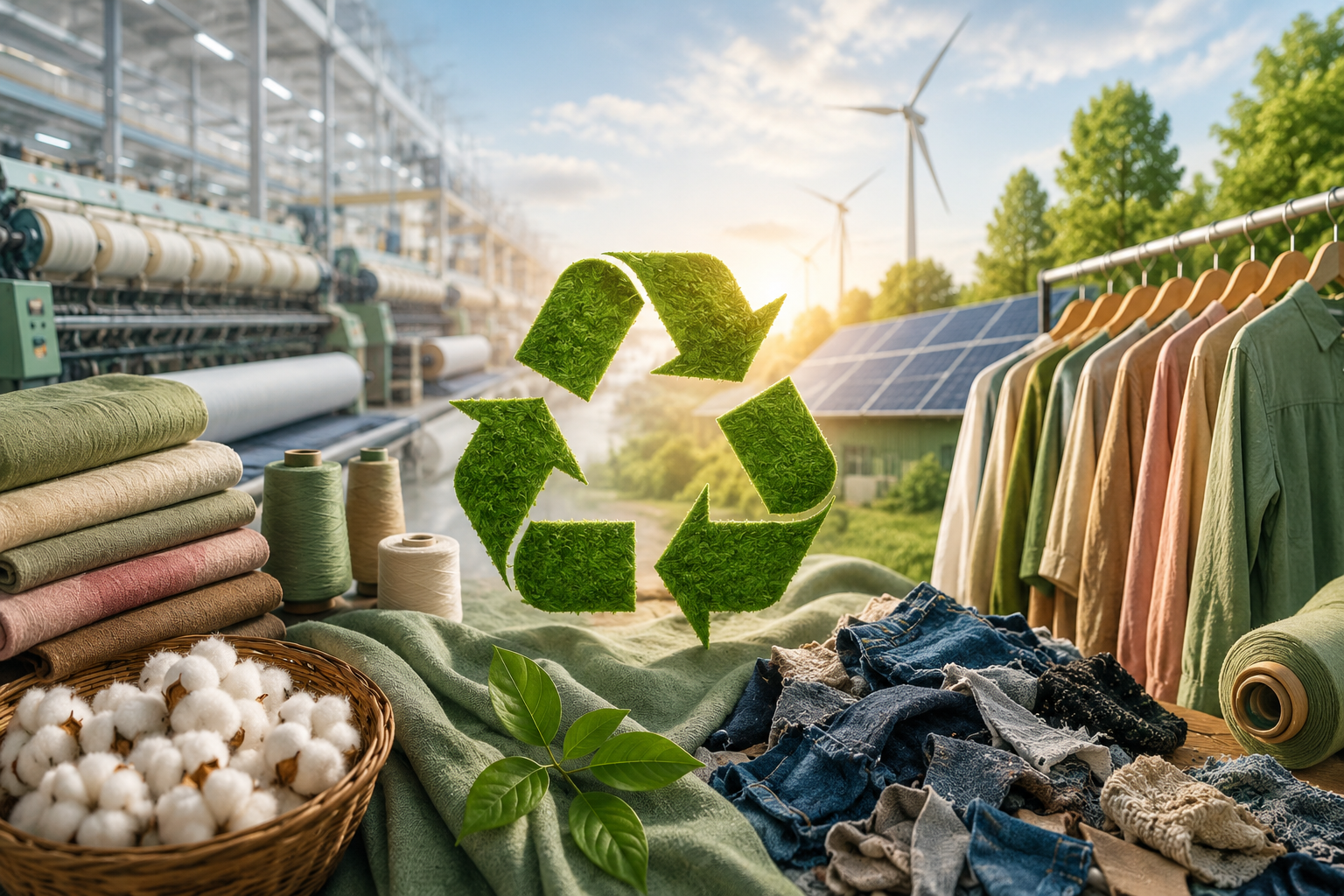
India's textile industry, one of the country's oldest economic pillars and among the world's largest employers, is entering a defining phase of transformation. As international markets increasingly favour environmentally responsible products and stricter sustainability standards become the new norm, the industry's future competitiveness will depend as much on its environmental credentials as on its manufacturing capacity. From organic fibres and green manufacturing to textile recycling, carbon reduction and circular production, India is gradually redesigning its textile value chain for a low-carbon future. The transition represents not only an environmental imperative but also a significant economic opportunity that could strengthen exports, generate green jobs and position India as a global leader in sustainable textiles.
For decades, India's textile sector has been a backbone of the manufacturing economy. It contributes around 2 per cent to the country's Gross Domestic Product (GDP) and nearly 11 per cent of manufacturing Gross Value Added (GVA). It directly employs more than 45 million people, making it one of India's largest sources of industrial employment, particularly for women and rural workers. India is also the sixth-largest exporter of textiles and apparel globally, accounting for nearly 4 per cent of world textile exports. Yet the industry now faces a new challenge: remaining globally competitive in an era where sustainability has become a market requirement rather than a marketing slogan.
Across Europe, North America and several developed economies, consumers, retailers and regulators are demanding greater transparency in supply chains, lower carbon emissions, reduced chemical usage and responsible sourcing. New environmental regulations, particularly within the European Union, are making sustainability an essential condition for market access. Consequently, Indian exporters can no longer compete solely on cost and production capacity. Their long-term success will increasingly depend on how efficiently they reduce environmental impact while maintaining quality and competitiveness.
Fortunately, India enters this transition with a unique advantage. The principles of the circular economy—reuse, repair, recycling and resource conservation—have existed in Indian society for generations. Traditional households routinely reused garments, recycled fabrics into quilts or household products and minimised waste long before circularity became a global industrial concept. Today's challenge is to scale those traditional practices through modern technology, industrial policy and organised value chains.
The numbers demonstrate that India already possesses a substantial foundation for circular production. The country manages nearly 7.8 million tonnes of textile waste annually, and over 70 per cent of this waste is recovered through recycling, reuse, upcycling or downcycling. Recovery rates are particularly impressive at the factory level, where almost 95 per cent of pre-consumer textile waste is collected and reintroduced into production. Even post-consumer waste, traditionally considered difficult to recycle, now sees around 55 per cent diverted from landfills through organised collection networks. This recycling ecosystem supports an estimated 40 to 45 lakh livelihoods, many of them women working in collection, sorting and redistribution activities.
Several cities have emerged as successful models of India's evolving circular textile economy. Navi Mumbai hosts the country's first Municipal Textile Recovery Facility, integrating waste collection, sorting, recycling and livelihood generation under one organised framework. Panipat has developed into one of India's largest textile recycling clusters, processing thousands of tonnes of discarded textiles every day and supplying recycled fibre to manufacturers across the country. Meanwhile, Delhi's Mongolpuri Katran Market demonstrates how the informal sector continues to play a critical role by collecting, sorting and supplying textile waste to formal recycling industries. These examples highlight that India's transition towards sustainability will rely on strengthening—not replacing—the existing informal ecosystem.
The transformation begins even before textile production starts. Sustainable fibre production has become an important policy focus. Through initiatives such as the National Programme for Organic Production (NPOP), the government promotes certified organic cotton cultivation that meets international standards. Simultaneously, programmes such as Jute-ICARE, the New Age Fibre Mission and the National Fibre Scheme encourage climate-resilient natural fibres including flax, ramie and sisal as environmentally friendly alternatives to synthetic materials. These initiatives reduce the environmental footprint of textile production from its earliest stage while helping farmers diversify towards high-value sustainable crops.
Another significant area of reform concerns chemical usage. Textile dyeing and processing remain among the most environmentally intensive industrial activities. India has already restricted benzidine-based dyes and prohibited the use of several hazardous azo dyes while implementing projects aimed at eliminating harmful chemicals across hundreds of textile factories. Cleaner chemical management not only reduces environmental pollution but also improves the recyclability of textile fibres, making circular production more efficient.
Manufacturing practices are also undergoing a structural transformation. The government's PM Mega Integrated Textile Region and Apparel (PM MITRA) Parks represent one of the most ambitious industrial infrastructure initiatives in the sector. These integrated textile parks combine manufacturing, logistics and environmental infrastructure through Common Effluent Treatment Plants (CETPs), wastewater recycling systems, scientific waste management and shared utilities. Seven such parks have been approved across multiple states, with investment commitments exceeding ₹27,000 crore. The objective is not merely to expand production but to ensure that future textile manufacturing follows globally accepted sustainability standards.
Small and medium enterprises (MSMEs), which account for over 80 per cent of India's textile production capacity, are equally central to this transition. Through schemes under the Raising and Accelerating MSME Performance (RAMP) programme, including MSE-GIFT and MSE-SPICE, the government is encouraging adoption of green technologies, energy-efficient machinery and circular production practices by offering interest subsidies, capital support and financial incentives. These interventions recognise that India's sustainability goals cannot be achieved unless smaller manufacturers also become part of the green transition.
Climate policy is beginning to reshape the textile industry as well. Under the Indian Carbon Market and the Carbon Credit Trading Scheme, carbon-intensive industries, including textiles, are required to monitor greenhouse gas emissions and meet prescribed emission intensity targets. Enterprises exceeding these targets will receive tradable carbon credits, creating market incentives for investment in cleaner technologies, energy efficiency and low-carbon manufacturing. This approach aligns India's industrial strategy with emerging international carbon regulations that increasingly influence global trade.
Waste management reforms further strengthen the circular economy. The Solid Waste Management Rules, 2026 incorporate extended producer responsibility and encourage productive utilisation of textile waste. Non-recyclable textile waste can now be converted into Refuse Derived Fuel (RDF), reducing landfill pressure while supporting industrial energy requirements. Simultaneously, research under the National Technical Textiles Mission is exploring innovative technologies to convert discarded textiles into advanced materials such as carbon fibres and high-performance technical textiles, opening new avenues for value addition.
Beyond manufacturing, sustainability increasingly influences branding and market access. Eco-labelling under the Eco-Mark Scheme, certification initiatives such as Kasturi Cotton and Silk Mark, traceability systems and public procurement of upcycled products through the Government e-Marketplace (GeM) are improving consumer confidence and helping Indian exporters meet international compliance requirements. Industry-led initiatives such as SURE (Sustainable Resolution) and awareness campaigns promoting textile recycling further demonstrate that sustainability is becoming embedded across the entire value chain rather than remaining confined to production processes.
However, significant challenges remain. India's textile sector continues to be highly fragmented, with thousands of small enterprises lacking access to advanced recycling technologies, affordable green finance and technical expertise. Post-consumer textile collection systems remain uneven across different regions. Digital traceability systems, carbon accounting and ESG compliance require substantial investments that many smaller manufacturers may find difficult to afford without continued policy support. Additionally, balancing rapid industrial growth with environmental protection will require effective enforcement of regulations and stronger collaboration between government, industry and local communities.
Despite these challenges, the long-term economic opportunity is considerable. India's textile recycling industry is projected to grow into a USD 3.5 billion market by 2030, creating nearly one lakh green jobs over the next five years. Sustainable manufacturing can also improve India's attractiveness as a sourcing destination at a time when global brands are actively diversifying supply chains and seeking environmentally responsible production partners.
Ultimately, India's textile industry stands at a historic turning point. The sector that once drove industrialisation through scale and labour-intensive production is now preparing for a future where innovation, resource efficiency and environmental responsibility will determine global leadership. If policy implementation, private investment and technological innovation continue to move in the same direction, sustainability may become not merely a compliance requirement but India's greatest competitive advantage in the global textile market. The country's centuries-old tradition of resource-conscious craftsmanship, reinforced by modern industrial reforms, has the potential to weave a future where economic growth and environmental stewardship advance together.








[[comment.comment_text]]