India's economy growing but wealth not getting distributed: Rahul Gandhi

 2 years, 9 months ago
Even my social media is fully capped. I've got a shadow ban 24/7...my Twitter's under control, my YouTube is under control and I'm not alone, the entire opposition, alleges Congress leader
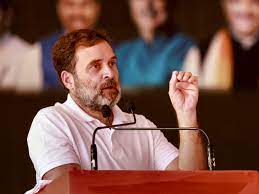
New Delhi, EW News : India's economy is growing but the wealth is getting concentrated in a few hands and the challenge of unemployment continues, Congress leader Rahul Gandhi said in an interaction with some students of Harvard University.
The former Congress president on Saturday shared on X a video of the interaction held on December 15, and said, "My advice to all students - True power comes from connecting with people, listening deeply to what they're saying, and being kind to yourself." Asked about India's economic growth in the last 10 years during the interaction, the Congress leader said, "When you talk about economic development you have to ask the question in whose interest is that economic development." "The question to ask is, what is the nature of that growth and who is benefiting from that. Right next to the figure of growth in India, you have the figure of unemployment in India. So India's growing, but the way it's growing is by massively concentrating wealth towards very few people," he said.
ADVERTISEMENT
"We are operating on a debt sort of model and we are no longer producing. The real challenge in India is how do we set up a production economy that is able to give large numbers of people jobs. We have two or three businesses that are pretty much entire businesses," he said.
"We have Mr. Adani, everybody knows he is directly connected to the prime minister, he owns all our ports, airports, our infrastructure! With that kind of concentration, you will get growth but you will not get any distribution," he said.
Asked why this has not translated into an electoral outcome or mobilisation of people, Gandhi there is a massive mobilisation but there is a requirement for an "infrastructure to fight an election".
"...you need a fair media, fair legal system, fair election commission, access to finance, institutions that are neutral. Imagine a United States where the IRS, the FBI, their full time job is destroying the lives of the opposition. So that's the paradigm we're in. I didn't walk 4,000 kilometers because I like walking 4,000 kilometers. I walked 4,000 kilometers because there was no other way to get our message across," he said, referring to his Bharat Jodo Yatra.
"Even my social media is fully capped. I've got a shadow ban 24/7...my Twitter's under control, my YouTube is under control and I'm not alone, the entire opposition.... I don't think India is running a free and fair democracy anymore...," he said.
He said caste is a real problem in the country and likened it to "apartheid".
The Congress leader also accused the BJP-led central government of not treating India as a union of states, but as a nation with "one ideology, one religion, one language".
"So they kill the negotiation, they try to capture the institutions. So that's really the political fight in India right now," he said.
"We feel if you end the negotiation in India, the conversation between the union India collapses, India tears itself apart. So you can see that Manipur is burning, you can see Jammu and Kashmir is burning. You can see Tamil Nadu has a problem...," he said.
He said a "full scale civil war" is going on in Manipur.
In response to a question on India's relations with Russia, he said, "A solid Russian-Chinese alliance is a real problem for the United States. We have traditionally had a relationship with Russia. Being an ally of the United States or a partner of the United States...doesn't mean we don't talk to anyone else." Asked about his experience from the Bharat Jodo Yatra, he said, "I realised what is called the politician in the West and in India is basically dead. It's a category that has collapsed on itself." "...Huge part of why the politician is dead is that he is not listening anymore. Politician has gone into a zone where he just wants to please at all costs," he added.





[[comment.comment_text]]