Gilded Profits, Gagged Labour: MODI’S REBUKE EXPOSES INDIA Inc.


 8 minutes ago
More jobs, better wages and shared responsibility, by the industry is rocking India amid economic crisis.
The perception is unravelled by Prime Minister Narendra Modi during a comprehensive address to Indian corporate leaders at the centenary celebrations of the Federation of Indian Chambers of Commerce & Industry (FICCI). Modi spotlighted critical issues around employment, wage growth, tax reforms, corporate responsibility, and the broader state of the Indian economy—urging the business community to reflect on how government incentives have translated into tangible benefits for workers and the economy at large.
He remains silent on further privatisation of the public sector and dismal affairs on hitting many Navratnas, including the steel or telecom PSUs, backbone of the Indian economy.
The critical issues are a realisation that could have dawned years before. The prime minister harps on it now. And he has been deadly honest that after tax concessions to the industry – income tax relief from – 30 percent to 22 percent, that an individual had been seeking for the last eight decades, - to GST reductions and I-T exemptions up to Rs 12 lakh to individuals so that it could become a purchasers’ economy.
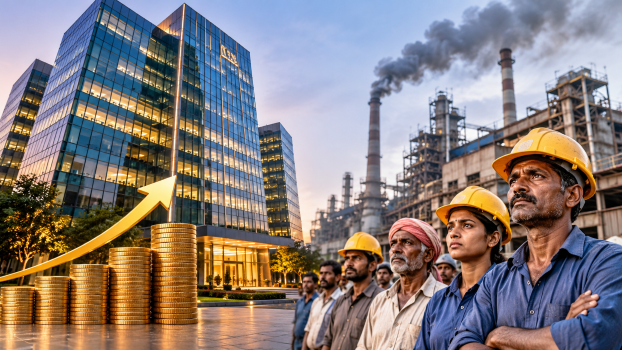
Modi’s unhappiness is open. The industry gobbles up the benefits. In exchange it gives little but job cuts, higher prices and lacking in corporate responsibility. His dismay is sharp. The industry has not hiked salaries or wages.
He is correct. He has taken too long to react sending people to desperation. They were wondering why nobody nailed it earlier. Wider feelings of the industry being pampered were common. The industry was being shielded for many defaults even if they kept salaries frozen, made arbitrary cuts or penalised for echoing concerns on the pretext of “indiscipline”.
Trade unionism was frowned upon even for demanding just wages, forget about legitimate needs as per the rising prices reflected in the consumer price index (CPI). The memories of the prolonged farmers’ agitation remain fresh.
How many are penalised for wage defaults, the primary trigger, remains unknown as data are not easily available. According to Labour Bureau Industrial Disputes reports, disputes over wages and allowances account for roughly 46 percent of all recorded industrial disputes, with the manufacturing sector making up two-thirds of these conflicts.
5000 Laid Off & Verbal Sacking
Official datasets from the Ministry of Labour and Employment log around 4,900 to 5,200 formal workers laid off annually across central and state spheres, alongside smaller numbers of formal retrenchments. Because firing permanent workers in factories with 300 or more employees requires prior government approval under the Industrial Relations Code.
Most factory floor workers in industrial hubs—such as auto parts, electronics, and garment clusters—are hired through third-party contractors without written contracts. Employers routinely terminate or replace them verbally without generating formal retrenchment records.
Unions note that while hundreds file formal wage complaints, far more stay silent over wage theft or unlawful firing, fearing blacklisting and immediate job loss. Because national totals are unavailable, the scale of the issue is mostly visible through localized flashpoints reported in the media.
Across Surat, Gujarat; Noida/NCR/Delhi and Mysuru, Karnataka; thousands of workers protesting or filing legal claims for fair wages, overtime, and statutory benefits faced mass dismissals, contract terminations, and police detentions.
The labour department is aware of it but it’s hamstrung. The laws are diluted. Getting justice is not easy. Judicial or quasi-judicial systems are time consuming. Labourers may have some recourse the managerial staff and higher wage-earning IT sector personnel find it more difficult.
Modi rings it rightly when he says, “No country can progress unless it respects its farmers, small entrepreneurs, industries, wealth creators and taxpayers. A country cannot move forward by abusing them morning and evening”.
Wage Boards Scrapped
The obvious query is why the labour laws are further weakened and wage boards virtually abolished as the industry wanted. It’s contrary to the higher profits the industry is earning.
In Q2 FY2026-27, net profits across 3,568 listed Indian companies jumped 26.2 percentyear-on-year on 22.6percent revenue growth, with Nifty 50 firms recording their fastest earnings pace in over four years (19percent–27percent), led by BFSI, metals, oil and gas, and autos. While both large (Rs10,000 cr) and small (Rs1,000 cr) companies saw roughly 36percent adjusted net profit growth compared to ~18percent for mid-sized firms, broader Indian manufacturing profits also climbed to Rs11.56 trillion in 2025 from Rs10.73 trillion the prior year. Some industries earn 20 to 45 percent profits.
RBI notes operating profit in manufacturing rose to 10.3 percent, up from 6 percent in 2024 but with operating profit margin pf 13.9 percent; in IT services 10.7 percent - with 22.4 percent operating profit margin and non-IT services with operating profits at 7.1 percent, operating profit margin is 20 percent. But wages and quality concerns remain unaddressed
Cronyism
It is moreexpansive. Crony capitalism is on the rise. An Indian billionaire, largely unknown globally, has dethroned Bernard Arnault as the world’s third-richest person, trailing only Elon Musk and Jeff Bezos with a $143 billion (€140 billion) fortune after his company's shares surged over 2,400 percent since March 2020. Rather than reflecting innovation, his meteoric rise highlights widening inequality and "crony capitalism" in India, as his conglomerate relies heavily on state-allocated licenses and government contracts across sectors like airports, ports, mining, aerospace, and defence.
The Tata group has during the last few weeks expressed fears of a takeover by hostile businesses. There are many others that have either been taken over or in the process with some state agencies, though unconnected, carrying on simultaneous operations making survival difficult.
Critics argue that insolvency resolutions often force creditors to take 70 to 90 percent write-offs while buyers acquire assets at steep discounts. Meanwhile, defaulting promoters allegedly abuse moratoriums and file endless appeals to stall the 330-day timeline and erode asset values, while Section 32A immunity can obscure accountability for past corporate misconduct.
Severe Haircuts
The reengineered laws like Insolvency and Bankruptcy Act are feared to be helping rogue companies in taking over for peanuts. Even banks are worried as they apprehend severe haircuts in such clandestine operations.
While the prime minister’s concerns are genuine, the processes are not so simple as crony capitalism has mutual gainers at the cost of certain essential attributes of a sound economy and principle of natural justice.
As India aims to become a global industrial powerhouse, the balance between incentives and accountability, profits and people, must define its economic narrative.
(Author, a well-recognised senior journalist and commentator, has served as a Professor & Dean at the capital-based IIMC.)








[[comment.comment_text]]