Starlink vs Jio: Who Will Control India’s Digital Skies?

 2 hours ago
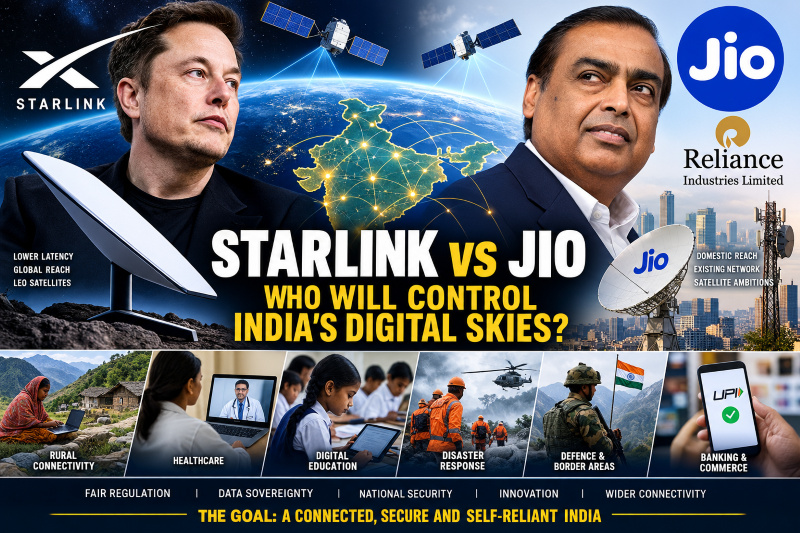
The next major contest in India’s digital economy may not be fought on the ground, where fibre-optic cables criss-cross cities and telecom towers dominate the skyline, but thousands of kilometres above the Earth. As Elon Musk’s Starlink expands its satellite internet ambitions and Reliance Jio explores plans for its own satellite constellation, the competition is opening a new front in the struggle over technology, national security and digital sovereignty. For India, the question is not simply which service can deliver faster internet to remote villages, but who will control the infrastructure on which an increasingly connected nation may depend.
Satellite-based internet has the potential to transform connectivity in regions where conventional telecommunications infrastructure remains expensive, difficult or impractical to deploy. Remote villages, mountainous terrain, border areas, islands and disaster-hit locations could benefit from internet access without waiting for extensive fibre networks or mobile towers. Low Earth orbit (LEO) satellites, which operate much closer to the planet than traditional geostationary satellites, can provide lower-latency connectivity and expand access to locations that terrestrial networks struggle to reach. In a country as geographically diverse as India, this technology could strengthen digital education, healthcare, financial inclusion, disaster response and public service delivery.
Starlink has already established a substantial operational satellite internet network internationally, giving it a significant advantage in experience, deployment and service development. Reliance Jio, meanwhile, has the potential to draw on its existing telecommunications infrastructure, domestic market reach and commercial partnerships as it pursues satellite connectivity. However, the two should not be treated as equivalent in their present stages of development. Starlink’s operational network and Jio’s proposed satellite ambitions represent different levels of deployment. Announced timelines and constellation targets are plans, not proof that the intended network has already been completed or is commercially operational.
The competition matters because satellite internet is not merely another consumer service. As connectivity becomes essential to banking, commerce, governance, defence logistics and emergency communication, the infrastructure carrying data acquires strategic importance. Dependence on a small number of private operators, particularly those whose technology and corporate decision-making are located outside India, could create vulnerabilities if adequate safeguards are absent. Such concerns do not establish that any particular foreign provider poses a security threat; they underline the need for transparent rules that apply to all operators.
India must therefore ensure that satellite internet providers comply with its licensing conditions, security requirements, lawful interception procedures and applicable data-protection laws. Authorities need clarity on network architecture, access to relevant information when legally required, incident reporting and the responsibilities of service providers during emergencies. At the same time, security provisions must be proportionate, legally grounded and subject to appropriate oversight so that national security does not become a justification for arbitrary access to private communications.
The question of data sovereignty also requires careful consideration. The nationality of a company alone does not determine whether a network is secure or whether user data remains under effective legal protection. What matters is how data is collected, transmitted, stored and accessed; which laws govern the operator; and whether regulators can enforce compliance in practice. India needs enforceable safeguards rather than assurances based solely on corporate identity or promises of technological sophistication.
There is also a question of market power. A global satellite operator with a large constellation, established technology and substantial financial resources may enjoy advantages that domestic competitors find difficult to match. Yet protecting Indian companies should not mean insulating them from competition or allowing them to operate without scrutiny. A fair regulatory framework must encourage investment, innovation and consumer choice while preventing discriminatory practices, excessive concentration and barriers that undermine competition. Indian consumers should benefit from better connectivity, reliable service and reasonable prices, regardless of which company provides the technology.
For Jio, the challenge will be to translate its ambitions into a reliable, affordable and scalable satellite service. For Starlink, success in India will depend not only on technological capability but also on meeting the country’s regulatory and operational requirements. Both will need to demonstrate that their services can work effectively within India’s legal framework and serve consumers beyond commercially attractive urban and business markets.
India’s larger objective should be to develop domestic capabilities across the satellite communications ecosystem, including spacecraft manufacturing, launch services, ground infrastructure, network management, cybersecurity and research. Simply having an Indian company sell a service does not automatically create technological independence. Genuine capacity requires skilled workers, indigenous innovation, resilient supply chains and the ability to maintain critical systems without excessive dependence on external suppliers.
The Starlink–Jio contest, therefore, should not be reduced to a choice between a foreign company and an Indian conglomerate. It is an opportunity to determine the terms on which advanced connectivity enters the country. India must remain open to global technology and investment, but it must also retain the regulatory authority, technical expertise and strategic capacity necessary to protect its interests.
The real measure of success will not be the number of satellites launched or the speed advertised in a commercial campaign. It will be whether satellite internet connects underserved communities, strengthens essential services, protects users’ rights and contributes to a resilient domestic technology ecosystem. India’s digital future must not be held hostage by any single company, domestic or foreign. The objective should be clear: wider connectivity, fair competition and national control over the rules governing the digital infrastructure on which the country increasingly depends.
(Author is senior journalist and commentator on current affairs.)










[[comment.comment_text]]