Pakistan’s Diplomatic Double Game Reaches Its Limits

 2 hours ago
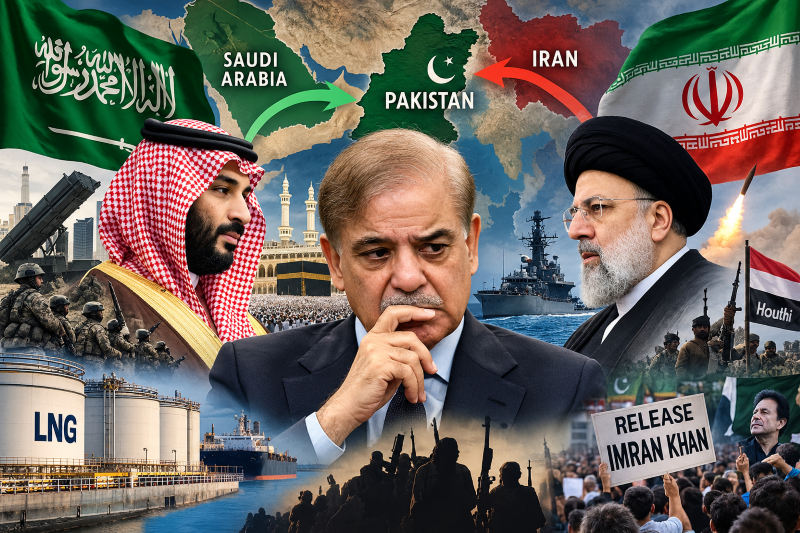
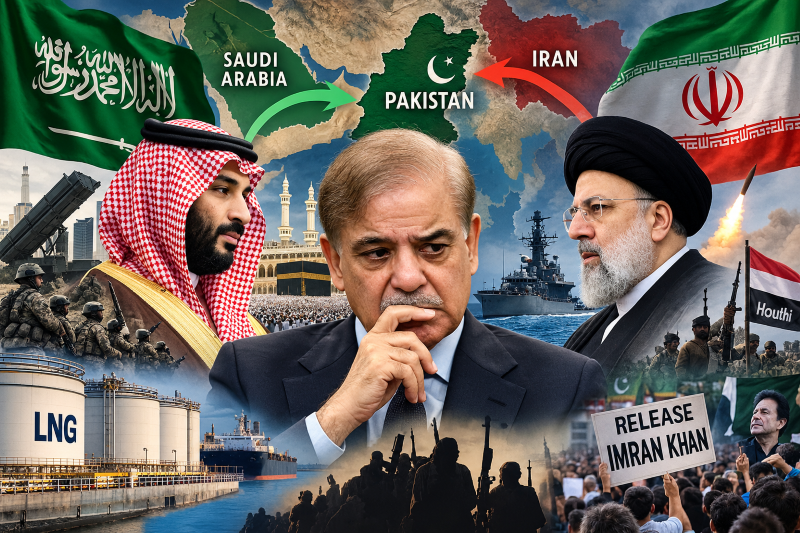
Pakistan’s foreign policy is increasingly defined by contradictions that may soon become impossible to manage. Islamabad promises to stand “shoulder-to-shoulder” with Saudi Arabia through the newly established Mecca Defence Alliance, intended to protect the Kingdom against external threats, particularly those linked to Iran. Yet, at the same time, Pakistan has reportedly relied on Iranian contacts to secure vital liquefied natural gas (LNG) supplies from Qatar. While Prime Minister Shehbaz Sharif signals solidarity with Riyadh, Pakistan remains reluctant to confront the Iran-backed Houthis, even as it continues military operations against Afghanistan that risk aggravating its own security crisis. This balancing act, once a useful instrument of diplomatic survival, is becoming increasingly untenable. Pakistan cannot indefinitely maintain competing commitments while its economic fragility, domestic instability and terrorism challenge continue to deepen.
The Mecca Defence Alliance’s emerging institutional structure suggests that Saudi Arabia and its partners are moving beyond declarations of support towards practical cooperation. The appointment of retired Lieutenant-General Nauman Mahmood as the alliance’s first secretary-general, with its secretariat to be established in Riyadh, is an important step. A meeting of foreign ministers on the sidelines of the United Nations General Assembly also reaffirmed Saudi Arabia’s right to self-defence under Article 51 of the UN Charter and called for an urgent meeting of military chiefs to consider concrete assistance. France’s reported offer of soldiers, radar and defence systems to protect Yanbu further underlines the seriousness of the threat. However, any meaningful military response against the Houthis would risk escalating tensions with Iran, whose support has contributed to the group’s formidable capabilities. China’s simultaneous engagement with Tehran and Riyadh, including reported efforts to persuade Iran to restrain the Houthis, illustrates the intricate web of competing interests. For Pakistan, participation in this alliance will require more than diplomatic assurances; it will demand difficult decisions about the limits of its strategic commitments.
General Mahmood’s appointment places him at the centre of this dilemma. His experience in military command and intelligence, including his tenure as commander of XI Corps in Peshawar during the turbulent period surrounding the US withdrawal from Afghanistan, could prove valuable in navigating the region’s security challenges. His understanding of the Taliban and Pakistan’s western border may be particularly relevant. Yet the most urgent consideration for Islamabad should be the security crisis within its own borders. Pakistan’s confrontations with Afghanistan, coupled with rising militant violence, threaten to undermine domestic stability at a time when the country can ill afford another prolonged conflict. The Global Terrorism Index has placed Pakistan among the countries most severely affected by terrorism, underscoring the danger of pursuing military ambitions abroad while insecurity grows at home. The new secretary-general will therefore have to reconcile the alliance’s expectations with Pakistan’s limited capacity and competing national priorities. Without a workable approach to Afghanistan and domestic militancy, Islamabad’s regional commitments could become liabilities rather than strategic assets.
Pakistan’s predicament is not without precedent. In 2015, despite Saudi Arabia’s requests for military assistance during Operation Decisive Storm in Yemen, Pakistan’s Parliament declined to commit troops, reflecting fears that involvement would inflame sectarian divisions at home. Islamabad subsequently pursued diplomatic engagement involving Turkey and Iran, presenting itself as a potential mediator rather than a direct participant in the conflict. The same tension now threatens to resurface. Any action against Iran or the Houthis could provoke political opposition and deepen sectarian fault lines, while failure to support Riyadh meaningfully could damage relations with a longstanding partner. Meanwhile, Pakistan’s dependence on Iranian facilitation for energy supplies exposes the practical limits of its alignment with Saudi Arabia. The country’s traditional strategy of maintaining relations with rival powers and extracting benefits from each has become harder to sustain as regional conflicts overlap. Mediation may enhance Pakistan’s diplomatic profile, but it cannot substitute for a coherent policy or remove the consequences of conflicting commitments.
The contradictions in foreign policy are compounded by an increasingly fragile domestic political order. The Pakistan Tehreek-e-Insaf’s planned march to Islamabad to demand the release of former prime minister Imran Khan has prompted extensive security preparations, while the detention of senior party leaders has weakened the opposition’s ability to mobilise. The absence of a meaningful political dialogue, alongside concerns over civil liberties and democratic accountability, risks deepening public alienation. A military establishment that exercises decisive influence over national affairs may be able to contain immediate challenges, but repression cannot resolve the structural problems confronting the state. Pakistan now faces a convergence of economic distress, terrorism, political confrontation and regional insecurity. Its leadership must decide whether to continue treating diplomacy as a game of tactical advantage or recognise that credibility depends on consistency and restraint. No country can indefinitely run with the hare and hunt with the hounds. If Pakistan continues to promise everything to everyone while resolving little at home, its carefully cultivated balancing act may ultimately leave it isolated, overstretched and less secure.







[[comment.comment_text]]