Protest, Policing, and Human Dignity
 2 months, 2 weeks ago
The size of a police force or the degree of its coercive authority are not the genuine indicators of a democracy. It is gauged by something much deeper: the humanity, constitutional integrity, sensitivity, and moderation with which that authority is used. The purpose of the police in a democratic society is to give people confidence that the law will protect them, not to induce fear in them. Therefore, the issue goes beyond the specifics of a single occurrence whenever claims of excessive force, human rights abuses, or maltreatment of nonviolent protestors—especially women—emerge during public demonstrations. It turns into an examination of the constitutionality of law enforcement.
In India, donning a police uniform entails a serious constitutional commitment rather than just accepting public employment. They swear loyalty to the Constitution, the rule of law, and the fair administration of justice. The fundamental tenet of police service regulations in all Indian states is clear: the police are answerable to the law, not to the current administration or any political party. State police manuals, foundational policing papers, and the Model Police Manual created by the Bureau of Police Research and Development (BPR&D) all support this constitutional perspective. These frameworks continually stress that the preservation of fundamental rights, impartiality, proportionality in the use of force, and respect for human dignity must serve as the foundation for law enforcement.
These ideas have been reiterated by the Indian Supreme Court on several occasions. Most significantly, the Court emphasised in Prakash Singh v. Union of India (2006) that law enforcement must operate in a professional, accountable, and legal manner while being as free from political interference as practicable in a constitutional democracy. Democratic policing is characterised by a steadfast dedication to legality, proportionality, accountability, and respect for human dignity rather than blind submission to authority.
More responsibility is imposed by a uniform, not more power. The purpose of a police baton is to protect the law, not to exact revenge, and to preserve public order, not to reduce citizens' dignity. The ability of a democratic police force to maintain peace while simultaneously defending the rights, liberties, and dignity of the people it serves is its greatest accomplishment. In the end, the police are the most direct representation of the moral conscience of the Constitution, not just the outward manifestation of governmental power. The baton held by a police officer represents not simply the power of the law but, more significantly, the constitutional discipline that limits its application.
This raises a crucial constitutional question: Is the police's main responsibility to safeguard the populace or the powerful? The Indian Constitution provides a clear solution. The police are not a government, political party, or individual's private militia. Their primary responsibility is to protect the Constitution, enforce the law, and protect each citizen's life, liberty, and dignity. Constitutional oaths do not alter, but governments do. Constitutional values endure, but political power is transient. Therefore, the rule of law must be the uniform's first and ultimate loyalty rather than political power.
So why does it sometimes seem that constitutional obligation is subordinated to political power? The larger administrative culture that governs policing, rather than the actions of a single officer, holds the key to the solution. By its very nature, a police force is a disciplined organisation where following the law is crucial. However, democracy necessitates an equally important safeguard: the distinction between law and orders must always remain clear. Questions concerning the police's professional credibility and democratic legitimacy eventually surface when they start to be seen more as extensions of the ruling establishment than as unbiased defenders of the law.
For this reason, the public's perception of the police is influenced by more than just how successfully they deal with criminal activity. In the end, it is determined by how it handles the most vulnerable, weakest, and even most dissident parts of society. The way the police treat unarmed civilians, women, students, farmers, workers, and peaceful protestors reveals a democracy's genuine moral character more than how serious criminals are policed. The necessity, proportionality, and accountability of the use of force all play a role in determining its legitimacy, in addition to its legal authorisation.
In a democratic democracy, the defence that "I was only following orders" cannot free anyone of moral responsibility. Without a question, discipline is the cornerstone of any police force, but it must never require the sacrifice of morality. A democratic police force is supposed to prioritise the Constitution, the rule of law, and the dignity of every human being when following commands conflicts with moral judgement.
This brings up an important question: Is the police's responsibility limited to following orders, or must each order also be evaluated in light of the Constitution and the law? Conscience is indispensable, but orders are necessary. While discipline is important, good judgement is much more crucial. This distinction is fundamental to democratic policing since police are the protectors of the Constitution, not the government's private army. Their first loyalty must always be to the law and citizens' rights rather than to a political party, a person, or those in positions of authority. A uniform loses its moral power the moment it fails to distinguish between a command and a constitutional obligation.
In a democracy, it is crucial to hold police officers accountable, but it is also critical to acknowledge their humanity. Only after being a regular citizen—a son or daughter, a husband or wife, or a father or mother—can any police officer don the uniform. Beyond public responsibility is a private existence that, like everyone else's, needs relaxation, time, emotional support, and family comfort. Ironically, society ignores the conditions in which police officers are obligated to serve while expecting them to offer security around-the-clock.
For a long time, India's police forces have been severely understaffed. Police strength is still well below internationally recognised levels in relation to the nation's population. As a result, officers are frequently forced to work 12 to 16 hours a day due to an overwhelming workload. The majority of police officers are denied regular eight-hour shifts, weekly holidays, and a healthy family life, according to reports from the State of Policing in India and the Bureau of Police Research and Development (BPR&D).
Although the need for extensive police changes has been recognised for decades, the majority of proposals have remained limited to official reports due to political resistance. The National Police Commission, led by Dharam Vira, produced eight seminal papers in 1977 that suggested a more unbiased, professional, and politically neutral police force. Unfortunately, these suggestions were never put into practice in a significant or thorough way. Consequently, one of the unfulfilled promises of Indian democracy is police reform.
According to research from IIM Lucknow, police officers' performance might be significantly enhanced—possibly even doubled—by just providing them with regular leave and enough sleep. Psychiatrists concur, stressing that for individuals tasked with upholding public order, occasional vacation is a psychiatric requirement rather than a privilege.
Police officers are more likely to suffer from chronic stress, sleeplessness, hypertension, diabetes, and other lifestyle-related disorders due to their demanding workloads, erratic schedules, and ongoing psychological strain. It becomes quite difficult to expect officers to exhibit unwavering patience, restraint, and compassion in such situations. Society must first make sure that individuals tasked with upholding human dignity are treated with dignity if it hopes to create a police force that is humane, measured, and respectful of human dignity.
However, none of this can ever excuse the abuse of official authority or actions that compromise citizens' dignity. It is required of a law enforcement agency to act responsibly, professionally, and within the confines of the Constitution. Anytime there are claims of excessive force or violations of human rights, an unbiased investigation must be conducted and the perpetrators must be held accountable. However, we will never find a long-term solution if we only consider the result and ignore the challenging conditions that the police are frequently forced to work under.
The biggest tragedy in a democracy is when people start to fear the people who are supposed to protect them. The purpose of a police uniform was to reassure people that the state is there for them during times of crisis, not to instil fear. The damage goes well beyond bruised bodies when the same uniform becomes to represent intimidation rather than security; it damages democracy's core conscience.
The first line of the Indian Constitution is "We, the People of India". Those words represent a key constitutional truth: every institution of the state—whether the government, the judiciary, or the police—derives its legitimacy from the people and exists to serve them, not to rule over them. Therefore, the State's authority must keep in mind the depth of its constitutional commitment rather than the scope of its power whenever it encounters an unarmed individual. Justice, fairness, and integrity are the qualities that gain respect for the law, not fear.
Every police officer needs to keep in mind that the greatest honour of the uniform is to exercise restraint, compassion, and dignity toward the weak and unarmed rather than to show toughness against criminals. The real test of a democracy is not how well it can stifle opposition but rather how politely it can hear different points of view.
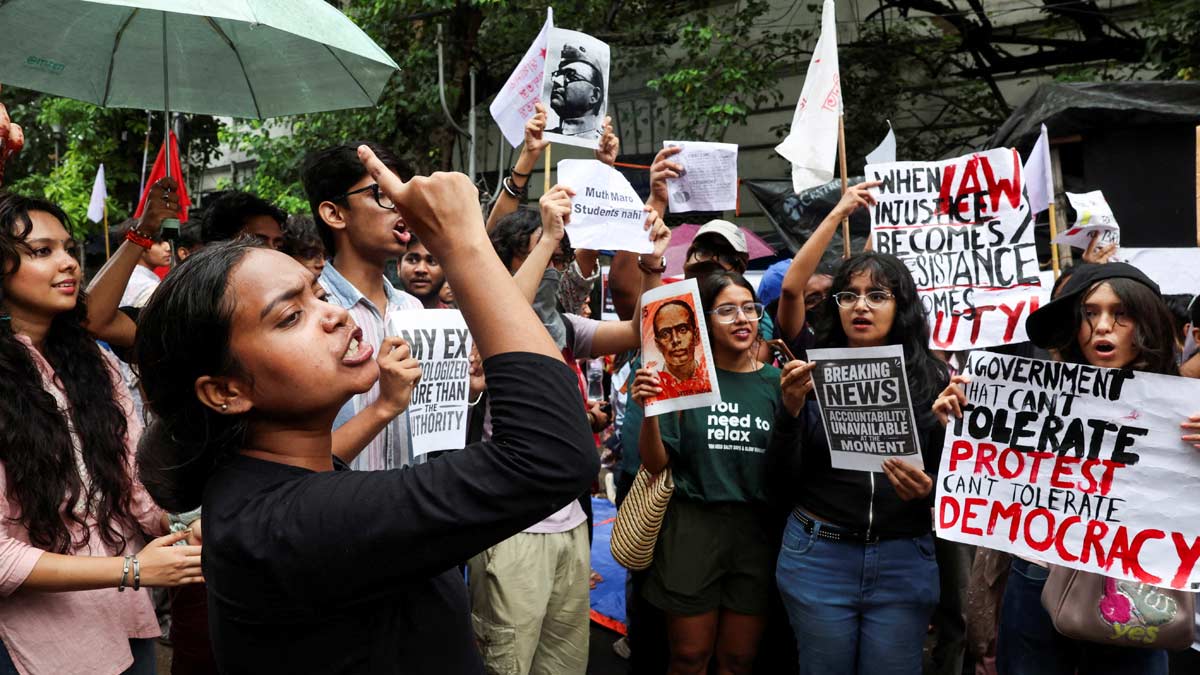
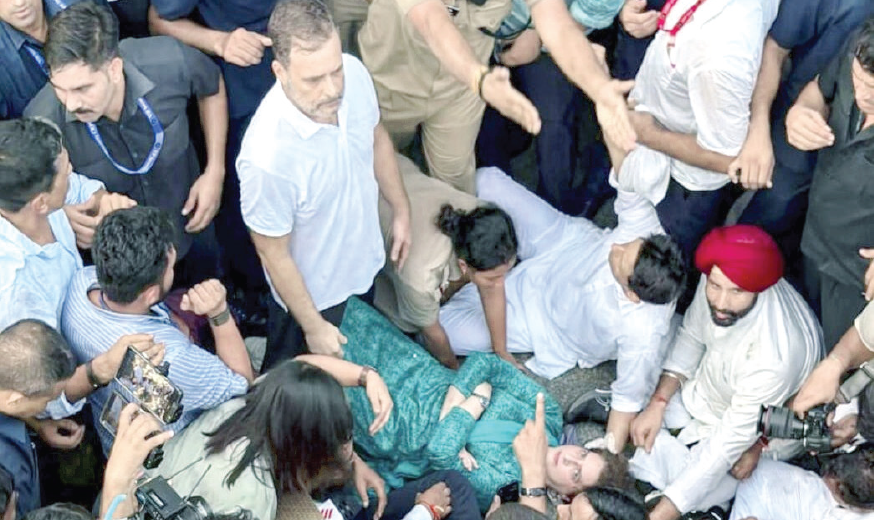
The problem goes beyond an administrative error if the claims about how the police in Delhi's Jantar Mantar treated women and students are validated. It turns into an examination of the ethical legitimacy of Indian democracy. Any democratic institution is best examined when it encounters unarmed civilians rather than armed adversaries. Bullets do not leave the deepest scars on democracies; rather, it is when people start to feel that their opinions are being silenced by force rather than being respectfully heard. Such occurrences throw long-lasting shadows on a country's democratic culture, public trust, and institutional credibility—they don't just make headlines for a day.
In every such case, an unbiased investigation, accountability, and the establishment of truth are not just calls for justice; they are necessary to maintain democracy's validity and dignity. A democracy's strength is determined by how fairly, justly, and with dignity it handles even its most outspoken opponents, not by how many batons it has.
In the end, the question goes much beyond any particular episode. It concerns how the police will be perceived by future generations—as defenders of constitutional rights or as tools of repression. History remembers a country's character rather than how many uniforms it had. Wisdom must come before every baton, the rule of law must come before every command, and human dignity must come before every use of force if the words of our Constitution—"We, the People of India"—are to continue to be a living principle rather than a ceremonial phrase. Because when people trust the government rather than fear it, democracy has achieved its ultimate success.
The uniform's actual identity is found in the wisdom it exercises rather than the baton it carries. Its honour comes from inspiring confidence rather than instilling fear. The public's trust in the police is their greatest asset, not their weaponry. The uniform becomes nothing more than a piece of cloth once that faith is lost, but it becomes democracy's most reliable defence when that trust persists. The moral authority of the police will start to return the day they start to view every person as a citizen with constitutional rights rather than as a subject to be ordered.



[[comment.comment_text]]