From Jantar Mantar to Lok Kalyan Marg: Opposition Brought Student Rage to Power’s Doorstep

 2 months, 2 weeks ago
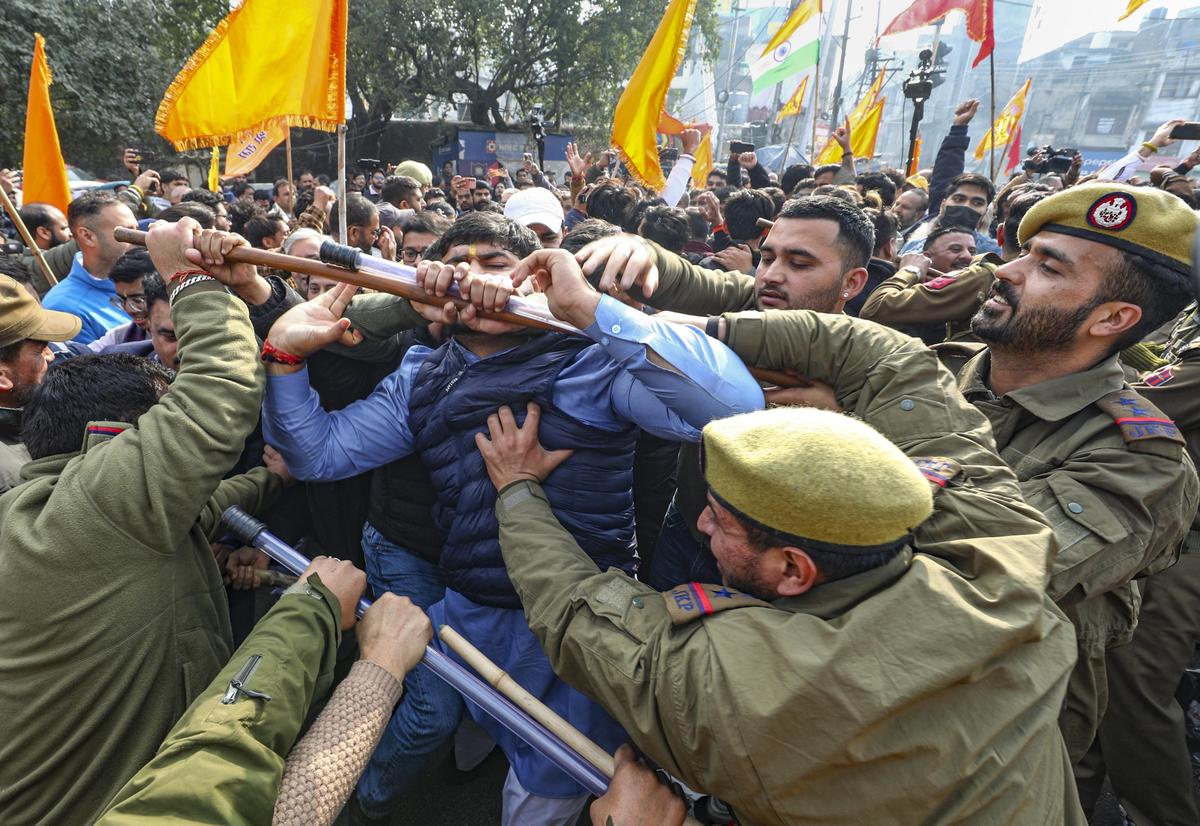
There are moments in the life of a democracy when symbolism becomes substance, when a single image encapsulates the moral crisis of an age. Rahul Gandhi’s impromptu march to 10, Lok Kalyan Marg on 21 July 2026, accompanied by Priyanka Gandhi Vadra and fellow Congress leaders, was one such moment. It was not merely a protest. It was an attempt to carry the anguish of thousands of students from the barricaded streets of Jantar Mantar to the very gates of executive power.
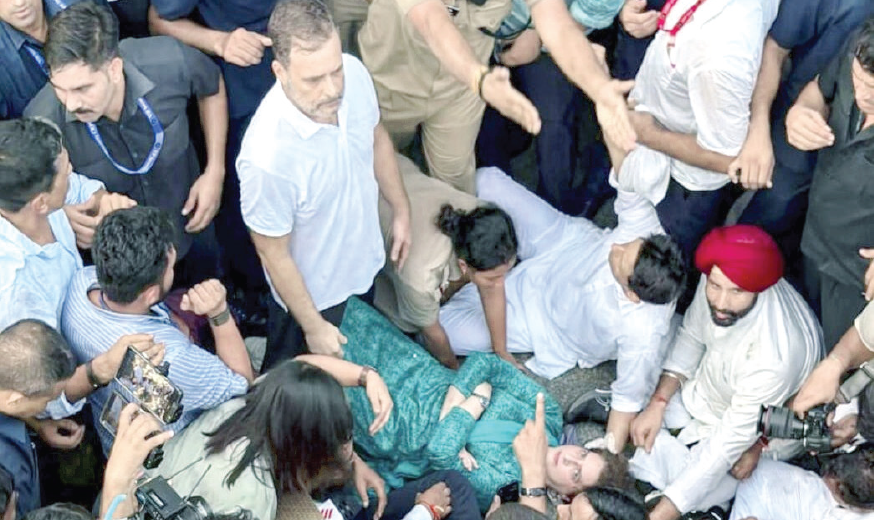
The images that emerged from Delhi that afternoon will outlive the news cycle. The Leader of the Opposition dragged across the road by the Delhi Police, his nose bleeding after being manhandled; Priyanka Gandhi pushed into a police vehicle; Members of Parliament detained alongside ordinary students—these scenes transformed what had begun as a students’ movement against examination corruption into a national indictment of the government’s increasingly coercive political culture.
Ironically, the state achieved precisely what it had sought to prevent. By choosing brute force over dialogue, it gave the movement a renewed moral legitimacy and a national resonance that speeches alone could never have produced.
When Parliament Falls Silent, The Streets Begin to Speak
The crisis did not begin with Rahul Gandhi’s march.
For over two months, he had relentlessly demanded the resignation of Union Education Minister Dharmendra Pradhan over the NEET-UG controversy, repeatedly raising questions about corruption, institutional collapse and accountability within India’s examination system. His “Chhatron Ki Goonj” rallies in Kota and Dehradun were not isolated political events but sustained attempts to convert student anxiety into a national political conversation.
Yet Parliament remained unresponsive.
Repeated demands for a full discussion were frustrated. Appeals for ministerial accountability were brushed aside. The government insisted that arrests had been made and the guilty would be punished, while avoiding the larger question: how had one of India’s most consequential public examinations descended into such a crisis of credibility?
When democratic institutions refuse to hear the voices outside their walls, the streets inevitably become the nation’s alternative Parliament.
That is precisely what happened.
The Brutality That Changed The Movement
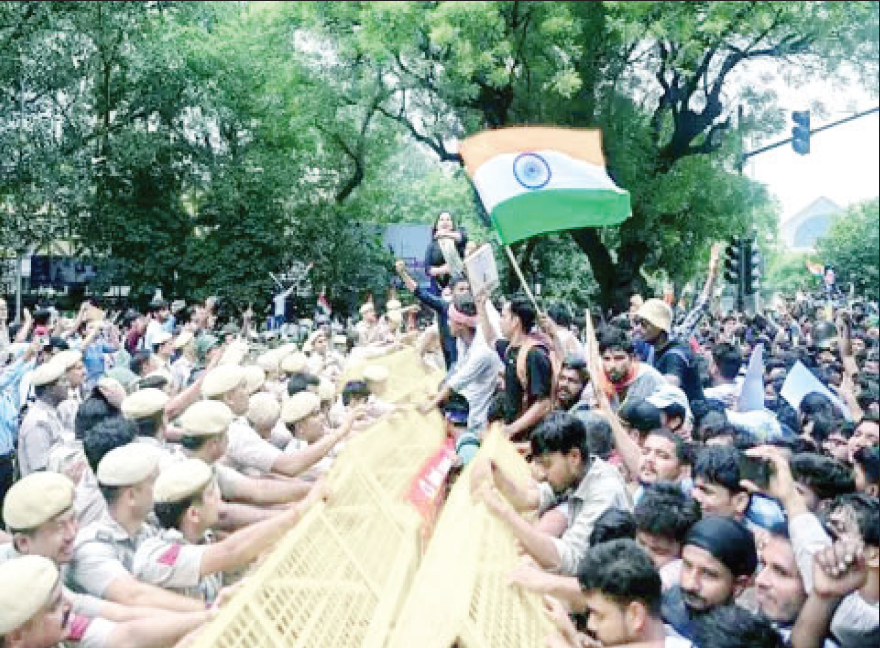
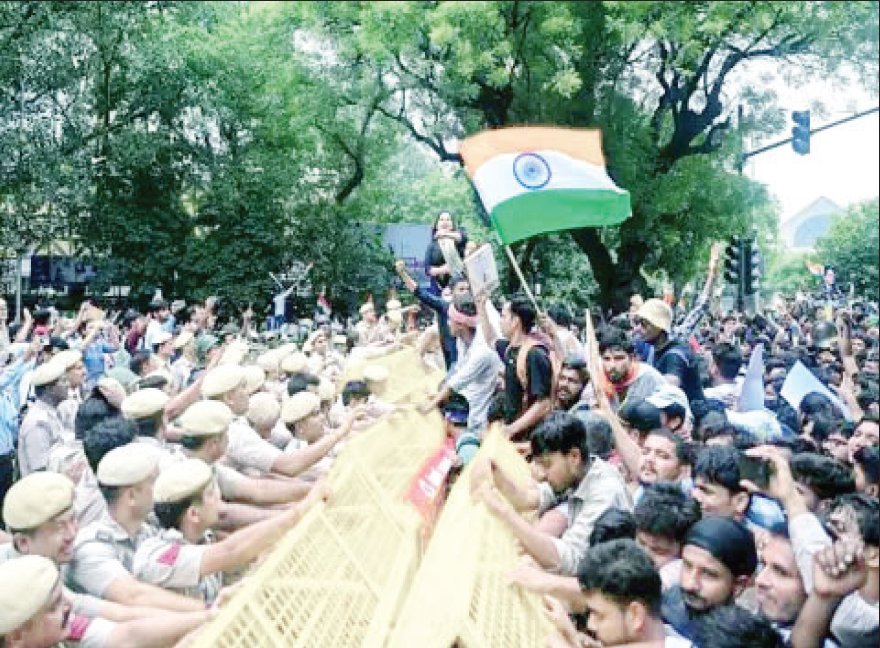
The police assault on protesting students at Jantar Mantar and Parliament Street on 20 July altered the trajectory of the agitation.
Young men and women demanding transparency and accountability suddenly found themselves confronting batons, detentions and barricades rather than dialogue. Instead of calming public anger, the crackdown deepened it.
Three days later, Rahul Gandhi took the protest directly to the Prime Minister’s residence.
The destination mattered.
It signified that the responsibility for the crisis could no longer be confined to a single ministry. By demanding not merely Dharmendra Pradhan’s resignation but also political accountability from the Home Minister and the Prime Minister for the violence inflicted upon peaceful demonstrators, the Congress fundamentally reframed the issue.
The question was no longer simply about examination malpractice.
It became a question about the character of the Indian State itself.
“Deep jis ka mehllaat hi mein jaley…” (“A lamp that shines only upon palaces… Such a system, such a lightless dawn, I refuse to accept.”)
Pakistani Urdu poet Habib Jalib wrote these immortal lines against authoritarianism masquerading as order during General Zia-ul-Haq’s regime (1977-1988).
They resonate with unsettling relevance today.
A democracy cannot illuminate only the corridors of power while leaving its universities, classrooms and examination halls in darkness. A government that speaks endlessly of demographic dividend cannot simultaneously criminalise the aspirations of its youth.
When students demanding fairness are dragged across the streets while those politically convenient to the establishment often receive accommodation and space, uncomfortable questions inevitably arise about the selective exercise of state power.
Equal citizenship cannot coexist with unequal policing. Selective tolerance gradually erodes constitutional morality.
The Politics Of Shared Vulnerability
Perhaps the most remarkable aspect of Rahul Gandhi’s intervention was not the protest itself but the manner in which he dissolved the visible distance between political leadership and ordinary citizens.
For years, Indian politics has increasingly become an exercise in spectacle—leaders speaking from elevated platforms while citizens remain passive audiences.
Delhi witnessed something different. Rahul Gandhi sat where no opposition leader sat before.
He faced the same barricades that the students faced at Jantar Mantar. He was dragged away by the same police personnel.
He entered custody not as a distant parliamentarian issuing statements but as another protester confronting state authority.
Politics thrives on symbolism, but symbolism becomes powerful only when accompanied by personal risk. The government may have intended the arrest to demonstrate authority.
Instead, it projected vulnerability—not of Rahul Gandhi, but of a government seemingly unwilling to tolerate peaceful dissent even outside the gates of its own residence.
A Leader Who Refused To Make Himself The Story
Perhaps the most revealing moment came not during the police action itself but in its aftermath. When a journalist observed that this was the first occasion in the history of independent India when a Leader of the Opposition had been dragged across the road by the police, Rahul Gandhi’s response carried a moral force that far exceeded the dramatic visuals of his arrest.
“How I was treated is irrelevant to me,” he said. “I don’t care. Treat me five times worse. I don’t care. The focus has to be on what was done to the students.”
Those few sentences transformed the political meaning of the episode. At a time when contemporary politics often revolves around personalities and carefully curated victimhood, Rahul Gandhi consciously declined to make himself the centre of attention. He refused to convert his injuries into political capital. Instead, he redirected the nation’s gaze towards the thousands of young protesters who had first endured police batons, barricades and arrests simply for demanding fairness, transparency and accountability in India’s education system.
That response elevated the movement beyond party politics. His bleeding nose ceased to be the defining image of the day; it became instead a symbol of the violence inflicted upon an entire generation whose aspirations had collided with an increasingly intolerant State. By refusing to personalise the confrontation, Rahul Gandhi reaffirmed that the struggle was never about one political leader but about the rights and dignity of India’s students.
In that brief exchange lay the essential distinction between political theatre and political solidarity. One seeks sympathy for itself; the other insists that the spotlight remain firmly on those whose voices power has sought most desperately to silence.
The Limits of Fear
Every authoritarian project ultimately rests upon a single political assumption—that fear can indefinitely silence dissent.
Citizens are expected to internalise the belief that resistance is futile. Students are meant to conclude that questioning authority carries an unbearable price. Opposition leaders are expected to retreat before the coercive power of the State. Fear, in such a system, ceases to be merely an instrument of governance; it becomes the governing principle itself.
Yet history has rarely been kind to governments that mistake coercion for consent. There comes a defining moment in every democratic struggle when repression begins to undermine the very authority it seeks to preserve. Every baton charge, every arbitrary arrest and every attempt to criminalise peaceful protest weakens not the resolve of those on the streets but the moral legitimacy of those who command the machinery of the State. What is intended as an exhibition of strength gradually comes to be recognised as an admission of political insecurity.
Delhi appears to have reached precisely such a moment.
The brutal police action against students on 20 July, followed by Rahul Gandhi’s impromptu march to 10, Lok Kalyan Marg and the dramatic spectacle of the Leader of the Opposition being dragged away alongside fellow parliamentarians, has not weakened the movement; it has fundamentally transformed it. What began as an agitation against examination malpractice and institutional corruption has now evolved into a broader democratic resistance against executive arrogance, police excesses, shrinking constitutional freedoms and the systematic silencing of dissent.
Rather than intimidating the nation into submission, the government’s heavy-handed response has infused the movement with fresh energy, moral legitimacy and unprecedented public sympathy. Students demanding examination reforms increasingly find themselves joined by citizens who recognise that the battle is no longer confined to NEET or educational accountability. It is about the future of democratic institutions themselves.
Every mass movement reaches a point where fear changes sides.
Delhi may well prove to have been that turning point.
For the greatest paradox confronting every authoritarian regime is this: repression may secure temporary obedience, but it can never manufacture legitimacy. Once fear ceases to intimidate and begins instead to inspire solidarity, the architecture of coercion starts to crack under the weight of its own excesses.
Read in this light, Rahul Gandhi’s arrest was not the culmination of the protest but its political rebirth. By attempting to crush a peaceful demonstration through force, the government inadvertently elevated a students’ agitation into a nationwide democratic movement. The road from Jantar Mantar to Lok Kalyan Marg may have been sealed with barricades, but the road from public anger to collective resistance has become immeasurably wider—and infinitely harder to block.
A Government Confronting Its Own Reflection
Governments frequently underestimate the political consequences of excessive force.
Barricades may prevent marches from reaching official residences, but they cannot prevent images from reaching millions of homes.
The visual memory of a bleeding Leader of the Opposition being dragged across the road will likely endure longer than official press releases explaining police procedure.
Power often mistakes physical control for political legitimacy.
The two are not identical.
History is replete with governments that successfully dispersed demonstrations while simultaneously strengthening the movements they sought to suppress. Every baton raised against peaceful dissent ultimately raises another question before the nation: what precisely is the government afraid of?
Beyond A Protest, Towards A Democratic Reckoning
Whether Rahul Gandhi’s intervention yields immediate political dividends remains uncertain. But politics is rarely transformed by immediate outcomes. It is transformed by moments that alter public imagination. The march to Lok Kalyan Marg accomplished precisely that.
It shifted the national conversation from an administrative scandal to a constitutional question.
It transformed students from isolated victims into participants in a broader democratic struggle.
And it reminded the country that opposition politics derives its legitimacy not merely from parliamentary speeches but from the willingness to stand where citizens stand when institutions fail them.
The struggle that began over examination integrity now speaks to something far larger: the future of democratic accountability itself.
Habib Jalib’s words continue to echo across generations because they articulate a timeless truth:
“Main bhi khaif nahin takht-e-dar se…Zulm ki baat ko, jahl ki raat ko,
Main nahin maanta, main nahin jaanta.”
(“I am not afraid of the gallows… The language of oppression, the darkness of ignorance—I refuse to accept.”)
That refusal is the first principle of every democratic resistance.
Democracies rarely collapse in one dramatic moment. They are weakened gradually through the normalisation of silence, intimidation, selective justice and the criminalisation of dissent.
Against such erosion, every peaceful act of resistance acquires constitutional significance. And every attempt to crush that resistance risks becoming the very spark that carries it further.
The road from Jantar Mantar to Lok Kalyan Marg may have been blocked by barricades. The road from public outrage to a nationwide democratic movement, however, appears far more difficult to obstruct.
(Hasnain Naqvi, a former member of the history faculty at St. Xavier’s College, Mumbai, is a known commentator on democracy, diversity, and dissent. Views are personal.)


[[comment.comment_text]]