Democracy Under Administrative Siege: The Election Commission's Unanswered Questions

 an hour ago
Millions of disputed electoral appeals in West Bengal, glaring errors in Uttar Pradesh's voter lists and complaints by two Election Commissioners expose a disturbing deficit of transparency, administrative competence and institutional accountability.
Democracy is not compromised only when votes are manipulated or polling is disrupted. It can be undermined much earlier—when eligible citizens find their voting rights entangled in opaque administrative procedures, when electoral records are riddled with elementary errors, and when those entrusted with protecting electoral integrity cannot demonstrate accountability within their own institution.
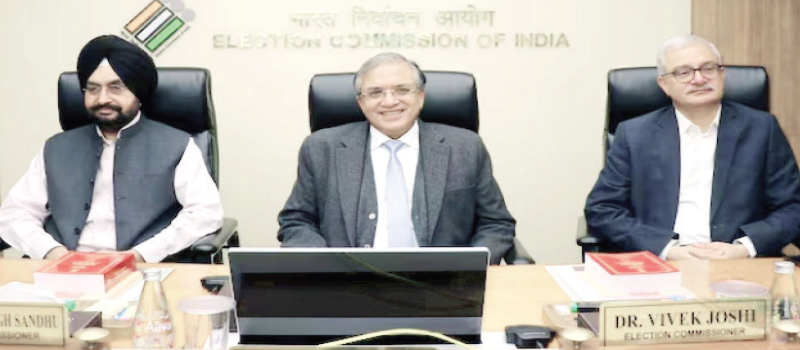
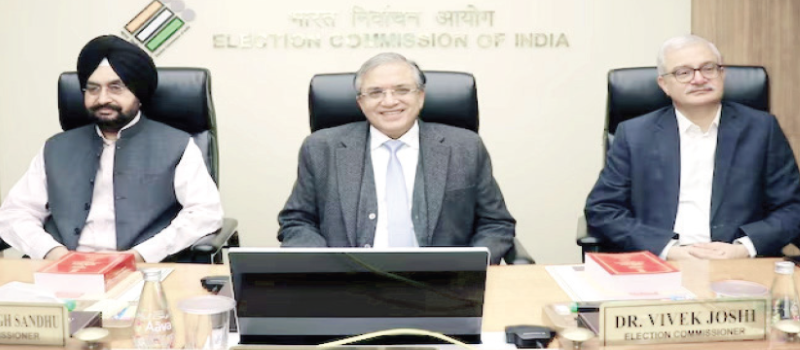
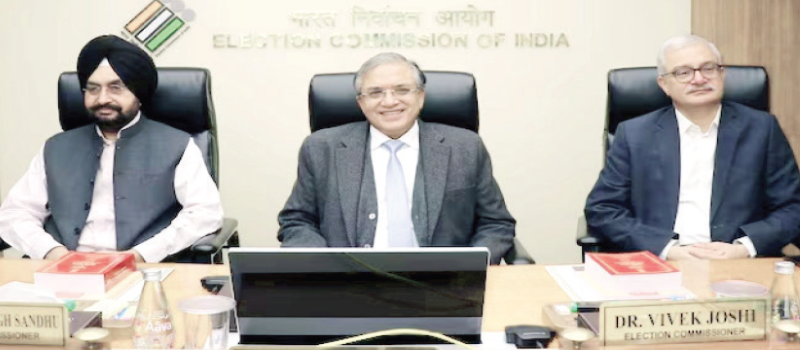
Several developments in 2026 have brought these concerns into sharp focus. In West Bengal, records have emerged of appeals challenging the inclusion of more than 1.6 million voters whom judicial officers had already deemed eligible. In Uttar Pradesh, extraordinary errors in electoral rolls have exposed deficiencies in digital data conversion and official verification. Meanwhile, Election Commissioners Sukhbir Singh Sandhu and Vivek Joshi have formally complained to the Union Government about administrative decisions taken by a senior official within the Election Commission of India (ECI).
These are separate developments, and no established evidence demonstrates a direct connection between them. Yet their institutional implications converge on one uncomfortable question: is India's electoral machinery sufficiently accountable to protect the democratic rights it is constitutionally entrusted to safeguard?
The Election Commission's responsibility extends far beyond conducting polling and announcing results. It must ensure that electoral rolls are accurate, objections are fairly adjudicated, administrative decisions are transparent and eligible citizens are not subjected to arbitrary uncertainty. When these elementary obligations are compromised, the damage is not merely bureaucratic. It strikes at the credibility of the electoral process.
West Bengal: 1.6 million appeals and an extraordinary administrative question
The controversy surrounding West Bengal's Special Intensive Revision (SIR) of electoral rolls demands particular scrutiny.
Ahead of the 2026 Assembly election, 6,006,675 voters were referred for examination by judicial officers, according to Election Commission data and documents compiled by researchers. Of these, 3,277,360 were deemed eligible to remain on the electoral rolls, while 2,728,500 were identified as ineligible.
The subsequent appeals process, however, has raised questions of extraordinary magnitude.
A report published by The Wire on 24 October 2026, based on documents gathered and verified by the Civic Research Group, identified appeals challenging the inclusion of 1,608,175 of the 3,253,401 voters whom judicial officers had declared eligible. That represents approximately 49.4 per cent of the eligible voters covered by the researchers' documentation.
The figure closely corresponds with the Commission's own disclosure. In information submitted to the Supreme Court in September, the ECI reported 1,610,311 appeals against inclusion—a difference of only 2,136 from the researchers' tally.
This is not an insignificant procedural anomaly. Nearly half the eligible voters covered by the records examined had apparently become the subject of appeals challenging their inclusion. The Commission cannot dismiss such a development as routine electoral administration.
To be clear, an appeal does not establish that a voter is ineligible, nor does it automatically invalidate an earlier judicial determination. But the extraordinary volume raises fundamental questions: who initiated these appeals, on what grounds, with whose authorisation and after what verification?
The questions become more serious when the timestamps embedded in the appeal identification numbers are examined.
According to The Wire, approximately 99 per cent of the appeals analysed carried timestamps corresponding to 5, 6 or 8 April 2026. More than 1.2 million reportedly bore the same date, 5 April.
The timing is particularly significant. The electoral roll was frozen at midnight on 7 April, while the first phase of polling took place on 23 April. The concentration of such a vast number of appeals within a few dates, immediately before the finalisation of the electoral roll, calls for a comprehensive technical explanation.
The researchers' analysis suggests that a substantial number of appeals may have been generated or uploaded in bulk rather than individually entered. Timestamps alone, however, cannot establish who directed the process, whether the appeals were independently scrutinised or whether the objections were genuine. Those questions require access to the Commission's technical logs, authorisation records and administrative files.
There is another, equally disturbing issue: what happened to the citizens whose inclusion was challenged? Were they individually notified? Were they given adequate time to respond? Could they inspect the objections and produce supporting documents? Was there a meaningful opportunity to be heard?
A procedure that allows challenges to a citizen's voting entitlement without guaranteeing effective notice and an opportunity to respond risks turning due process into a bureaucratic illusion.
The ECI must publicly explain the grounds of the appeals, identify the authorities responsible for initiating them, clarify the unusual concentration of timestamps and disclose how the affected voters were informed and how their cases were disposed of.
When millions of electoral entries are involved, silence is not an acceptable institutional response. The burden of transparency rests with the Commission, not with citizens or independent researchers seeking explanations.
Uttar Pradesh: technology cannot excuse administrative incompetence
A different but equally revealing failure emerged from Uttar Pradesh's electoral rolls for Legislative Council elections.
On 23 October 2026, reports exposed bizarre entries in the Allahabad Graduates' constituency roll. Some voters' names had been transformed into nonsensical sentences such as "Ram ne Yadav ko mara" and "Ram ne Sharma ko mara"—roughly, "Ram struck Yadav" and "Ram struck Sharma". In another instance, a voter's father's name appeared as "B.Com".
The entries might appear farcical. The administrative failure behind them is anything but amusing. Uttar Pradesh Chief Electoral Officer Navdeep Rinwa stated that 158 anomalous entries had been identified among 1,481,310 entries across five graduates' and six teachers' constituencies. Although statistically a small proportion, each error represents a failure to maintain an accurate official record of a citizen's identity.
The explanation offered by the Chief Electoral Officer's office points to deficiencies in digital conversion. Online registration and digital procedures had been introduced for the first time in compiling these rolls. Software designed to convert Roman-script names into Devanagari apparently translated certain words according to their meaning rather than reproducing their sounds. Thus, an entry such as "Ramhit Yadav", mistakenly separated into "Ram Hit Yadav", could be interpreted as a sentence about Ram striking Yadav.
But software cannot be made the convenient scapegoat for every administrative failure. The entry of "B.Com" in a father's name field was attributed to probable human error or negligence. Although editing and correction facilities existed, officials apparently failed to identify and rectify the mistakes before the final rolls were published.
Explanations were sought from the Electoral Registration Officers and Assistant Electoral Registration Officers concerned. District administrations were also instructed to ensure that eligible voters were not inconvenienced at polling stations because of erroneous entries.
Yet the fundamental question remains: why were these errors not detected before publication? Why should citizens bear the consequences of inadequate official supervision? And what
accountability follows when those entrusted with maintaining electoral records fail to discharge even elementary verification responsibilities?
Digitalisation is not synonymous with administrative modernisation. Technology without adequate testing, human supervision and quality control merely transfers old bureaucratic incompetence into a new technological format.
The Uttar Pradesh episode is distinct from the West Bengal controversy. One concerns defective data conversion and verification; the other concerns the scale and provenance of appeals against voters already found eligible. Nevertheless, both expose a troubling weakness: the machinery of electoral administration appears capable of generating vast quantities of official data without consistently demonstrating that the data are reliable.
Internal dissent: accountability within the Election Commission
The controversy extends beyond electoral rolls. In July 2026, two Election Commissioners, Sukhbir Singh Sandhu and Vivek Joshi, wrote separate letters to Cabinet Secretary T. V. Somanathan, raising objections to administrative decisions taken by Manish Garg, the Commission's Senior Deputy Election Commissioner.
According to documents subsequently obtained under the Right to Information Act, the letters, dated 29 July, concerned the redistribution of responsibilities among senior officials.
The matter arose when Bhanu Prakash Yeturu, Deputy Election Commissioner in charge of the administration wing, proceeded on leave. Garg was assigned additional responsibilities temporarily, from 27 July to 9 August. Within hours of assuming charge, however, he issued an order altering the distribution of work among Senior Deputy Election Commissioners, Deputy Election Commissioners, Directors General and officials of equivalent rank.
Sandhu and Joshi objected that these changes had been made without consulting the Commission or even informing its members.
Sandhu alleged that Garg had assumed responsibilities belonging to officials of equal or greater seniority, despite previous instructions that such changes required prior approval or consultation. He also referred to an earlier instance of similar administrative action. Sandhu argued that the decision was inconsistent with established institutional practice and raised questions under Section 18 of the 2023 legislation governing the service
conditions of the Chief Election Commissioner and other Election Commissioners. Joshi raised similar concerns. Particularly significant was his allegation that he had been denied access to the file concerning the redistribution of responsibilities, despite formally requesting it.
If substantiated, the allegations raise serious questions about internal administrative controls. How can Commissioners exercise meaningful oversight if decisions affecting the institution's senior administrative structure are taken without consultation? How can institutional accountability function if relevant files are not made available to those responsible for supervising the Commission?
The distinction between allegations and established findings must, of course, be preserved. The letters establish that two Commissioners formally raised objections; they
do not independently prove every allegation. The ECI subsequently stated that the disputed order had not been implemented and that arrangements concerning oversight of its Information Technology wing had not been withdrawn.
Nevertheless, non-implementation does not erase the questions surrounding the circumstances in which the order was issued. Institutional discipline requires more than withdrawing or shelving a contentious decision. It requires transparent procedures and an identifiable chain of responsibility.
What the RTI disclosures reveal
Commodore Lokesh K. Batra (retd) subsequently filed an RTI application on 24 September 2026, seeking copies of the Commissioners' letters, details of the action taken by the Cabinet Secretariat and relevant internal comments and file notings.
The documents revealed that the Cabinet Secretariat acknowledged receipt of the letters on 5 August. Copies were forwarded to relevant officials in the Department of Personnel and Training, the appointments establishment and the office of Chief Election Commissioner Gyanesh Kumar.
An internal note, however, introduced another important dimension. It observed that the two Commissioners had written in their individual capacities and that their correspondence could not be treated as an official communication from the Election Commission as a whole. It further cautioned that direct intervention in the internal affairs of a constitutional body might constitute interference in its functioning.
The decision was therefore to acknowledge the correspondence and forward it to the relevant offices rather than intervene directly.
The concern about protecting constitutional autonomy is legitimate. The Union Government must not use administrative authority to interfere with an independent constitutional institution. But autonomy must not become a shield for opacity. Independence from executive interference and accountability within an institution are complementary principles, not competing ones.
Section 18 of the 2023 Act provides that the Commission's business should, as far as possible, be conducted unanimously. Where the Chief Election Commissioner and the other Commissioners differ, decisions are to be taken according to the majority opinion.
The Wire has questioned the treatment of the two letters as individual communications when two members of a three-member Commission had raised objections concerning the same administrative matter.
There is, however, an important legal distinction: two separately written letters do not automatically constitute a formally adopted majority decision of the Commission. That would depend upon the applicable procedure and the relevant institutional records.
But the Cabinet Secretariat's response does not remove the need for clarity. The Commission must explain how such disagreements are formally considered, recorded and resolved. A constitutional institution cannot credibly demand public confidence while leaving questions about its own internal accountability unanswered.
Democracy cannot be administered through opacity
These three developments reveal different but deeply consequential weaknesses in India's electoral machinery. West Bengal raises questions about mass appeals against eligible voters. Uttar Pradesh exposes the consequences of defective digital processes and inadequate verification. The Commissioners' correspondence reveals tensions surrounding administrative authority, access to records and institutional oversight.
They should not be conflated, but neither should they be dismissed as isolated bureaucratic mishaps. There is a glaring asymmetry in an electoral system that demands documentary precision from ordinary citizens while struggling, in these instances, to demonstrate comparable precision within its own administrative processes. Citizens may be required to establish their identity, eligibility and entitlement through extensive documentation. The institutions responsible for maintaining those records must be held to an equally exacting standard.
The Election Commission's constitutional independence is indispensable. But independence does not confer immunity from scrutiny, just as administrative authority does not confer freedom from accountability. The greater the institution's responsibility, the greater its obligation to explain its decisions.
The ultimate test of electoral integrity is not merely whether polling takes place on schedule or whether results are declared without delay. It is whether every eligible citizen's right to vote is protected, every objection is fairly examined, every administrative error is corrected and every exercise of authority can withstand public scrutiny.
Democracy cannot survive on institutional prestige alone. It requires competent administration, transparent procedures and officials who understand that public authority is an obligation, not a privilege.
The Election Commission must therefore answer the questions raise by these episodes—not as a concession to critics, but as a fundamental duty to the electorate.
The credibility of an election begins long before the first vote is cast. And when the machinery entrusted with protecting the ballot becomes a source of uncertainty, the institution itself must answer for the failure.
(A well-recognised Delhi-based author and commentator, is a regular TEW columnist on politics, culture, and sports.)





[[comment.comment_text]]