When Democracy Is Tested, the Constitution Must Speak

 2 months, 2 weeks ago
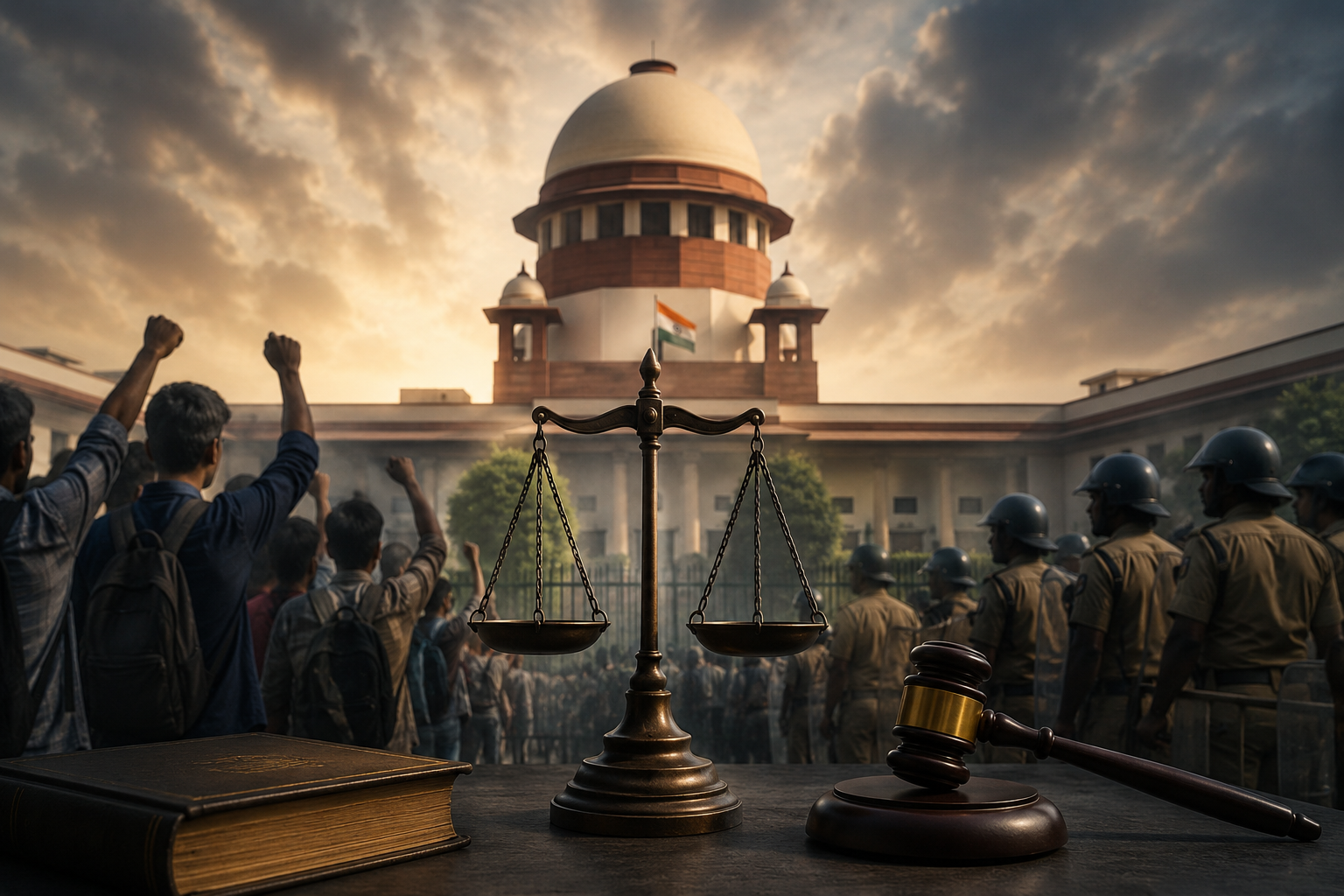
The Supreme Court’s observations today in the students’ protest case amount to far more than an interim judicial order. They represent a reaffirmation of the Constitution’s enduring promise that justice must be founded on truth, fairness and due process—not on assumptions, competing political narratives or executive assertions. By indicating the need for a fair and independent investigation into allegations of injuries sustained by both students and police personnel, and by expressing its inclination to constitute a Special Investigation Team headed by a former Supreme Court Judge, the Court has reminded the nation that constitutional democracy derives its legitimacy from impartial institutions capable of discovering the truth without fear or favour.
The events surrounding the nationwide student protests have deeply polarized public discourse. Allegations and counter-allegations have dominated the public space, leaving citizens to choose between competing versions of events. In such a charged atmosphere, the judiciary assumes its most vital constitutional role. Constitutional courts are not merely arbiters of legal disputes; they are guardians of fundamental rights, protectors of institutional accountability and custodians of the rule of law. Today’s proceedings demonstrate the Supreme Court’s determination to ensure that neither the grievances of citizens nor the conduct of the State remains beyond judicial scrutiny. That balanced constitutional approach alone can restore public confidence in democratic institutions.
The Court’s observations also carry a larger constitutional message. Democracies do not weaken because citizens protest; they weaken when institutions fail to respond to dissent with fairness, restraint and accountability. The true strength of a Republic lies not in its ability to suppress disagreement but in its confidence to accommodate diverse opinions within the framework of the Constitution. India’s constitutional architecture was deliberately designed to provide peaceful and democratic avenues for expressing dissent. Protest, debate and criticism are not signs of instability; they are manifestations of a vibrant constitutional culture.
Student movements have always occupied a distinctive place in India’s democratic evolution. From the freedom struggle to campaigns for social justice, transparency and institutional reform, young Indians have repeatedly emerged as catalysts for national transformation. The Constitution guarantees every citizen the freedoms of speech, expression and peaceful assembly under Articles 19(1)(a) and 19(1)(b), subject only to reasonable restrictions. These freedoms are not concessions granted by the State; they are constitutional guarantees forming part of the basic democratic compact between the citizen and the Republic.
History demonstrates that many of India’s most significant democratic reforms have been preceded by youth-led movements that questioned existing structures while remaining committed to constitutional ideals. Young citizens often become the nation’s conscience, compelling governments to introspect, correct mistakes and pursue more responsive governance. Their participation strengthens democracy, provided it remains peaceful and within the bounds of law.
At the same time, constitutional liberty carries corresponding constitutional responsibility. Every protest must remain peaceful, respect public property, uphold the rights of fellow citizens and reject violence in every form. Equally, the State bears a higher constitutional obligation because every exercise of governmental power must satisfy the tests of legality, proportionality and fairness. The constitutional response to peaceful dissent cannot be excessive force or indiscriminate criminalisation. Democracy demands restraint from those who govern as much as responsibility from those who protest.
The Supreme Court’s emphasis on investigating injuries suffered by both students and police personnel is particularly significant. Justice cannot be selective, nor can accountability be one-sided. If students were subjected to disproportionate force, those responsible must be held accountable in accordance with law. Equally, if police officials were unlawfully assaulted while discharging their duties, the law must respond with equal firmness. Constitutional governance rests upon the principle of even-handedness, not selective outrage. The credibility of the justice system ultimately depends upon its ability to protect rights while enforcing responsibilities without fear or favour.
Equally important is the Court’s recognition that an independent investigation is indispensable where public confidence has been shaken. In constitutional democracies, justice must not only be done but must also be seen to be done. An inquiry headed by an independent authority commands far greater public trust than one conducted by agencies whose impartiality may itself become a subject of controversy. Transparency and institutional credibility are not procedural luxuries; they are essential ingredients of democratic legitimacy.
The present controversy should also become an opportunity for governments to reconsider how they engage with India’s youth. Dialogue is invariably a more enduring instrument of democratic governance than confrontation. Universities must continue to remain spaces where ideas can be debated freely, differences expressed peacefully and democratic values nurtured. Governments, in turn, must distinguish between peaceful constitutional dissent and genuine threats to public order. Resorting prematurely to coercive measures risks alienating an entire generation that seeks participation, inclusion and accountability rather than suppression. A confident democracy does not fear questioning voices; it listens, engages and persuades.
The episode also calls for institutional reforms. India would benefit from clear national protocols governing the policing of peaceful assemblies, crowd-control measures consistent with constitutional norms, mandatory video recording of major protest-management operations, prompt medical assistance to all injured persons and independent mechanisms for examining allegations of excesses by any side. Such measures would strengthen both civil liberties and public order, demonstrating that constitutional governance is capable of balancing liberty with security.
Ultimately, the Supreme Court’s intervention may become a defining moment in the evolving jurisprudence of democratic dissent in India. By insisting upon an independent fact-finding process, the Court has reinforced public faith in the rule of law and reaffirmed its role as the sentinel on the qui vive—the vigilant guardian of constitutional liberties. Whatever the eventual outcome of these proceedings, one message already stands out with unmistakable clarity: constitutional democracy flourishes when justice is impartial, institutions remain accountable and the rights guaranteed by the Constitution are protected without discrimination.
At a time when democratic societies across the world are confronting increasing political polarisation, India’s constitutional institutions must continue to inspire confidence through independence, fairness and fidelity to the rule of law. The Supreme Court’s intervention serves as a reminder that the Constitution remains the nation’s ultimate compass. Governments may command majorities, political movements may command public attention, but it is the Constitution that commands enduring legitimacy. Whenever democracy is tested, it is the Constitution that must speak—and the Supreme Court has once again ensured that its voice is heard.
(The author is a noted Senior Advocate, Supreme Court of India.)






[[comment.comment_text]]