Beyond the Protest

 2 months, 2 weeks ago
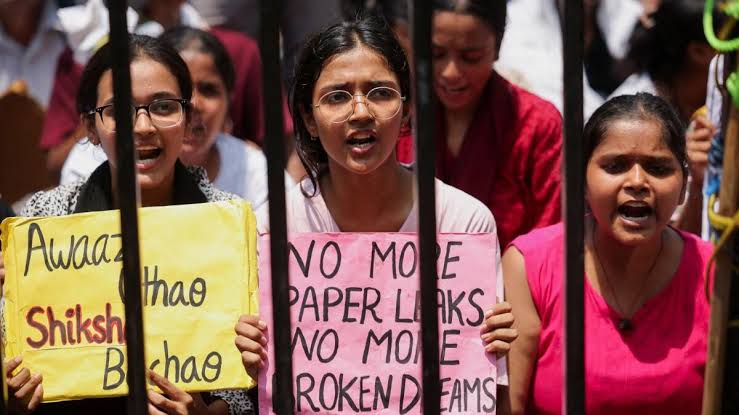
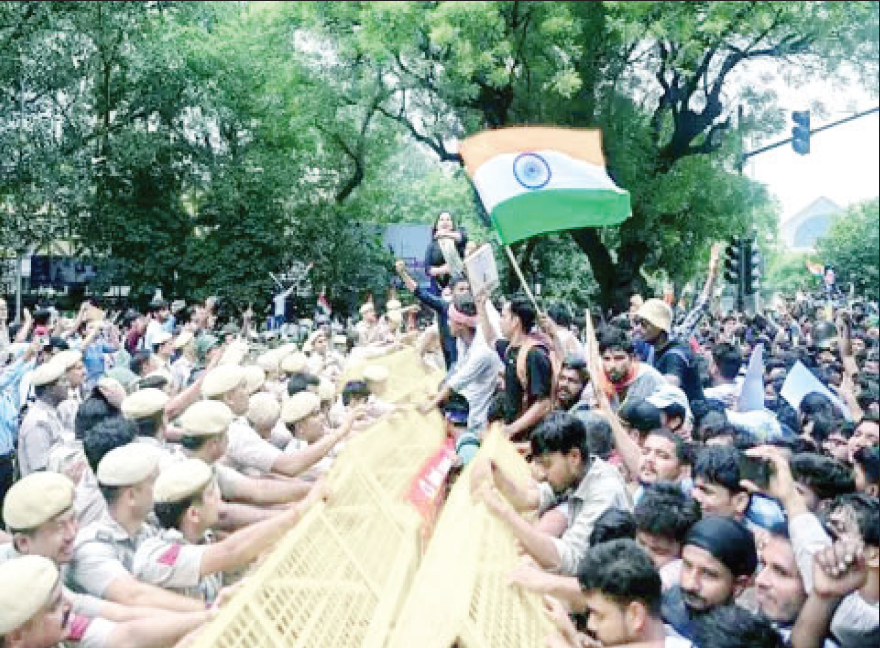
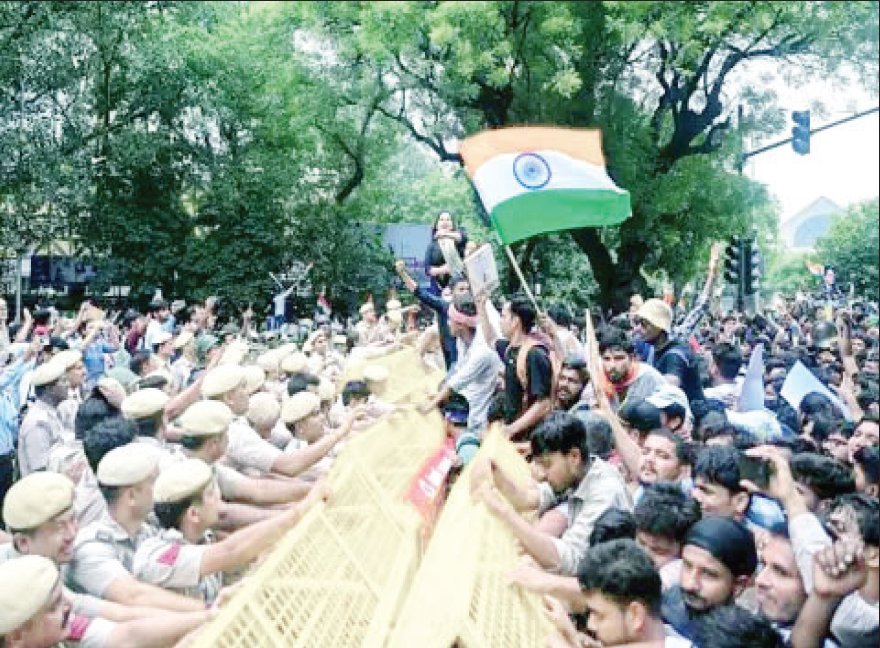
The government's decision to finally engage with the student agitation over examination irregularities marks far more than the end of a prolonged protest. It represents an acknowledgment that the issue had outgrown the boundaries of an administrative controversy and evolved into a crisis of public confidence. The resignation of the Education Minister, the decision to strengthen the Public Examinations (Prevention of Unfair Means) Act and the agreement reached with the protesters all point towards one unmistakable conclusion: the Centre recognized that allowing the agitation to continue unchecked would carry consequences extending well beyond the education sector. A movement that began with students demanding fairness in examinations had the potential to transform into a much broader political confrontation.
Every democracy witnesses moments when governments must choose between waiting for public anger to subside and addressing its underlying causes. In this case, delay carried considerable risks. Student movements possess a unique moral legitimacy because they are usually driven by aspirations rather than political ambitions. However, history also teaches that whenever a movement commands widespread public sympathy, political forces inevitably enter the scene. Opposition parties see an opportunity to challenge the government, activist groups seek to expand their influence and ideological organizations attempt to shape the narrative according to their own objectives. This is neither unusual nor unique to India; it is an inherent feature of democratic politics. The longer a movement continues without resolution, the greater the likelihood that its original purpose becomes intertwined with larger political battles.
The NEET controversy became particularly significant because it was never fundamentally about politics. At its heart was a question that resonated with millions of ordinary families across the country: Can India's examination system still guarantee fairness? Every year, millions of students dedicate years of their lives preparing for competitive examinations. Their parents spend substantial portions of their savings on coaching institutes, books, accommodation and travel, believing that hard work and merit will ultimately determine success. When repeated allegations of paper leaks, organized cheating, impersonation, delayed investigations and administrative failures begin to surface, that belief starts to weaken. Once students begin questioning whether the system rewards merit or manipulation, the problem ceases to be administrative—it becomes institutional.
That explains why the movement rapidly gained public sympathy. Unlike many agitations that remain confined to specific regions, communities or political ideologies, this issue touched almost every Indian household. Whether the examination involved NEET, JEE, UPSC, SSC, banking recruitment or state-level competitive tests made little difference. The underlying concern remained identical. Parents worried that years of sacrifice could be rendered meaningless by organized examination fraud, while students feared that honest preparation might no longer be enough. Public support emerged not because people wished to strengthen any political party or endorse any individual activist, but because they saw the issue as directly connected to the future of their own children.
Today's youth, often described as Generation Z, brought a distinctive character to this movement. They are perhaps the most digitally connected generation India has ever seen. They organize rapidly, communicate instantly and express themselves with remarkable confidence. Social media allows them to transform local grievances into national conversations within hours. This digital strength has empowered young people in unprecedented ways. At the same time, youth naturally carries a degree of impatience and emotional intensity. Every generation, irrespective of the era in which it lived, has possessed abundant energy before acquiring extensive experience. That is neither a weakness nor a criticism; it is simply the nature of youth. Precisely for this reason, leadership becomes indispensable during mass movements. Energy creates momentum, but leadership provides direction. Without responsible leadership, even movements born from genuine public concerns can lose focus, become fragmented or unintentionally create space for groups pursuing entirely different agendas.
One of the most remarkable aspects of this agitation was that students were not rallying behind a particular political ideology or personality. For the overwhelming majority of participants, the identity of political parties or public figures was secondary. What mattered was the demand for a transparent, accountable and credible examination system. Yet, as often happens in public life, various organizations and individuals attempted to associate themselves with the movement once it gathered national attention. Competing claims of political ownership are inevitable in a democracy. Governments portray reforms as evidence of responsive governance. Opposition parties argue that sustained pressure compelled those reforms. Activists emphasize the role of civil society. While each narrative may contain elements of truth, none should distract from the larger reality. The central issue was never about who would receive political credit. It was about whether India's education system could restore the confidence of millions of students.
The government's eventual response suggests that it understood both the administrative and political dimensions of the crisis. Strengthening the law, proposing fast-track courts and prescribing stricter punishment for organized examination offences are undoubtedly significant steps. However, legislation alone cannot rebuild public trust. The credibility of examinations depends equally upon secure digital infrastructure, encrypted question paper management, institutional accountability, independent oversight, transparent investigations and swift judicial processes. If these structural reforms are implemented effectively, the proposed amendments could become an important milestone in protecting the integrity of public examinations. If they remain confined to legislative intent, public skepticism will persist.
This episode also offers a broader lesson for Indian democracy. Public movements succeed not merely because they mobilize large crowds, but because they maintain clarity of purpose. History consistently demonstrates that movements with responsible leadership are better equipped to negotiate reforms, preserve discipline and conclude with tangible achievements. Leaderless crowds, on the other hand, are inherently vulnerable. Without accountability, misinformation spreads more easily, emotions overshadow strategy and external interests find opportunities to redirect public anger toward objectives unrelated to the original cause. Leadership is therefore not simply about leading protests; it is about safeguarding the legitimacy of those protests.
Ultimately, the examination crisis has reminded India of an uncomfortable but essential truth. In a country where competitive examinations determine educational opportunities, government employment and social mobility for millions, public trust is the foundation upon which the entire system rests. Once that trust is compromised, rebuilding it requires far more than ministerial changes or political agreements. It demands sustained institutional reform, administrative integrity and unwavering accountability.
The government's intervention may have come later than many students expected, but it has created an opportunity that should not be wasted. If the proposed legal reforms are accompanied by meaningful administrative changes and consistent enforcement, this crisis may eventually be remembered as the moment when India strengthened the credibility of its examination system. If not, the resignation of a minister and the passage of another law will merely become temporary political events, while the deeper crisis of confidence will continue to haunt millions of young Indians whose future depends on nothing more—and nothing less—than a fair chance.



[[comment.comment_text]]