De-siloing Administrative Tribunals Appointments
 an hour ago
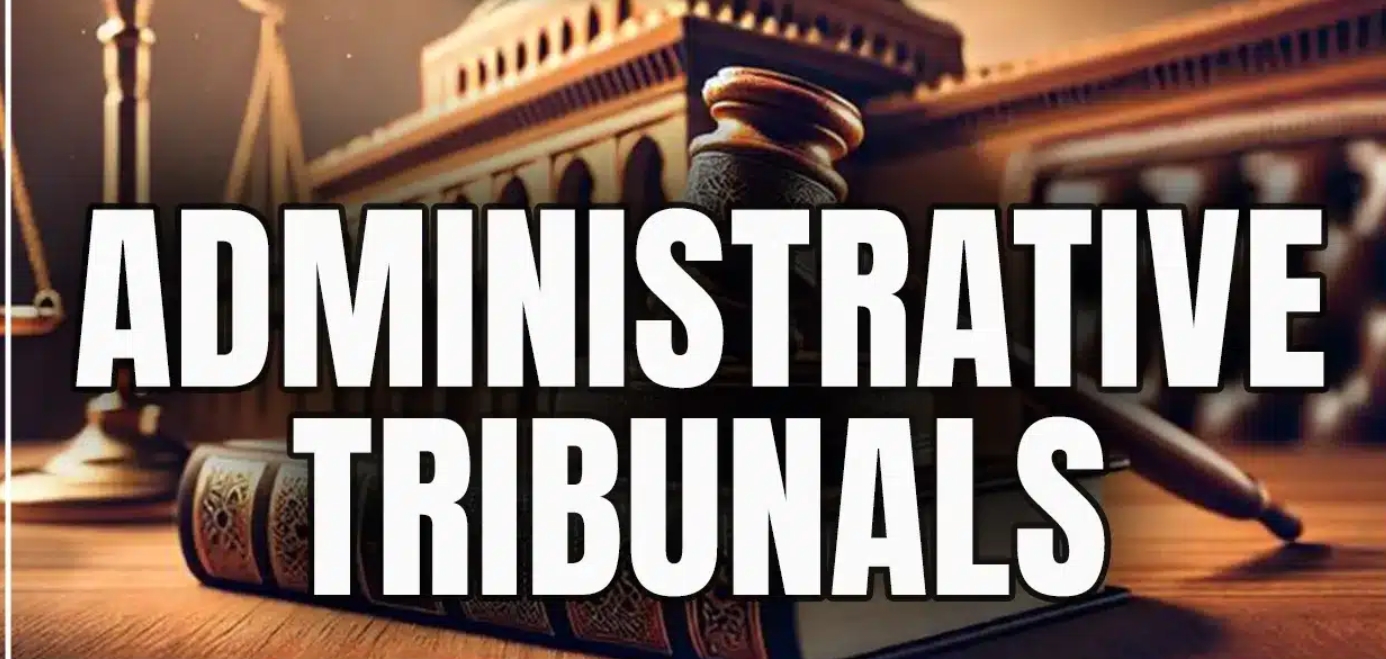
As a country we move ahead on the path of democratic governance since independence and adopted the British system of parliamentary form of governance. Since then, we had amended the constitution for more than 100 times as and when required to meet the changing aspiration of the society. As the population and governance paraphernalia grew over the years the judicial system became overburdened with massive pendency of employees service related cases in the High Courts, a need was felt to create Tribunals in the India’s administrative justice system so as to combine legal expertise with practical experience in governance and reduce the pendency. This was the rationale behind the creation of Central Administrative Tribunals (CATs) under the Administrative Tribunals Act, 1985 so that quick justice is dispensed with. Several other tribunals were also set up in many sectors like Income Tx, Telecom, Civil aviation, Armed forces etc. These tribunals were expected to provide speedy and informed decisions on service matters affecting government employees. Similarly State Administrative Tribunals (SAT) were also set up in many states to reduce the burden of High Courts.
Though the CAT’s the appointments have become broad based as administrative members are drawn from many civil services, however, over the years, a curious imbalance has emerged in the composition of State Administrative Tribunals (SATs). While the Constitution recognizes three All India Services—the Indian Administrative Service (IAS), Indian Police Service (IPS), and Indian Forest Service (IFS)—appointments of Administrative Members in many State Administrative Tribunals have largely been confined to retired IAS officers. The time has come to ask whether this practice serves the larger interests of administrative justice.The purpose of appointing Administrative Members is not merely to fill a position. It is to bring practical knowledge of government functioning into the adjudication process. Service matters often involve questions relating to recruitment, promotions, disciplinary proceedings, transfers, seniority, and pension. The value of an Administrative Member lies in his or her understanding of how government institutions actually function. Such expertise is certainly not the monopoly of any one service. Senior IPS officers spend their careers managing large organizations with thousands of personnel. They routinely deal with recruitment, promotions, disciplinary proceedings, vigilance matters, and service regulations. Few officers possess greater experience in questions of discipline, accountability, and organizational management. Similarly, senior officers of the Indian Forest Service (IFS) administer extensive field organizations, scientific institutions, wildlife authorities and large cadres of employees. Similar is the case for IRS/IRTS and other services. Their experience spans personnel administration, conflict resolution, regulatory enforcement, and public management across diverse and often challenging environments.
If these officers are entrusted with managing major arms of government throughout their careers, why should they not be considered equally suitable for serving as Administrative Members of State Administrative Tribunals? A broader representation would strengthen tribunals in several ways. First, it would enrich decision-making. Different services bring different experiences and perspectives. An IAS officer may contribute expertise in development administration and policy implementation. An IPS officer may offer valuable insights into disciplinary procedures and organizational conduct. An IFS officer may bring experience in technical administration, environmental governance, and decentralized management. Such diversity can only improve the quality of decisions.Second, broader representation would enhance public confidence. Tribunals are expected to function as impartial institutions. When appointments come predominantly from a single service, there can be a perception—fair or unfair—that the institution lacks diversity of administrative experience. Inclusion of officers from all All India Services would reinforce the credibility and neutrality of the tribunal system.Third, a wider pool of eligible candidates would allow governments to select the most capable individuals rather than limiting choices to a particular cadre. India has produced outstanding officers in all services. Administrative justice should benefit from the best talent available, irrespective of service affiliation.There is also a constitutional dimension to the issue. The IAS, IPS, and IFSare all All India Services created under the same constitutional framework. The Constitution does not assign superiority to one service over another. While their functions differ, all three contribute significantly to governance and public administration. A system that effectively reserves tribunal appointments for one service appears inconsistent with the spirit of equality embedded in the constitutional design. Further, it also gives rise to coordinated bias by the department head and the members if they are from same service and this writer knows full well a case when the Secretary of the Departments in CATs influence the high-profile cases.
Modern governance is becoming increasingly complex. Public administration today encompasses law and order, environmental management, disaster response, wildlife conservation, technology, public service delivery, and social welfare. No single service can claim exclusive expertise over this vast spectrum of responsibilities. Institutions dealing with administrative justice should therefore reflect this diversity.The solution is simple. Eligibility for appointment as Administrative Members of State Administrative Tribunals should explicitly include distinguished officers from all theAll India Services and some Central services. Selection should be based on merit, integrity, administrative experience, and suitability for quasi-judicial responsibilities. Service background should not become an unwritten barrier.Administrative Tribunals were established to provide informed and fair justice to public servants. To achieve that objective, they must draw upon the collective experience of India's entire administrative system. Opening these institutions to the IAS, IPS, and IFS and other Service alike would not only broaden representation but also strengthen the quality, credibility, and legitimacy of administrative justice.The success of institutions depends on their ability to harness the best available talent. State Administrative Tribunals should be no exception.
(The writer is former IFS officer and Chairman of Centre for Resource management and Environment.)




[[comment.comment_text]]