The Politics of Division: Is Asim Munir’s Plan to Chop Up Pakistan a Bid to Expand Military Power?
 55 minutes ago
- Banned, jailed, disappeared: the people Islamabad does not hear
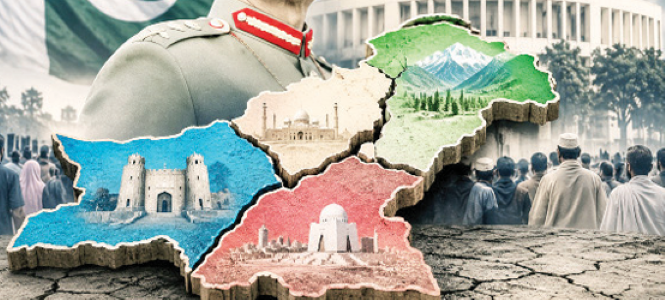
Some countries lose their freedoms in a single night. Others lose them slowly: one banned organisation, one locked cell, one redrawn boundary at a time. Reports now circulating about Pakistan point to the second path: they say Field Marshal AsimMunirfavours breaking the four provinces into many smaller units. Whatever the truth of that plan, it lands in a country where the state has already shown how it treats citizens who organise. The central concern is not administrative reform itself, but whether a restructuring of the federation would serve the people or alter the balance of power in favour of institutions that are not directly accountable to elected provincial constituencies.
To test that concern, this article begins not with the map, but with the people whose lives are shaped by decisions made far away: traders in Rawalakot, families searching for missing relatives in Balochistan, displaced communities in Waziristan and political workers who continue to demand democratic representation. Their circumstances differ, but one question connects them all: how much say do ordinary citizens have in decisions that determine their political future?
What Is Reported, and What Is Not
International reporting in October 2026 attributes to Field Marshal AsimMunir a preference for dividing Punjab, Sindh, Khyber Pakhtunkhwa and Balochistan into twelve to fifteen smaller provinces. The figure of one hundred and sixty comes from Planning Minister Ahsan Iqbal, who in September 2026 called for a national debate on two options: creating around fifteen new provinces, or keeping provincial boundaries and empowering local governments across roughly one hundred and sixty districts. Interior Minister Mohsin Naqvi has separately advocated additional administrative units and a referendum.
Yet neither arrangement has become official policy. Munir has not publicly endorsed a blueprint, and a 22 November report indicated that no formal government proposal had been initiated. This is an ambition under discussion, not yet law, which is exactly why it should be examined now. To understand what is at stake, we must first look at how the state has treated citizens who organise.
Banned for Asking: The People of Poonch
On 5 June 2026, the Azad Jammu and Kashmir government declared the Jammu Kashmir Joint Awami Action Committee a proscribed organisation under the region’s Anti-Terrorism Act. The committee is a coalition of traders, lawyers, students, transporters and ordinary families that formed in 2023. Its demands were affordable electricity and flour, an end to elite privileges, and the abolition of twelve Assembly seats reserved for refugees living outside the territory. The ban came while talks were still under way.
The government said the group acted against state security and accused it of killing policemen. The committee rejects this and says army personnel and Rangers killed protesters and civilians. The toll, too, is contested. By 12 June, an AFP tally based on official figures put the death toll from the clashes at twenty across the region, including police officers. After the clashes of 27 July, the committee claimed that nineteen protesters had been killed in Rawalakot. Amnesty International noted that no toll had been independently established, and cited media reports of at least forty deaths between June and the July election, thirty-four of them protesters. Amnesty also said mobile internet had been suspended since 5 June, called the terrorism designation disproportionate and unlawful, and urged that the ban be lifted.
Because allegations and official accounts contradict one another, an independent, impartial and transparent investigation is essential. A blanket security designation cannot substitute for evidence, due process and the right to peaceful political organisation.
The refugee-seat issue shows what the movement is really about. Those twelve seats are filled by representatives of people who live outside the territory, yet they sit in the same Assembly that decides budgets and policy for those who live in it. To many residents, that is the clearest symbol of too little say over their own affairs. Although Pakistan-administered Kashmir has a constitutional status separate from the four provinces, its lesson is about method: when people ask for affordable bread and electricity, the answer should be conversation, not a banned-organisations list.
The Captain in a Cell
For millions of Pakistanis, Imran Khan is simply “the captain,” the cricketer who lifted the 1992 World Cup and later served as prime minister. He was arrested in August 2023 and transferred to Adiala Jail in Rawalpindi on 26 September of that year. The UN Working Group on Arbitrary Detention, in an opinion made public in July 2024, found his detention arbitrary, without legal basis and apparently intended to disqualify him from political office, and called for his release. Such opinions are not binding, and the Pakistani authorities do not accept the Working Group’s reading of the case.
In December 2025, the UN Special Rapporteur on torture, Alice Jill Edwards, said reports of solitary confinement for up to twenty-three hours a day could amount to torture or inhuman treatment. Amnesty International has also raised fair-trial and access concerns. His family reports solitary confinement and, early this year, serious vision loss in one eye attributed to delayed medical care. Officials answer that he has dedicated accommodation, exercise facilities and continuing judicial oversight.
Beyond the captain himself stand the workers. Thousands were arrested after the unrest of 9 May 2023, when military installations were attacked, and the state is entitled to prosecute violence. But punishment must be individual and lawful, not collective and political. PTI says supporters were killed when security forces cleared its November 2024 march on Islamabad; the government disputes the figures and points to its own personnel who died. In August 2026, as Khan marked three years in prison, party leaders reported roads blocked, rallies obstructed and workers, including women, detained in Lahore, Islamabad and elsewhere. A party that cannot hold a rally without mass arrests is not competing on equal terms. Ultimately, the question is whether the law applies evenly, for a justice system earns trust when the powerful and the popular are treated by the same rules.
Balochistan: Mothers Who Wait
The same question of fairness runs through Balochistan, which holds vast mineral and energy wealth alongside some of the country’s deepest poverty. Its people have asked for a fair share of their resources, autonomy and answers about the missing. The Baloch Yakjehti Committee, led largely by women who have walked hundreds of kilometres carrying photographs of sons and brothers, has become the face of that demand.
According to the committee’s Human Rights Department, its report published on 30 September 2026 documented 507 alleged enforced disappearances and 150 civilian deaths during the first six months of the year. These figures are the committee’s allegations, not independently established findings or court rulings, and they demand transparent investigation. The state says its operations target armed separatists such as the Balochistan Liberation Army, whose attacks have killed civilians and soldiers. Violence against innocents is indefensible, and so is the disappearance of a citizen without charge or trial. A mother who does not know whether her son is alive is not a security statistic.
Khyber Pakhtunkhwa: Between Two Fires
In Bannu, Tank and South Waziristan, ordinary Pashtuns likewise live between two forces. The Tehreek-e-Taliban Pakistan has killed civilians, police and soldiers, and the state must protect its people from terrorism. Yet residents and groups such as the Pashtun Tahafuz Movement describe another burden: curfews, displacement, civilian casualties and tight limits on what they may say about any of it. For them the question is whether their dignity and representation are respected. Security without public confidence is brittle.
Why Dividing the Provinces Fits the Pattern
Seen beside these stories, the map looks less like administration and more like the next tool. Provinces remain among the most important constitutional counterweights to federal authority, giving elected governments political legitimacy, administrative autonomy and a voice in the federation. Punjab anchors the Pakistan Muslim League-Nawaz, Sindh the Pakistan Peoples Party, and Khyber Pakhtunkhwa the base of Khan’s PTI. A separate Seraiki province would dilute Punjab’s weight, separating Karachi would strike at the heart of the PPP, and splitting Khyber Pakhtunkhwa would scatter the very constituency the state has struggled to contain.
Analysts warn that smaller units dependent on federal money would be easier to steer, and decentralisation would then become centralisation under another name. Across all these regions runs a shared thread, and it is not geography. It is the experience of being governed from far away by people who are neither elected by nor answerable to those they govern. A fresh map drawn in Islamabad, without the participation of those who live inside its lines, would repeat that experience on a larger scale.
Many of these parties have governed poorly, but the remedy for weak provincial government is stronger provincial government, with real fiscal power and accountability. Resistance has already begun: the Sindh Assembly and a multiparty conference have rejected any division of Sindh, and Bilawal Bhutto-Zardari has warned of unrest if it is attempted by unconstitutional means.
The Constitutional and Financial Price
Several new provinces would need governors, assemblies, secretariats and possibly high courts, for an economy already straining under debt. A new map would also reopen the National Finance Commission award and the 1991 water apportionment accord, which govern how revenue and the Indus waters are shared. Above all, Article 239 sets a high bar, requiring two-thirds majorities in both houses of Parliament and in the total membership of each affected provincial assembly. The framers wanted such change to need broad consent, not institutional pressure.
What the World Should Say
Pakistan is a nuclear-armed state of more than 250 million people, and its stability is the world’s concern. Governments, the United Nations and human rights organisations should press for transparency, constitutional process and accountability. That does not mean backing separatism or choosing among parties. It means one standard everywhere: peaceful protest protected, detention governed by law, speech free, and communities heard. Human rights cannot be selective, and democracy is not measured by elections alone.
In practice, that means calling for independent inquiries into the deaths in Rawalakot and Kotli, a lawful and transparent process for any organisation accused of crimes in place of a blanket ban, access for independent monitors to detainees, and a public accounting of the missing in Balochistan. These are modest requests that any confident government should welcome.
Whose Pakistan?
Pakistan does not need fragmentation for its own sake. It needs independent courts, accountable security agencies, transparent finances and local governments with real power. If smaller provinces are ever created through open consultation and the consent of those who live there, they may bring benefits. If they are created to weaken elected forces and enlarge the reach of unelected ones, they will deepen the crisis they claim to solve.
A country is held together not merely by its borders, but by the confidence its people place in its institutions and the dignity with which those institutions treat them. The people of Poonch, the families of the missing in Balochistan, the displaced communities of Waziristan, the political workers who still carry the captain’s flag, and the citizens of Punjab and Sindh are not simply asking for a new map. They are asking to be heard, represented and counted. Democracy is not a concession granted by men in uniform. It is a constitutional right that belongs to the people.
When a society becomes crowded with dishonest minds and submissive souls, its honest and noble people are often left powerless.
References
The Economist, reporting on the reported AsimMunir proposal to divide Pakistan’s provinces, October 2026.
Ahsan Iqbal, Planning Minister, statements on fifteen new provinces or one hundred and sixty empowered district governments, September 2026.
Dawn, reporting on Interior Minister Mohsin Naqvi’s referendum proposal, November 2026; The News, report that no formal government proposal had been initiated, 22 November 2026.
Amnesty International, statements on the ban on the Jammu Kashmir Joint Awami Action Committee and protest deaths, 9 June and July 2026.
Agence France-Presse, report on the twenty deaths in the Azad Jammu and Kashmir clashes, 12 June 2026.
UN Working Group on Arbitrary Detention, Opinion No. 22/2024 (Imran Khan), made public July 2024; UN Special Rapporteur on torture, Alice Jill Edwards, statement of 12 December 2025.
Baloch Yakjehti Committee, Human Rights Department, report on enforced disappearances and civilian deaths, 30 September 2026.
Constitution of the Islamic Republic of Pakistan, Article 239.
(Author, a Kashmiri sociologist, is a writer, re searcher, and columnist. His research Interests In clude Kashmir Affairs, South Asian Politics, Human Rights, and Public Policy issues. krasool70@gmail.com)

[[comment.comment_text]]