SP-Congress Seat-Sharing Dispute Exposes Cracks in Opposition Unity.

 3 hours ago
Alliance on the Brink or a Battle for Political Supremacy?
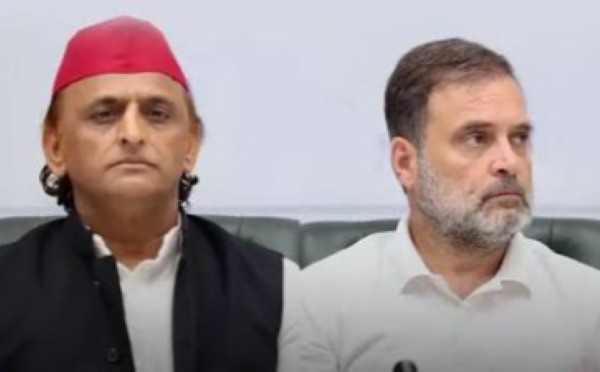
The political equations in Uttar Pradesh appear to be getting increasingly complicated even before the knots of the alliance can be untangled. The Samajwadi Party (SP) and the Congress, which have repeatedly pledged to join forces against the Bharatiya Janata Party (BJP), now seem more interested in asserting their political standing against each other. What began as a disagreement over seat-sharing has gradually turned into a battle of prestige, political influence and leadership credentials. The statements coming from leaders of both parties suggest that, rather than finding common ground at the negotiating table, they are competing to undermine each other's political stature. The war of words is intensifying, while the fragile framework of opposition unity continues to weaken.
The seat-sharing dispute between the SP and Congress ahead of the Uttar Pradesh Assembly elections has become increasingly contentious. The Congress initially demanded 181 seats, subsequently reducing its claim to 131 and eventually to around 100-110 seats. The party argues that its improved performance in the 2024 Lok Sabha elections and Rahul Gandhi's prominent role in the national fight against the BJP justify a respectable share in the alliance. The SP, however, considers the Congress's demands disproportionate to its actual political strength in the state. According to media reports, SP general secretary Ram Gopal Yadav has indicated that his party has offered the Congress just 26 seats.
Amid the ongoing negotiations, the SP further complicated matters by announcing candidates for several constituencies, including Saharanpur, Behat, Kairana, Amroha and Lalitpur. By declaring its nominees without reaching a final understanding with the Congress, the SP appeared to signal that it was unwilling to make its electoral decisions entirely dependent on its alliance partner. The move particularly upset the Congress, which considers several constituencies in western Uttar Pradesh electorally significant for itself.
Congress MP and Uttar Pradesh Congress working president Imran Masood openly expressed his displeasure. "We are not begging for seats," he declared. Taking direct aim at the SP's proposed allocation, he added, "We will not contest on worthless seats." Masood argued that the Congress could not be expected to accept constituencies where it had little chance of winning. The party, he maintained, wanted to contest only those seats where it could deliver meaningful electoral results. He also asserted that the Congress alone had the right to assess its electoral strength, not the SP.
Masood reminded the SP of its earlier political arrangements as well. He pointed out that when Akhilesh Yadav was the chief minister, the Congress had contested 107 Assembly seats. If the party had been given such a substantial share then, he questioned, why should its present demand be considered unreasonable? Emphasising Rahul Gandhi's leadership, Masood said the real political battle in the country was against the BJP's ideology and that Rahul Gandhi was leading this struggle. Without him, he argued, the fight would lose its meaning and direction.
SP leaders, meanwhile, have been equally aggressive in questioning the Congress's political standing. SP MP S.P. Singh said the Congress should not be given more than 35-40 seats. Taking a swipe at the party, he remarked, "A party with just two MLAs should not demand so many seats." He pointed out that the Congress had been allotted 17 Lok Sabha seats in the previous general election but managed to win only six. Going further, he claimed that the Congress would fail to win even a single seat if it contested independently. In his view, giving seats to the Congress could ultimately mean losing those constituencies and weakening the alliance.
SP MP Iqra Hasan also questioned the Congress's political leverage, claiming that the party had secured the position of Leader of the Opposition in the Lok Sabha largely because of the support and contribution of the Samajwadi Party. She made it clear that the SP would not compromise on its 111 sitting Assembly seats. According to her, the party has a legitimate claim over these constituencies, and the Congress must recognise ground realities rather than stake a claim to them.
Shivpal Yadav and other SP leaders have maintained that seat-sharing should be determined by the winnability of candidates rather than political prestige. Their argument is that only a party with a strong organisational network and a firm grassroots presence can effectively challenge the BJP in Uttar Pradesh. The SP therefore considers the results of the 2022 Assembly elections an important basis for deciding the distribution of seats.
Amid the escalating tensions, Akhilesh Yadav has attempted to bring the discussion back on track through social media. Referring to seat-sharing as 'seat adjustment', he argued that an alliance should focus not on the number of seats but on the prospects of victory. According to him, discussions have already taken place on 26 constituencies identified as priorities by the Congress, and the party should submit the names of other constituencies it wishes to contest. However, his intervention has done little to ease the Congress's resentment. Imran Masood has indicated that his party will not accept any arrangement involving fewer than 60 seats.
The bigger question is whether the two parties will exhaust their political energy challenging each other before taking on the BJP. The Congress draws confidence from Rahul Gandhi's national leadership and its performance in the Lok Sabha elections, while the SP relies on its organisational strength, sitting legislators and established regional support base in Uttar Pradesh. Both parties have political arguments to support their claims, but neither appears willing to acknowledge the other's strengths.
Alliances are not built merely through the arithmetic of seat distribution. They survive on mutual trust, respect and political maturity. If the Congress expects a larger share on the strength of its national role, it must also acknowledge the political realities on the ground in Uttar Pradesh. At the same time, the SP must recognise that taking on a formidable electoral force like the BJP cannot be achieved through regional dominance alone.
For now, leaders of both parties appear preoccupied with questioning each other's political worth, even as the real electoral challenge lies ahead in the form of the BJP. The irony is unmistakable: an alliance that was supposed to emerge as a formidable challenge to the ruling party is increasingly being weakened by mistrust, ego and competing ambitions.
Unless both parties rein in their rhetoric and arrive at a mutually acceptable arrangement in time, the seat-sharing dispute could become the opposition's biggest electoral vulnerability. After all, in politics, diminishing the stature of an ally does not necessarily strengthen one's own position. Sometimes, the determination to weaken a partner only ends up undermining one's own political ground.
(The writer is a senior Delhi-based journalist and political analyst. Views are personal.)







[[comment.comment_text]]