Congress's Ghost in Bengal's Muslim Heartlands: Spoiler or Saviour?

 5 months, 3 weeks ago
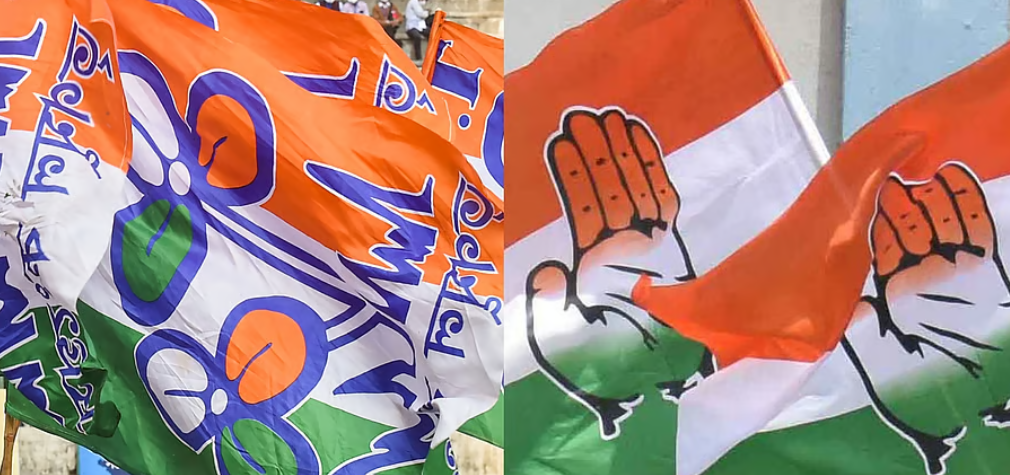
Congress remains a potential disruptor in Bengal’s minority-heavy districts like Malda, Murshidabad, Nadia, and Raiganj, but the latest electoral data shows that Trinamool Congress (TMC) still commands the majority of Muslim votes, making Congress more of a spoiler than a revivalist force.
The story of these districts is deeply tied to historical Congress dominance, family feuds, defections, and the rise of Mamata Banerjee’s populist politics. Malda, once the fortress of A.B.A. Ghani Khan Choudhury, has seen Mausam Noor’s defection to TMC and subsequent ghar wapsi debates fracture loyalties. Noor herself admitted she had been compelled to quit Congress earlier, but her cousin Ishaque Khan Choudhury contested against her, creating a family rift that weakened Congress’s grip. Yet, she now claims Muslims in Malda are disillusioned with TMC’s failure to deliver on promises like the Waqf Act and OBC reservations, and that Congress could regain ground. Malda has 2 Lok Sabha seats and nearly 20 lakh minority voters reinstated after deletions, making it a crucial battleground.
Murshidabad, with 18.8 lakh electors and a Muslim majority of over 55%, has long been Adhir Ranjan Choudhury’s bastion. Despite his stature as Leader of Opposition in Parliament, he lost to TMC’s Abu Taher Khan in 2024, who secured 682,442 votes against CPM’s Md Salim (518,227) and BJP’s Gouri Sankar Ghosh (292,031). This defeat highlighted Congress’s erosion even in its strongholds. Yet, Adhir’s persistence and Congress’s legacy in Murshidabad keep alive the possibility of revival, though analysts argue Congress risks being reduced to a vote-splitter.
Nadia, with 17 seats and a mixed electorate, has historically leaned towards Congress but has seen TMC consolidate through welfare schemes and grassroots mobilization. Minority voters here are around 30–35%, while Hindu voters remain influential. Congress’s presence is marginal, and TMC dominates.
Raiganj, with 1.38 million electors and 7 seats, reflects volatility. In 2024, BJP’s Kartick Chandra Paul won with 560,897 votes, defeating TMC’s Kalyani Krishna (492,700) and Congress’s Ali Imran Ramz (263,273). Minority voters here constitute about 40%, but the BJP’s rise complicates Congress’s revival.
The larger narrative is that while Congress leaders like Mausam Noor and Adhir Choudhury attempt to mobilize disillusioned minorities, TMC’s aggressive SIR drive and Mamata’s Supreme Court interventions to reinstate disenfranchised voters have bolstered its credibility. Critics argue Congress’s revival is non-beneficial, serving only to dilute opposition strength, but saffologists note that minority voters, while skeptical of TMC, still see it as the most viable protector of their rights.
The comparison with Arvind Kejriwal’s AAP is instructive: hyper-governance politics in Gujarat and Haryana failed to dislodge entrenched players, and Congress’s aggressive Delhi strategy collapsed against AAP’s rise. Similarly, in Bengal, Congress risks overplaying its hand. Malda, Murshidabad, Nadia, and Raiganj remain districts where Congress could theoretically challenge TMC, but the ground reality is that minorities continue to rally behind TMC as the only bulwark against BJP.
Thus, the battle is emblematic of Bengal’s churn: Congress clings to legacy and family networks, while TMC consolidates through populism and organizational strength. The question is not whether Congress can win outright, but whether it can fracture enough votes to alter Bengal’s political arithmetic. For now, the data suggests Congress is more likely to redistribute votes than reclaim its old dominance.










[[comment.comment_text]]