A Nation Addressed, A Democracy Diminished

 5 months, 3 weeks ago
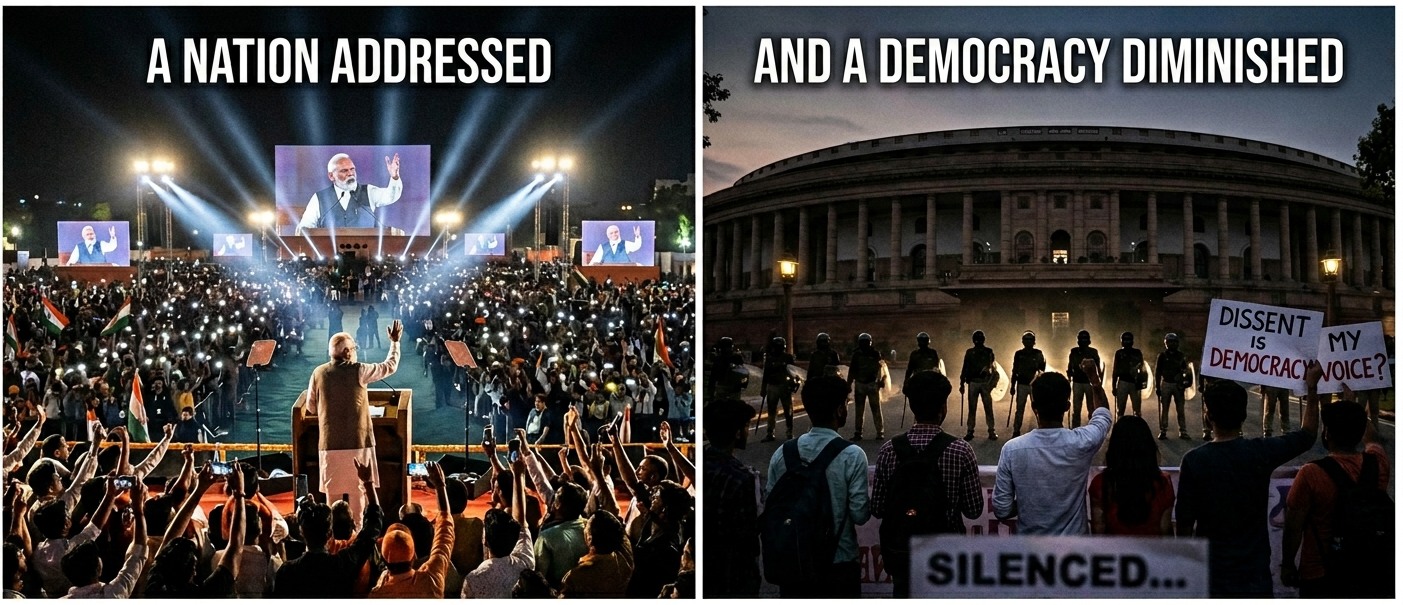
Prime Minister Narendra Modi’s post-defeat broadcast blurred constitutional lines, deepened political acrimony, and raised troubling questions about democratic restraint.
When a Prime Minister addresses the nation, the expectation is not merely of communication, but of constitutional sobriety. Such moments are meant to transcend partisan divides, offering clarity, reassurance, and statesmanship. Narendra Modi’s 29-minute televised address on April 18, 2026, delivered in the aftermath of the government’s failure to pass the Women’s Reservation and Delimitation Bills, did precisely the opposite.
Instead of uniting a politically charged nation, the speech sharpened fault lines, transformed an institutional setback into a political spectacle, and unsettled long-standing democratic conventions.
A Legislative Defeat, A Rhetorical Escalation
At the heart of the address was the government’s inability to secure the constitutionally mandated two-thirds majority for what was projected as a historic reform—granting 33% reservation to women in legislatures. The proposed constitutional amendment, however, was not a standalone measure. It was intricately tied to a contentious delimitation exercise based on post-2011 demographic data, which envisaged a significant expansion of Lok Sabha seats—potentially beyond 800.
Opposition parties, including the Indian National Congress, Trinamool Congress, and Dravida Munnetra Kazhagam, did not reject women’s reservation per se. Their resistance stemmed from the coupling of this reform with a delimitation plan they argued would structurally disadvantage southern states while consolidating political gains for the ruling party in the Hindi heartland.
This distinction—central to parliamentary debate—was conspicuously flattened in the Prime Minister’s address.
The Language of “Foeticide”: Political Hyperbole or Moral Overreach?
Perhaps the most controversial aspect of the speech was the Prime Minister’s accusation that the Opposition had committed “bhroon hatya” (foeticide) by blocking the Bill. This was not merely rhetorical excess; it was a moral indictment of an extraordinary kind.
To equate legislative dissent—an essential component of parliamentary democracy—with the killing of an unborn child is to dangerously conflate disagreement with moral depravity. It elevates political contestation into the realm of ethical criminality, leaving little room for legitimate opposition.
Such language does not strengthen democratic argument; it delegitimises it.
A National Platform, A Partisan Message
Criticism from opposition leaders was swift and sharp. Mallikarjun Kharge described the address as a “travesty of democracy and the Constitution,” accusing the Prime Minister of converting an official broadcast into a partisan attack laden with “mudslinging and lies.” John Brittas went further, calling it “a breach of a long-standing democratic norm—no Prime Minister, he argued, had used a national address so overtly to target political opponents.”
This criticism is not without historical grounding. National addresses in India have traditionally been reserved for moments of collective crisis—wars, pandemics, economic upheavals—where the Prime Minister speaks as a constitutional head of government, not as a party leader.
By contrast, this address bore the unmistakable cadence of an election rally.
The Model Code of Conduct Question
The timing of the speech adds another layer of complexity. With Assembly elections underway in multiple states, the Election Commission of India’s Model Code of Conduct (MCC) was in force—a framework designed to ensure a level playing field by restricting the misuse of official machinery for electoral gain.
Opposition leaders have argued that the Prime Minister’s broadcast, aired on national platforms and laden with direct political messaging against rival parties, constituted a violation of the MCC. Some have even demanded that the cost of the address be added to the ruling party’s election expenditure.
Whether or not the Election Commission acts on these complaints, the ethical question remains: can a sitting Prime Minister, during an active electoral cycle, use the authority of his office and the reach of state platforms to advance a partisan narrative?
Women’s Reservation as Political Instrument
Lost in the din of accusation and counter-accusation is the substantive issue itself: women’s political representation. India has debated women’s reservation for decades, with multiple governments—across party lines—failing to translate intent into law.
What made the recent Bill particularly contentious was its design. By tethering reservation to delimitation, the government introduced a structural precondition that effectively delayed implementation while simultaneously reshaping the federal balance of representation.
Critics argue that this coupling transformed a long-overdue social reform into a strategic political instrument—a “decoy,” as some opposition leaders described it—designed to achieve multiple objectives under the moral cover of gender justice.
The Erosion of Democratic Norms
Beyond the immediate controversy, the episode raises deeper concerns about the evolving nature of political communication in India. The distinction between state and party, between governance and campaigning, appears increasingly blurred.
When the highest constitutional office adopts the idiom of partisan combat in an official national address, it risks normalising a new standard—one where institutional platforms become extensions of electoral strategy.
Democracy does not merely depend on electoral outcomes; it rests equally on the norms that govern political conduct. These norms—restraint in language, respect for opposition, and the careful use of institutional authority—are not ornamental. They are foundational.
A Moment That Calls for Reflection
Prime Minister Modi’s address was, in many ways, emblematic of the current political moment—assertive, polarising, and deeply contested. But it was also a missed opportunity.
At a time when Parliament had failed to deliver a transformative reform, the nation needed reflection, consensus-building, and perhaps even introspection. What it received instead was confrontation.
In the long arc of democratic practice, such moments matter. They shape not only political narratives but institutional precedents. And the question they leave behind is both simple and urgent: when the nation is addressed, who is truly being spoken to—the citizen or the voter?
(Hasnain Naqvi is a former member of the history faculty at St. Xavier’s College, Mumbai. Views are personal.)
(Views expressed are of the author and do not necessarily reflect the views of THE EMERGING WORLD)


[[comment.comment_text]]