NATO A Strained Alliance in the Shadow of the Iran War, a Defining Crisis for the Transatlantic Alliance

 5 months, 3 weeks ago
NATO: A Strained Alliance in the Shadow of the Iran War
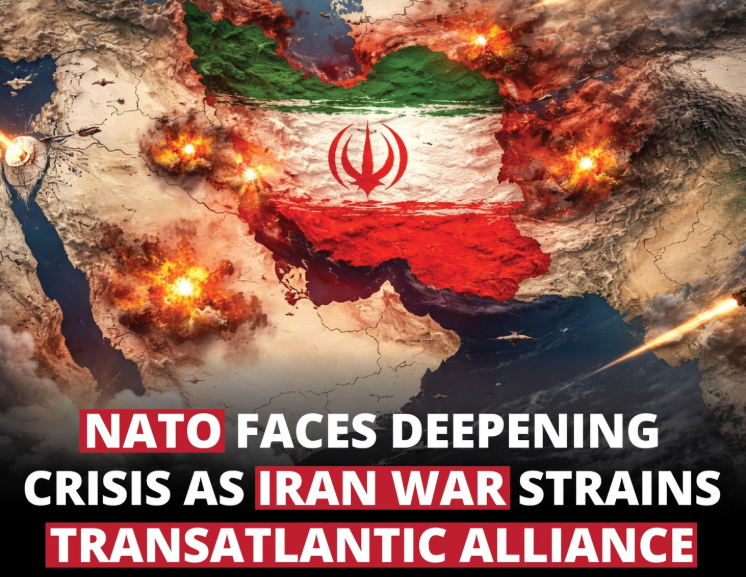
The health of the North Atlantic Treaty Organization (NATO) is currently facing what many analysts call its most profound existential crisis since its founding. The recent escalation of the US-led conflict with Iran, spearheaded by President Trump without prior consultation with his European allies, has exposed a fracture that is no longer just rhetorical, but operational. The North Atlantic Treaty Organization (NATO) is a 32-member strategic military alliance established in 1949 by a Washington Treaty. Its primary purpose is collective defence - an attack against one member is considered an attack against all. It provides a forum for transatlantic security cooperation and conflict prevention.
Genesis of Crisis:
The February 28, 2026, U.S.-Israeli strikes that killed Iran's Supreme Leader Ayatollah Ali Khamenei marked a dramatic escalation in the Middle East region. What began as targeted action quickly spiralled into open conflict, with Iran retaliating against U.S. bases and blocking the Strait of Hormuz—a critical chokepoint carrying about 20% of global oil. President Donald Trump, pursuing an "America First" agenda that had already seen cuts to USAID and WHO funding and scepticism toward NATO's relevance, called on allies to help reopen the strait and support operations against Iran. Most NATO members refused, condemning the strikes as unprovoked, especially since nuclear negotiations with Iran had been progressing well. Countries like the UK, France, Germany, Spain, and others publicly criticized the move and restricted U.S. access to airspace or bases. This marked the first major U.S. conflict where key NATO allies withheld meaningful cooperation. Trump responded by labelling NATO a "paper tiger" and warning of a "very bad future" for the alliance if it failed to step up.
Trump's Unilateral Approach and Allied Backlash
Trump's decision to strike without broad consultation revived long-standing tensions. His administration viewed the operation as necessary to counter Iran's nuclear ambitions and regional threats, but European leaders saw it as a risky distraction from the ongoing Russian threat in Ukraine and a violation of international norms. Spain closed airspace to U.S. warplanes, Italy denied base access, and several nations limited logistical support. Only a handful of members—such as Canada, the Czech Republic, and some Baltic states—offered public backing. Trump accused allies of freeloading, noting that the U.S. imports far less oil from the Gulf (around 5%) than Europe does, and suggested those dependent on the route should handle the Hormuz issue themselves. He signalled a potential unilateral U.S. withdrawal from the conflict within weeks, even if the strait remained contested. European responses ranged from condemnation to cautious neutrality, with figures like Finland's president stating outright that "this is not our war" and not a NATO matter.
This episode highlights a fundamental clash: Trump's transactional style demands reciprocity and burden-sharing, while many Europeans prioritize strategic autonomy and multilateral consensus. The lack of unity exposed how diverging national interests—Europe's greater reliance on Gulf energy versus America's shifting focus—can fracture collective action outside Article 5 scenarios.
Militarily, integration remains intact. However, politically, trust has eroded. Trump's flamboyant unilateralism—launching strikes and then blaming non-cooperation—has deepened scepticism. Some European officials privately discuss preparing for a "post-American" security landscape, accelerating EU defence initiatives, Germany's rearmament, and French-led strategic autonomy efforts. Yet full replacement of U.S. capabilities in power projection, logistics, and nuclear deterrence remains years away. However, NATO has weathered past crises, including Suez, Vietnam, Iraq, and Trump's first term. External threats from Russia and China continue to act as a binding force.
To understand whether NATO is on the path to disintegration or if this is a temporary "flamboyant" detour, we must look at the structural, political, and economic tensions currently pulling the alliance apart.
The Iran Fracture: A "Not Our War" Sentiment
The primary source of the current friction is the unilateral nature of the US offensive against Iran. Traditional heavyweights like France, Germany, and the UK have maintained a policy of "detachment." While they have provided pragmatic support—such as allowing the use of airbases for logistics—they have pointedly refused to join the combat mission or the maritime escort mission in the Strait of Hormuz.
European leaders argue that the attack occurred while diplomatic negotiations were showing potential. They view the current escalation as a violation of international law and a threat to global energy stability. However, President Trump has characterized this refusal as a "very foolish mistake." His logic is transactional: since only about 5% of US oil comes from the Gulf, he argues that the country’s most dependent on that route (Europe and Asia) should be the ones paying for and fighting to keep it open.
Is Trump the "American Gorbachev"?
The comparison to Mikhail Gorbachev is striking but complex. Gorbachev sought to reform the Soviet system to save it, but his actions inadvertently accelerated its collapse. Similarly, Trump’s "America First" doctrine aims to "update" the American model by shedding what he views as the "obsolete" and "unfair" burdens of global leadership.
The Parallel: Just as Gorbachev’s Glasnost and Perestroika weakened the central authority of the Eastern Bloc, Trump’s rhetoric—calling NATO allies "delinquent" and threatening to withdraw—is weakening the "central authority" of the West. However, a difference remains. While Gorbachev’s goal was peace and integration with the West, Trump’s approach is rooted in decoupling and transnationalism. If NATO finishes, it won’t be because of a loss of military power, but because the "mutual defence" guarantee (Article 5) has lost its credibility. If the world doesn't believe the US will show up, the treaty is essentially a dead letter.
The Current State of NATO's Health
The health of the alliance is currently "critically unstable" but not yet dead. There is a strange duality at play. As a Sign of decline the US is operating under political isolation. The US is acting without its allies in major Middle East operations. However, under logistical integration, the US commanders still oversee NATO maritime and air commands; the "machine" of NATO still functions. Trump came out with exit threats and has stated he is "absolutely" considering a formal withdrawal from the treaty. The "Eastern Flank", countries like Poland and the Baltics remain staunchly pro-US, fearing Russia more than they fear Trump's volatility. Moreover, there is a sign of economic warfare brewing. Tensions over oil and trade are replacing security cooperation. Secretary General of NATO Mark Rutte’s diplomacy continues to flatter the US administration to keep the door open. Before his role at NATO, Rutte was the Prime Minister of the Netherlands for nearly 14 years (2010-2024), making the longest-serving PM in Dutch history. He is known for his pragmatic leadership style.
Is NATO Going to Finish?
One argument is that despite the rhetoric, NATO is not on the verge of disintegration. The alliance, now with 32 members including Finland and Sweden, maintains robust military structures, joint exercises, and intelligence-sharing focused primarily on deterring Russia. Defence spending has risen significantly, with most members approaching or exceeding the 2% GDP target, driven by the Ukraine war and earlier U.S. pressure. Article 5, the collective defence clause, was never invoked here, as Iran did not attack a NATO member state directly. Secretary-General Mark Rutte has stressed continuity on core missions like Ukraine support.
Militarily, integration remains intact. However, politically, trust has eroded.
Under another argument, NATO is unlikely to "disappear" overnight, but it is rapidly evolving into a "two-tier" alliance. The Core Atlanticists: The US, Poland, and the Baltic states, focused on hard military power and aggressive deterrence and The European Autonomists: France and Germany, who are increasingly pushing for "strategic autonomy"—a European military capability independent of Washington. The danger of disintegration is real because NATO relies on trust. If President Trump continues to blame allies for "non-cooperation" in a war they never agreed to, the "North Atlantic" part of the treaty becomes a geographic label rather than a security guarantee.
NATO is currently in a state of "atrophy by neglect." While the physical infrastructure remains, the political soul of the alliance—the idea that an attack on one is an attack on all—is being replaced by a "pay-to-play" model. If the US unilaterally exits or continues to bypass the North Atlantic Council, NATO may not "finish" with a bang, but rather fade into a bureaucratic relic while Europe builds its own separate defence shield. President Trump’s refusal to protect the Strait of Hormuz for "free" is the clearest sign yet that the era of the US as the "Global Policeman" is ending. Whether this leads to a safer, more balanced world or a chaotic power vacuum remains the defining question of 2026.
(Author, a PhD in International Relations from JNU, is a senior editorial adviser at EW.)








[[comment.comment_text]]