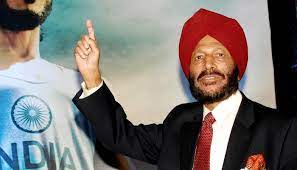
The ‘Flying Sikh’ finished his last race, leaving behind an inspirational story for generations to come

 5 years, 4 months ago
“Life’s game was neither started by me nor it will end with me. I have only spent a small part of a century with my fluttering body and one day, I will leave this stadium leaving the other players between their activities.”, Milkha Singh wrote in his autobiography. And on 18 June 2021, the ‘Flying Sikh’ finally left the stadium of life, leaving behind an inspirational story for generations to come.
Milkha Singh’s life was all about running. running, running. From a boy who narrowly escaped death during the partition, to a young Army recruit who ran for small privileges (a daily glass of milk), to a great sprinter who put India on the world map, breaking records and winning several medals for the country in the international tournaments.
A Narrow Escape
Milkha was born in undivided India. As a boy, Milkha witnessed the terrifying situation during the partition and escaped death with a fine margin. Singh moved to India from Pakistan in 1947. In the beginning, Milkha carved out his living from working in roadside restaurants. But it was the Indian Army that enabled Milkha to explore himself. During small drills and competitions in the army, Singh realized his abilities as a sprinter.
Changed the course of life for Milkh
In the Army, Milkha was spotted for his abilities as a sprinter, which he doesn’t knew. From running for small privileges like a daily glass of milk to representing his unit in regimental games. Milkha improved his abilities drastically which finally gave him the chance to represent India on the world platform.
1958 Tokyo Asian Games: A new era for Indian Athletics led by Milkha Singh
Milkha Singh was eliminated during the preliminary heats at the 1956 Olympic Games in Melbourne. But the 1958 Tokyo Asian Games saw a different Milkha Singh, where he won 2 gold medals for India in 200m and 400m. Later, he won a gold medal in the 1958 Commonwealth games with a time of 46.6 seconds.
A race to remember
In the Rome Olympics, hopes were high from the Flying Sikh as he was on his peak during that time. But things didn’t go that way. The finals of the 400m competition was a race to remember, initially, Milkha Singh was dominating the race, and, at around the 250m mark, Milkha slowed down in the belief that his pace could not be sustained till 400m. After that, his competitors Davis, Carl Kaufmann, and Malcolm Spence all passed him and finished in the top 3. Milkha finished fourth in the race.
After the Rome Olympics, Milkha regained his Asian gold medal in the 400m event. He also won gold for India in the 4x400m relay in the 1962 Jakarta Asian Games.
Milkha Singh, a true legend will always be remembered for his great contribution to the country and will continue to inspire generations of sportspersons. The legendary athlete will always be remembered for many firsts in the field of athletics.
(EW News Desk)







[[comment.comment_text]]