Navigating India's Linguistic Dilemma: Bridging Roots and Progress

 3 months, 1 week ago
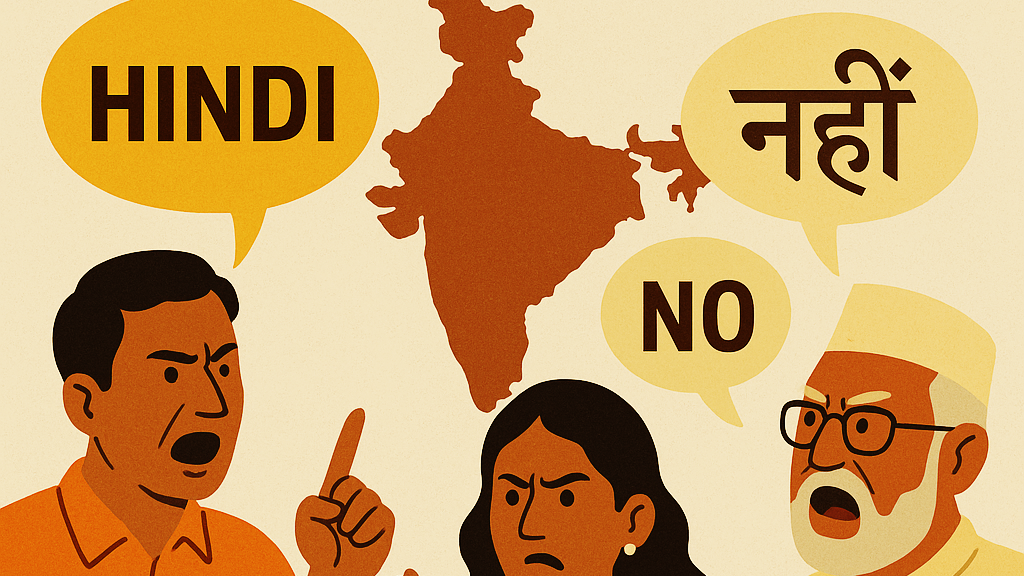
Nearly eight decades after independence, India faces a profound linguistic irony: Hindi holds a celebrated constitutional status, yet English remains the dominant language of governance, law, higher education, medicine, and scientific research. This creates a striking duality where official seminars praise Hindi, while institutional frameworks rely heavily on a foreign tongue. The true question is not about opposing English, but whether India can cultivate the self-reliance to empower its own languages.
Language is the cultural memory, history, and birthplace of ideas for any society. Distancing ourselves from our native tongue gradually erodes our cultural roots and national self-confidence. Hindi is not merely a regional language; it serves as a vital bridge of communication among millions across a multilingual nation. To champion Hindi is not to oppose other Indian languages, as the rich literary and historical heritage of Tamil, Bengali, Marathi, Telugu, and all others deserve equal respect.
The evolution of Hindi spans centuries, growing from Sanskrit, Prakrit, and Apabhramsha into the modern language of the masses. It was nurtured by saint-poets like Kabir and Tulsidas, who used it to awaken social consciousness and spread moral wisdom. In the modern era, literary giants like Bharatendu Harishchandra, Premchand, and Mahadevi Verma elevated Hindi to international stature, while freedom fighters like Mahatma Gandhi used it as a powerful tool for national unity.
Following independence, Article 343 of the Constitution declared Hindi in the Devanagari script as the Official Language of the Union, hoping Indian languages would lead governance. Today, that dream remains unfulfilled due to a persistent mindset of mental colonialism, where parents discourage Hindi and society equates English proficiency with intelligence. While learning foreign languages is valuable, viewing one's own language as inferior hinders national growth.
Globally, nations like Japan, Germany, France, and South Korea achieved advanced development by conducting science, technology, and research in their native languages without displacing them. India can similarly transform into a true knowledge-based nation only when Hindi and other regional languages become the primary mediums for higher learning and technical fields.
Fortunately, the digital age has opened unprecedented possibilities for Hindi. The internet, digital journalism, social media, e-books, and artificial intelligence have dramatically expanded its reach, with hundreds of millions consuming content daily. However, this shift brings challenges, including a neglect of grammar, superficial expressions, and an over-reliance on foreign words, making it crucial to protect the language's core structural integrity.
To truly thrive, Hindi must transcend creative literature and fully integrate into science, law, agriculture, and information technology. Universities need to encourage original research in Hindi, develop practical scientific terminology, and publish high-quality textbooks. The National Education Policy 2020 offers a promising framework by emphasizing education in mother tongues, which provenly fosters deeper conceptual understanding and creativity in students.
Ultimately, the future of Hindi cannot be shaped by government mandates alone; it requires a collective societal shift. It flourishes when families read classic literature at home, when scientists publish research in native languages, and when courts increase their use of Indian languages. Furthermore, the progress of Hindi is deeply intertwined with the prosperity of all regional languages, as nation’s true strength lies within its rich linguistic diversity.
(Author is a senior Professor at the Department of Hindi, Aryabhatta College, University of Delhi.)











[[comment.comment_text]]