Ken‑Betwa Link Project: Tribal Existence, Governance, and Democracy’s Test
 5 months, 3 weeks ago
“Apne qatil ki zehaniyat se pareshan hoon main, Roz ik maut naye tarz ki ijad kare”—Parveen Shakir
India is a land of the richest diversity, with countless rituals and traditions under one sky. This is the essence of Bharat, where we proudly say “Hum Bharat ke log”— We the people of India, living with our own beliefs and ways of life. Tribal communities have historically played a crucial role in shaping this identity. In the Ramayana, many tribes stood with Lord Rama in his battle against Ravana, forging a pact of friendship that resonates even today. The Constitution of India, mindful of this legacy, carved space for every community, ensuring inclusivity as a democratic principle.
Against this backdrop, the historic Ken‑Betwa Link Project gained momentum when the Prime Minister inaugurated it on 25 December 2024. The project was long envisioned by former Prime Minister Atal Bihari Vajpayee as part of India’s ambitious river‑linking initiative. At the inauguration, the Prime Minister appealed to “Adivasi brothers to believe in him,” promising that the project would transform the region long plagued by hurdles.
Yet, the inauguration was not merely a developmental milestone—it carried electoral undertones. The Uttar Pradesh Assembly elections scheduled for February 2027 loomed large. The project directly impacts four districts, covering nearly 13 legislative assembly seats. In the last election, 12 of these seats were won by the BJP and one by the Samajwadi Party. Political observers note that the project’s benefits could consolidate the BJP’s gains, especially amid protests by Madhya Pradesh’s tribal communities, while Uttar Pradesh stands to gain electorally.
The political landscape of Bundelkhand adds another layer. Actor-turned-leader Raja Bundela launched the Bundelkhand Congress, raising slogans on water scarcity, migration, development, and the survival of the Bundela identity. He even advocated for a separate Bundelkhand state. Though he contested elections in coalition with Apna Dal and Peace Party, he eventually merged his party into the BJP, signalling the ultimate goal of political consolidation.
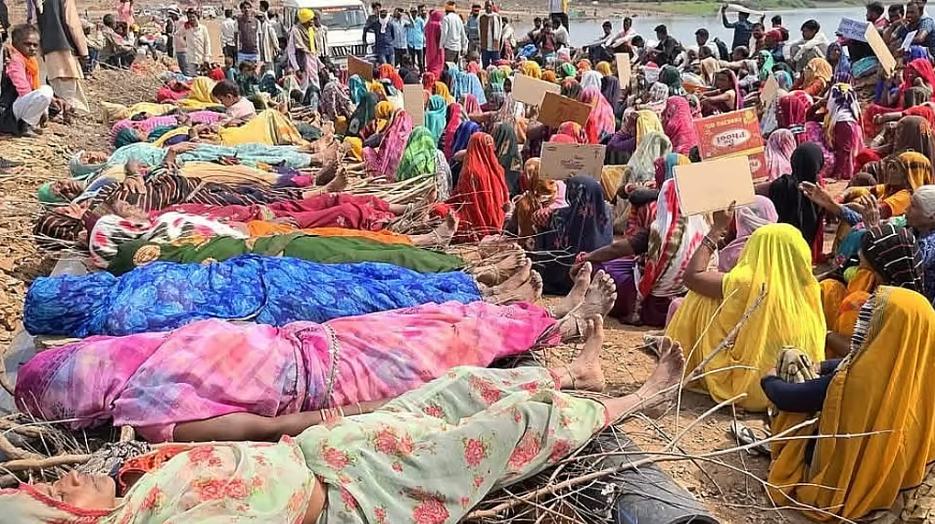
Despite the promise of development, protests erupted within days of the canal’s initiation. Large numbers of tribals, including women and children, staged demonstrations—some standing in water, others lying on funeral beds—declaring: “Either fulfil our demands or take our lives.” This raises a critical question: is this a credibility crisis of governance? Are promises inadequately implemented, or is trust eroded by repeated failures?
The District Magistrate of Chhatarpur admitted receiving complaints against revenue staff, terminated one official, and promised to bring in others to work without bribes. Yet, sources revealed a massive bribery scandal: over 90% of affected people had not received compensation as promised, while dispossession and displacement had already begun. This echoes former Prime Minister Rajiv Gandhi’s famous remark that “when the Centre allots 10 rupees, only a few paise reach the needy.” Ironically, a statement once mocked by the BJP now appears validated, undermining claims of “good governance.”
Philosophical reflections sharpen the critique. Arthur Schopenhauer, a pessimist of human nature, once wrote: “Compassion is the basis of morality.” His skepticism of political systems resonates here, as governance appears corrupted by greed and dishonesty. In contrast, Charlie Chaplin, in his timeless speech from The Great Dictator (1940), declared: “I’m sorry, but I don’t want to be an emperor. That’s not my business. I don’t want to rule or conquer anyone. I should like to help everyone—if possible—Jew, Gentile, black man, white.” Between Schopenhauer’s pessimism and Chaplin’s humanism lies the Indian reality: governance promises development, but tribal communities continue to feel excluded from the mainstream.
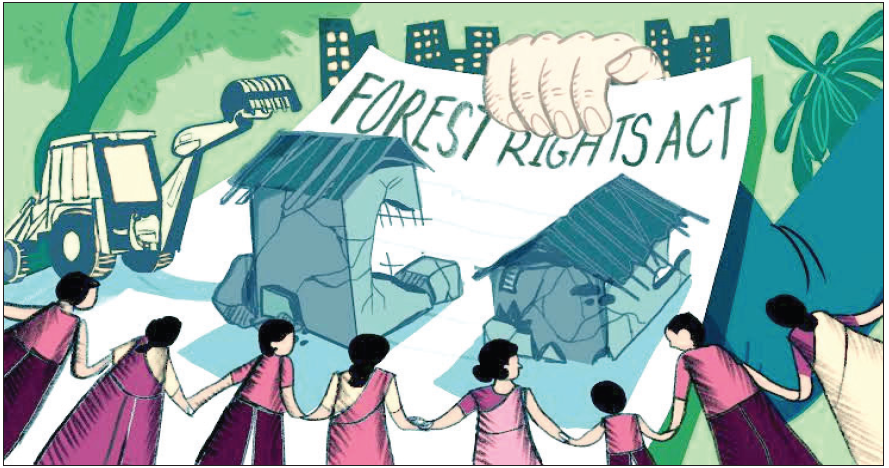
The protests are not merely about compensation or bribery. They are about existence. Tribals assert that land, forests, and rivers belong to them, and they are the custodians of their deities. Their resistance mirrors the farmers’ movement at Delhi’s borders, demanding rightful recognition in a democracy where all rights belong to citizens. They reject being treated as “subjects,” insisting instead on dignity and justice.
Development Promises and Tribal Resistance
The Ken‑Betwa Link Project, together with the Runjh‑Majhguwa Dam, has become the center of a tense confrontation between promises of development and the lived realities of tribal communities. For eleven days, hundreds of tribal women have staged what they call the Panchtatva Movement, gathering along the riverbanks, raising slogans and placards, and declaring their resistance to displacement. Their words carry both pain and defiance: “Our forests, land, and homes are being taken away, so we are forced to protest. It’s been 10 days, today is the 11th, and no officials have come. We will not leave until our demands are met. If they ignore us, we may be pushed towards extremism. Like Durga or Kali, we too can become fierce… Our children live in fear, but the government doesn’t care what happens inside our homes.” This testimony reveals the depth of mistrust and the existential anxiety of communities that feel excluded from the mainstream narrative of progress.
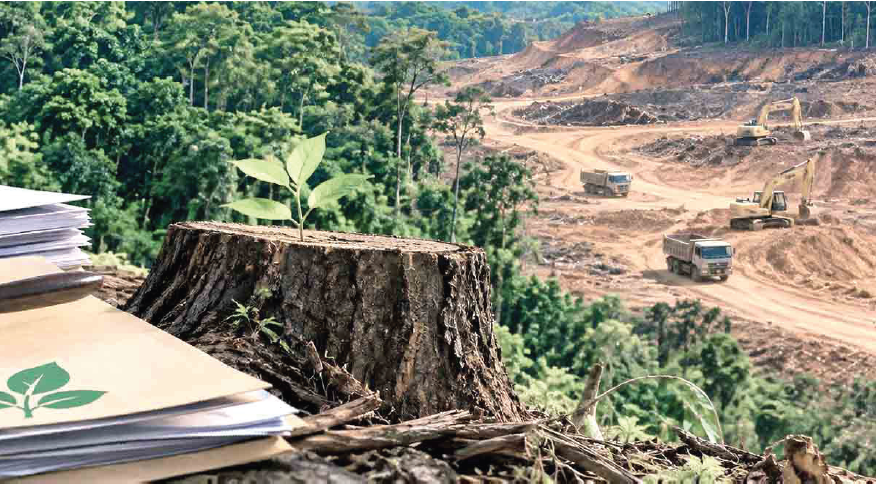
The government, on the other hand, presents the project as a landmark in irrigation and energy generation. Built on the Ken River in Chhatarpur and Panna districts of Madhya Pradesh, the plan includes a 77‑meter high and 2.13‑kilometre‑long “Daudhan Dam” inside the Panna Tiger Reserve, two tunnels to transfer surplus water, and a 221‑kilometre link canal. With a storage capacity of 2,853 million cubic meters, the project is expected to irrigate 8.11 lakh hectares across 2,000 villages in ten districts, benefit nearly seven lakh farmer families, and provide drinking water to 44 lakh people in Madhya Pradesh and 21 lakh in Uttar Pradesh. It also promises to generate 103 MW of hydropower and 27 MW of solar energy, while reviving 42 Chandela‑era heritage ponds to enhance groundwater recharge. In official language, the project is framed as a solution to Bundelkhand’s chronic water crisis, a step toward prosperity, and a way to curb migration by creating local opportunities.
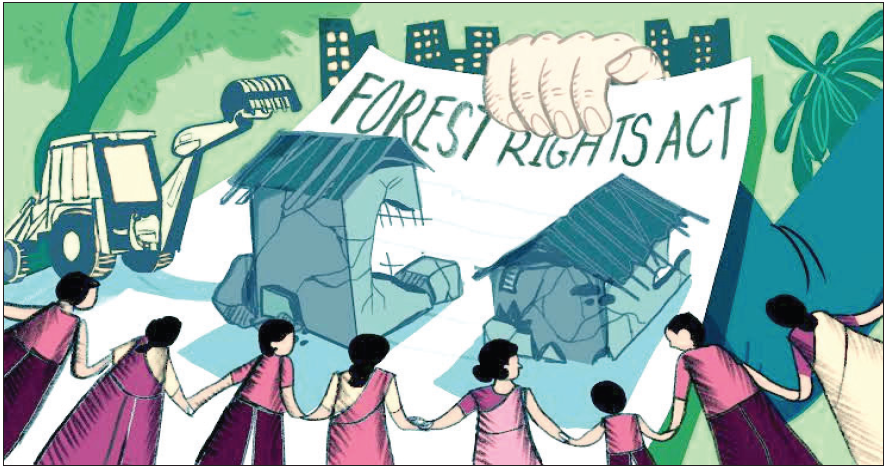
Yet constitutional principles remind us that development cannot be pursued at the cost of rights. The Fifth Schedule and the Panchayats (Extension to Scheduled Areas) Act mandate consultation with tribal Gram Sabhas before land acquisition in scheduled areas, and Article 21 guarantees the right to livelihood and dignity. When compensation is delayed or denied, as reports suggest in most cases, the constitutional promise is undermined. The protests, therefore, are not simply about money or relocation; they are about existence, identity, and trust. The invocation of Durga and Kali by protesting women is symbolic of both desperation and empowerment, a warning that neglect could radicalize communities who otherwise seek only recognition and justice.
The government’s figures—hectares irrigated, megawatts generated, millions supplied—stand in sharp contrast to the voices of those who say their homes, forests, and rivers are being taken away. This discontent mirrors the farmers’ movement at Delhi’s borders, where marginalized groups demanded recognition beyond electoral arithmetic. Here too, the project intersects with politics, with thirteen assembly seats in Uttar Pradesh directly affected and the stakes high for ruling and opposition parties alike. Development promises risk being seen as electoral strategies rather than genuine governance.
In the end, the Ken‑Betwa Link Project embodies India’s paradox: grand visions of irrigation, energy, and heritage revival on one side, and grassroots resistance rooted in survival and dignity on the other. For tribals, the struggle is not about statistics but about existence. Unless governance bridges the gap between promises and lived realities, the slogan “Hum Bharat ke log” risks becoming rhetorical, excluding those who have long been custodians of land, forest, and river.
Inter-Linking Rivers: Fulfillment of Sustainability Component
The idea to link rivers is noble but contested. Interlinking of rivers may address drought and flood issues, preventing loss of life and property by appropriate redistribution in water-deficient areas. This idea is, however, viewed with skepticism by the scientific community as it may disturb ecology, including the monsoon pattern. It is contended that the idea to link rivers stands on a dangerous and flawed premise - flood water is wasted once it enters the sea; instead, it is useful for maintaining the water cycle in the form of rain. Linking the idea is not only dangerous to natural ecology but also to people residing in the catchment area.
While under the Constitution of India, water is a State subject (Schedule VII, List II Entry 17) and covers water supply, canals, drainage, and embankments, etc., the Union Government has power to regulate and develop inter-state water rivers and river valleys (Schedule VII, List I Entry 56) in the public interest. Article 262, on the other hand, empowers the Union Parliament to adjudicate disputes of waters of inter-state rivers.
The concept of sustainable development, though still evolving, at the international level starts with Brundtland Report (1987), and in the G20 New Delhi Leaders’ Declaration (2023) sustainable development was once again emphasized as it seeks to integrate and balance issues of economic development, social equity, and environmental protection. The Supreme Court in the Narmada Bachao Andolan case, incorporating the idea of sustainable development, noted that sustainable development means development that can be sustained by nature and, in the MC Mehta case, emphasized to balancing industrial growth with environmental protection. Development and ecology are not sworn enemies but require a judicious balancing; while ecology should not be disturbed, development should not suffer.
The legal impediment has been cleared by the Supreme Court, headed by Chief Justice S.H. Kapadia, in the Networking of River case (2012) favouring the idea of interlinking of rivers. The Court passed an order to the Central Government for the interlinking of rivers in a time-bound manner. However, it was to be done under the supervision of an Oversight Committee. The Supreme Court did not receive objections from most of the States but presumed it as tacit consent. It is expected that the Oversight Committee will judiciously harmonize the issues, taking into consideration social equity, whenever the issue of interlinking rivers arises. The Oversight Committee may also investigate the socio-economic affairs of people displaced during the construction of Sardar Sarovar dam.




[[comment.comment_text]]