Record Turnout, Unclear Tide: Bengal’s 92.9% and Tamil Nadu’s 85.1% 2026: Psephologist’s Nightmare

 2 weeks, 6 days ago
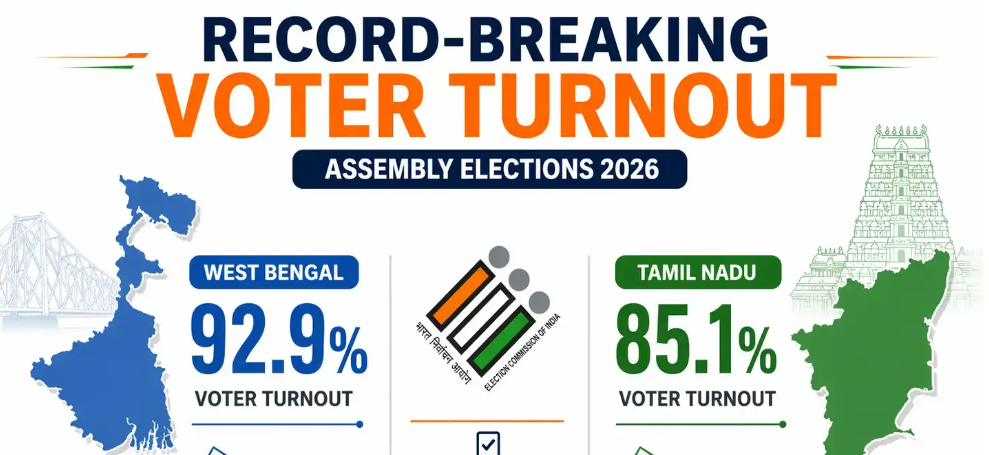
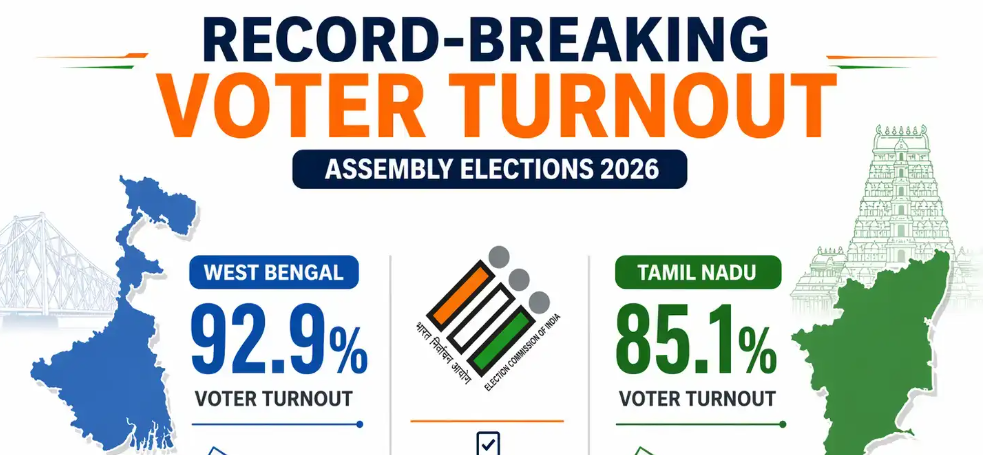
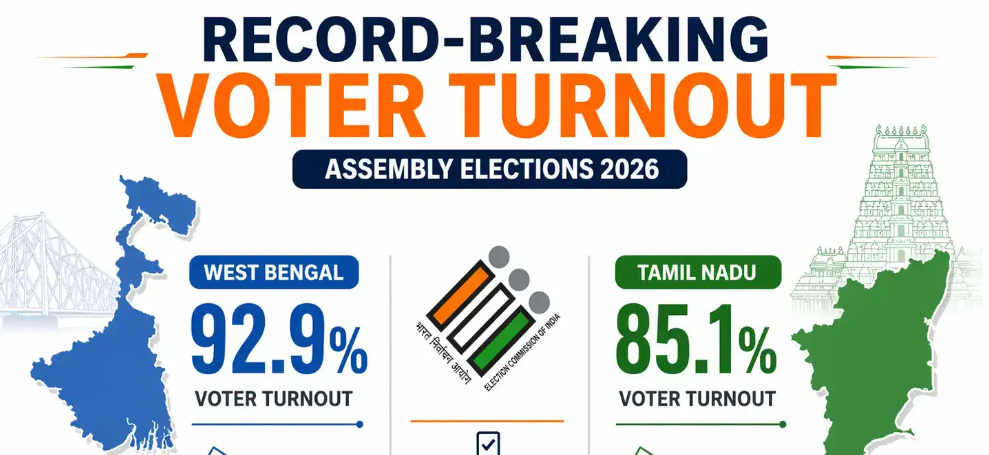
The record‑shattering 92.9 per cent voter turnout in the first phase of West Bengal’s 2026 Assembly election—across 152 of 294 seats—and the equally eye‑catching 85.1 per cent participation in Tamil Nadu have produced a genuine electoral riddle: such high intensity can simultaneously signal both anti‑incumbency anger and a consolidation of support for the ruling Trinamool Congress in Bengal and the Dravida Munnetra Kazhagam in Tamil Nadu. The result is that the outcomes in these two politically pivotal states have become a classic “psephologist’s nightmare,” where the same surge in turnout can be read as either a revolt against the establishment or a determined defence of it.
Turnout as a story in itself
West Bengal’s 92.9 per cent turnout—close to 93 per cent in 152 seats—has been described by authorities as the highest in the state’s electoral history since Independence, surpassing even the 84.72 per cent seen in 2011 when Mamata Banerjee dislodged the 34‑year Left Front regime. The raw energy of crowds, the extension of polling hours, and the visible mobilisation of Bengali‑Hindu, Muslim, and backward‑caste voters alike suggest an electorate that sees this election as more than a routine change of tenants.
In Tamil Nadu, the 85.11 per cent turnout, up from 72.73 per cent in 2021, translates into roughly 4.9 crore voters casting ballots against about 4.63 crore last time. Commentators note that while the percentage spike is dramatic, the actual increase—around 29 lakh voters—points to a more targeted, agenda‑driven mobilisation than a blind wave of enthusiasm.
Anti‑incumbency or a vote to protect the incumbents?
National and regional parties are reading the same numbers in opposite directions. The BJP and its allies argue that the surge reflects a pent‑up anti‑incumbency sentiment, especially in Bengal, where they claim years of organisational work, social‑media campaigns, and polarising narratives have finally drawn sections of society that once stayed home or voted for the status quo. The party’s narrative in Bengal is that years of TMC dominance, alleged corruption, and central‑state conflict have galvanised a “silent revolt,” particularly among Bengali‑Hindu and upper‑caste voters, as well as those alienated by internal party feuds and ticket‑denial resentment.
In Tamil Nadu, the BJP‑led alliance—anchored by the AIADMK and smaller regional players—frames the turnout as a sign of frustration with the DMK’s tight alignment with the INDIA bloc and its perceived softness on central policies. Yet for the DMK, the 85 per cent figure is less a rejection of the ruling party than a reaffirmation of the Dravidian electorate’s habitually high turnout, now channelled through a tightly knit, cadre‑driven network.
The DMK emphasises that its base has long voted in the high 70s and low 80s, and that 85 per cent is an extension of this entrenched discipline rather than a sudden uprising. In Bengal, Mamata Banerjee’s TMC similarly interprets the record turnout as a democratic upsurge against what she portrays as the BJP’s attempts to erode West Bengal’s semi‑federal autonomy and institutional independence, turning the election into a referendum on centralisation.
The BJP’s dual gambit in Bengal and Tamil Nadu
In both states, the BJP is running a parallel strategy whose core logic is the same but whose local flavour is distinct. In West Bengal, the party is banking on a mix of anti‑TMC sentiment in non‑Muslim pockets, the aftermath of defections and internal party fractures, and national‑level messaging around “security” and “development” to break the TMC’s 15‑year grip. The return of the intensive BJP‑TMC wrestling‑match dynamic—after the quieter 2021 contest—has heightened the sense that the stakes are existential: the BJP talks of a “double‑engine” change, while the TMC warns of a recolonisation of Bengal’s political autonomy by a centralising power.
In Tamil Nadu, the BJP’s wager is narrower but more delicate. It is trying to position itself as the “third force” that can puncture the DMK’s claim to be the sole legitimate guardian of Dravidian self‑respect, while leaning on the AIADMK’s residual base and the support of smaller regional partners. Yet this alliance also exposes the BJP to the enduring charge of being a “Brahmanical‑Hindutva” implant in a political culture that has historically defined itself against North Indian Brahminical dominance. The BJP’s hope is that the high turnout represents a shift in mindset, while its critics argue it is simply a reflection of the state’s entrenched habit of voting in high numbers without a clear directional tilt.
Fragmented opposition and the new players
The uncertainty is magnified by the fragmentation of the opposition space. In West Bengal, the Congress and the Left parties—still reeling from the 2011 and 2016 blows—have not only failed to build a united front but are now further squeezed by a proliferation of small outfits and individual defectors. The most prominent new entrant is Humayun Kabir’s Janata Unnayan Party (JUP), floated by a suspended TMC leader, which is contesting 182 seats and explicitly aiming to “stop the BJP” while simultaneously carving out a niche among Muslim and backward‑caste voters disillusioned with the TMC. If JUP and other micro‑parties succeed even marginally, they could alter the arithmetic of key constituencies from the margins, without necessarily winning them outright.
In Tamil Nadu, the big wildcard is actor Vijay’s nascent party, which has entered the fray with a youth‑centric, liberal‑populist platform that appeals to a younger, urban electorate weary of the DMK–AIADMK duopoly. Political commentators describe Vijay’s outfit as a “thunderbolt” that could realign the loyalties of the soft‑secular and aspirational middle class, but others caution that such charismatic but untested formations often end up as “vote‑splitting spoilers” rather than kingmakers—especially when the BJP‑AIADMK combine is already absorbing much of the opposition space.
Why the numbers defy easy reading?
The central puzzle is that record turnout in both Bengal and Tamil Nadu signals polarisation but not clarity. In Bengal, a high turnout may reflect the TMC over‑voting to protect its core strongholds, while the BJP relies on concentrated gains in swing belts and newly energised pockets; the outcome will depend on whether this surge translates into a broadening of the BJP’s base or merely a defensive consolidation of the TMC’s vote. In Tamil Nadu, the Dravidian electorate’s historic habit of high turnout combined with the fact that nearly 74 lakh voters were removed from the rolls through a massive revision exercise, which raises questions about whose participation is actually being counted. A percentage that looks like a record may, in raw terms, denote a more constrained expansion than it appears.
On top of this, the multiplicity of parties—from the BJP‑led coalition and AIADMK in Tamil Nadu to the splinter TMC factions, JUP, and the Congress‑Left rump in Bengal—means that the same energised voter is now choosing among more options than ever before. This is precisely why the two elections are being described as a psephologist’s nightmare: the volume of votes is high, the contest lines are sharp, but the direction of the wave is anything but clear.
More than just numbers: the mood of the moment
Beyond the arithmetic, the 92.9 per cent and 85.1 per cent turnouts capture a deeper political anxiety. Voters in these two states seem to see the 2026 Assembly elections not as a mid‑cycle drift but as an inflection point for their regional projects and for India’s federal compact.
In Bengal, the spectre of a BJP‑dominated central machinery, security‑state interventions, and the erosion of the state’s semi‑federal autonomy feeds a sense that a single vote is not just a mandate but a shield.
In Tamil Nadu, the DMK’s narrative of defending state autonomy and federalism against a “unitary” Centre, contrasted with the BJP’s claim to be the only “national” force capable of breaking the Dravidian wall, produces a similar feeling of irreversible stakes.
Whether this turnout ultimately translates into a BJP breakthrough, a consolidation of the TMC and DMK, or simply a more fractured and volatile politics in both states, the single clearest takeaway is this: the people of West Bengal and Tamil Nadu have turned up not out of complacency but out of the conviction that the future of their regional self‑understanding—and of India’s federal architecture—will be shaped in the next few weeks. For the psephologist, the journalist, and the party strategist, the only certainty in this election is that the numbers will not be kind to certainties.
(Author is a former member of the history faculty at St. Xavier’s College, Mumbai.)




[[comment.comment_text]]