Road Safety as a Constitutional Imperative!

 5 months, 2 weeks ago
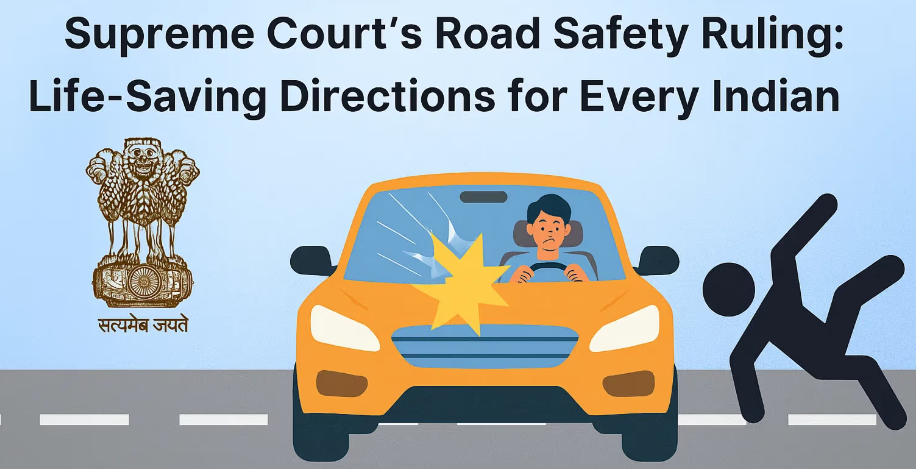
The recent intervention by the Supreme Court of India, which explicitly places highway safety within the ambit of the right to life under Article 21 of the Constitution of India, marks a critical moment in India’s evolving constitutional and policy discourse. At its core, the judgment does something both simple and profound—it acknowledges that the loss of life on roads is not merely an unfortunate by-product of modern mobility, but a preventable failure of governance that engages the State’s direct responsibility.
This recognition comes against a sobering reality. India’s roads continue to witness an alarming number of fatalities every year. Even with a modest decline in recent trends, the figure—over 160,000 deaths in 2025—remains staggeringly high. Behind these numbers are individuals, families, and communities disrupted in an instant. For many, these accidents are not acts of fate but consequences of systemic gaps: poorly designed roads, weak enforcement of traffic laws, inadequate signage, and delayed medical response. The Court’s ruling, therefore, is not an abstract legal expansion; it is grounded in the lived experience of a country where mobility often comes with disproportionate risk.
By bringing highway safety under Article 21, the Court has reinforced an important constitutional principle: the right to life is not passive. It does not only protect citizens from arbitrary State action; it obligates the State to actively create conditions where life is preserved. This interpretation is consistent with the Court’s broader jurisprudence, which has progressively expanded Article 21 to include rights that ensure a life of dignity—clean air, access to healthcare, and safe working environments. Road safety now joins this expanding horizon, reflecting the idea that governance must anticipate and prevent harm, not merely respond after it occurs.
The significance of this shift lies in how it reframes accountability. For decades, road accidents in India have often been treated as isolated incidents—triggering compensation, legal proceedings, or temporary enforcement drives. Rarely have they been viewed as indicators of systemic failure. The Court’s emphasis on prevention challenges this mindset. It places the burden squarely on institutions to address underlying causes, whether they lie in infrastructure design, regulatory enforcement, or emergency response systems.
Highways, in particular, represent a paradox. They are symbols of economic progress—facilitating trade, reducing travel time, and connecting regions. Yet, their design and usage also make them high-risk environments. Speed, volume, and mixed traffic conditions combine to create vulnerabilities that are often underestimated. In many instances, highways lack basic safety features: proper lane markings, crash barriers, pedestrian crossings, and adequate lighting. The expansion of road networks has not always been matched by a proportional investment in safety audits and maintenance. The Court’s ruling effectively signals that such gaps are no longer administratively tolerable—they carry constitutional implications.
Enforcement is another critical dimension. India’s legal framework governing road safety is not inherently weak. Laws exist to regulate speed, penalize drunk driving, and mandate the use of helmets and seatbelts. However, enforcement remains inconsistent. Violations are widespread, and compliance is often shaped by the perceived likelihood of being caught rather than an internalized sense of responsibility. By elevating road safety to a fundamental right, the Court has indirectly increased the accountability of enforcement agencies. Systemic negligence, or a failure to act against known risks, could now invite greater judicial scrutiny.
Equally important is the issue of post-accident care. A significant proportion of fatalities occur not at the moment of impact but in the critical minutes and hours that follow. Delays in reaching medical facilities, lack of trauma care infrastructure, and inadequate coordination between emergency services contribute to avoidable deaths. The concept of the “golden hour” is well established in medical science, yet its operationalization remains uneven across India. By linking road safety to the right to life, the Court has implicitly broadened the State’s obligation to include timely and effective emergency response. Saving lives, in this context, is as much about preparedness as it is about prevention.
The ruling also brings into focus the fragmented nature of road governance in India. Responsibilities are divided across multiple layers—central authorities manage national highways, states oversee state roads, and local bodies handle urban infrastructure. This division often leads to coordination gaps, inconsistent standards, and diffused accountability. The Court’s emphasis on a unified obligation to protect life could serve as a catalyst for more integrated policy frameworks, where safety is treated as a shared and non-negotiable priority.
Beyond institutional reforms, there is a broader societal dimension that cannot be ignored. Road safety is not solely a function of policy; it is also shaped by behaviour. Over-speeding, disregard for traffic rules, and risk-taking practices are deeply embedded challenges. Changing this requires sustained public engagement, education, and awareness. The law can mandate compliance, but long-term improvement depends on cultural shifts—where safety is internalized as a collective responsibility rather than an external imposition.
Internationally, road safety is increasingly viewed through a public health lens. Frameworks such as the “Safe System Approach” emphasize that human error is inevitable, and therefore systems must be designed to minimize its consequences. This includes safer road design, better vehicle standards, responsible user behaviour, and efficient post-crash care. India’s policy direction has begun to align with these principles, but implementation has been uneven. The constitutional backing provided by the Court could accelerate this transition, giving policy initiatives greater urgency and legitimacy.
However, the transformative potential of this judgment will depend on execution. Judicial recognition, while powerful, is only the first step. Translating constitutional principles into measurable outcomes requires administrative capacity, sustained funding, and political commitment. It also requires robust data systems to identify high-risk zones, monitor interventions, and evaluate impact. Without such mechanisms, the risk is that the judgment remains aspirational rather than operational.
What the Court has done, fundamentally, is to change the lens through which road safety is viewed. It has shifted the narrative from inevitability to accountability, from reaction to prevention, and from policy discretion to constitutional duty. In doing so, it has elevated the issue to a level where inaction is no longer defensible.
For a country in the midst of rapid urbanization and expanding mobility, this shift could not be more timely. Roads are not merely physical infrastructure; they are spaces where economic activity, social interaction, and daily life intersect. Ensuring that these spaces are safe is integral to the idea of a just and functional society.
The challenge now is to move from recognition to reform. If the State responds with the seriousness that the judgment demands—by investing in safer infrastructure, strengthening enforcement, and improving emergency care—India could begin to see a meaningful reduction in road fatalities. If not, the constitutional promise risks remaining unfulfilled.
In essence, the Supreme Court’s ruling is a reminder that the right to life is not an abstract guarantee. It is a living commitment—one that must be reflected in the everyday realities of citizens, including something as routine, and as risky, as a journey on the road.





[[comment.comment_text]]