Women's Reservation law in Limbo: Gender Politics or political chicanery

 5 months, 2 weeks ago
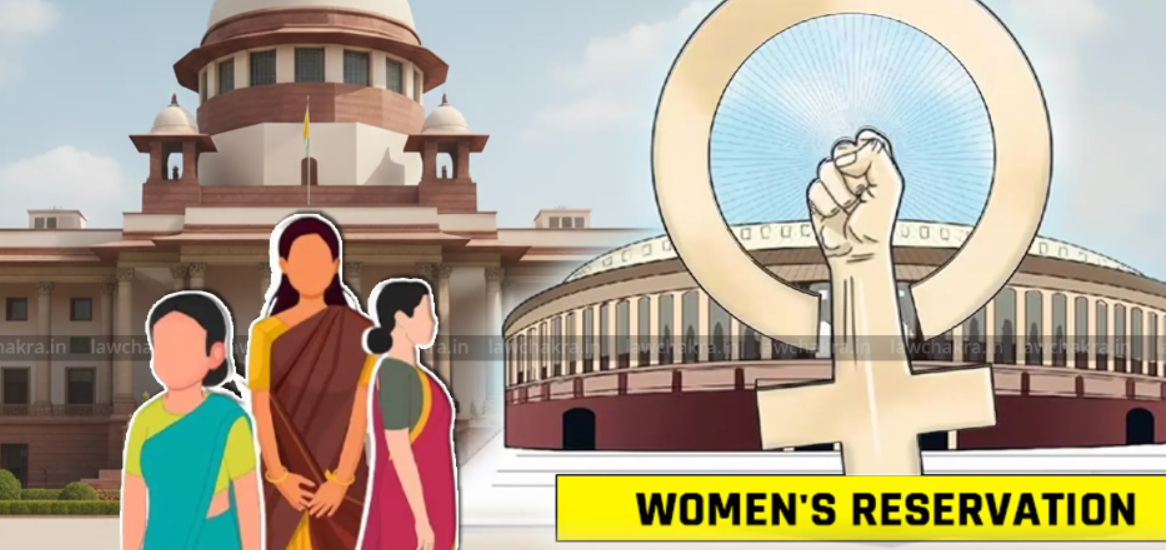
The Constitutional (131st Amendment Bill), 2026, aimed at implementing 33% women's reservation in the Lok Sabha and State Assemblies by 2029, fell through in the Lok Sabha on 17th April 2026, as the government could not muster the two-thirds majority required to pass the Bill. It has dashed the hopes of 50% of the population of the country at the altar of political rivalry, and thus an historical opportunity for gender equity in running the country’s legislatures was lost. One of the contentious issues was the delimitation being proposed by the government to increase the Lok Sabha seats to 850 from the present 543 seats. The opposition Congress and DMK opposed it on specious ground with no solid reasons that the seats of Southern States would be reduced. Rather the seats are indeed increasing after adjusting the women reservation in each state. In fact, Southern states as stated by Andhra Chief Minister Mr Chandra Babu Naidu have lost an historical opportunity for increased participation in the Parliament as there was a simple formula to increase seats by 50% in each State to accommodate 33% reservations for women. It was a well intentioned decision by the Narendra Modi government. The opposition parties have given a self defeating blow to them and committed a political hara-kiri of worst kind. While the principle of gender parity is widely celebrated in public discourse, the legislative journey of the Women’s Reservation Bill reveals a complex landscape of federal friction, identity politics, and the strategic survival of the existing political class.
Though since Independence India’s journey in gender equity has been far better than the western democracies like USA and Britain. It is actually quite a point of pride in Indian history that India adopted Universal Adult Suffrage immediately upon the commencement of the Constitution in 1950. Unlike Britain or the United States, which forced women to fight for decades or even centuries for the right, India enfranchised all women and men equally from day one. In that sense, India’s "starting line" was more progressive than the long, staggered journey the British had to endure. Britain though allowed sketchy women franchise in 1921 but one person one vote came only after 1948 Act.
In India the historical breakthrough was reached in September 2023, the Constitution (106th Amendment) Act was passed by the Parliament. It promised 33% reservation for women in the Lok Sabha and State Assemblies. Yet, a crucial caveat was inserted: the reservation would only take effect after a new Census was conducted and a subsequent delimitation for redrawing of constituency boundaries was completed.
The government logic is simple by adding new seats; the state can carve out a 33% quota for women without unseating current male representatives. It was a win-win situation which the opposition’s short sightedness derailed it. The DMK and the Congress raised the spurious issue of demographic dominance of North which is a frivolously diversionary Politics as the proposal has equal share for each state in the ratio of 50%. The opposition parties merged the divisive politics of federalism with the women reservation at a time when the women were about to get their share as agreed by all parties after the 2023 bill was passed. As of April 2026, this delimitation clause has become the epicentre of Indian politics highlighting the critical fault lines of Indian politics. Now many critics are asking the opposition parties why they did not raise the issue of reservation based on existing seats in 2023 when the Bill was passed and why they supported delimitation clause at that time and now finding fault with it. Many women organizations claim that it is a case of gender bias to deliberately deny the women their right by hook or crook.
Many family based parties raised the issue of reservation within reservations especially sub-quota for backward classes. The opposition fear is that the redrawing of boundaries could be used to strategically weaken opposition strongholds under the guise of gender empowerment. The politics of women’s reservation is not just about seats; it is about the gate keeping of political power. Even without a formal quota, political parties have the power to field more women candidates. However, data from recent assembly elections shows that women constitute only about 10% of total candidates. Parties often cite winning prospects as a reason for not nominating women, a logic that reservation aims to break. Furthermore, there is the well known phenomenon of "Sarpanch Pati" (husbands of elected women exercising actual power) seen at the grass root democracy. Critics argue that without systemic changes in the internal structures of parties and the elimination of muscle politics, a seat-based quota might only lead to "proxy" representation.
Let us also discuss about the tricky issue of delimitation which is mandated under Article 82 for the Parliamentary Constituencies and Article 170 for the State assemblies based on census data. The 42nd Amendment Act (1976) froze the allocation of seats to states and the division of constituencies at the 1971 census level until the year 2000. Further, 84th Amendment Act (2001) & 87th Amendment (2003) extended the freeze on seat allocation until 2026, though it permitted re-adjusting constituency boundaries within states based on the 2001 census. The current seat allocation is based on the 2001 Census, with the next delimitation exercise due after the first census conducted after 2026.
However, before the next step is taken the government of Prime Minister Narendra Modi must think of amending the constitution to lay out a broader framework for delimitation and abandon the sole criteria of census based population for delimitation of constituencies as the population control has become a prime national need of the present time. Already the Southern states who have controlled the population growth well have been demanding the change in approach. Similarly, Uttarakhand and Himachal were at loss in the past as their difficult terrains were not taken into consideration while allocating seats. A case in point is in 1950 Delhi with an area of 1489 sq km with a population in 1950 of little above four lakh after partition of the country was allocated seven Lok Sabha seats as against five to Uttarakhand with an area of 55,000 sq km and a population of around 29 lakh in 1950. In case of Himachal four seats of allocated as against a population of 23.86 lakhs in 1950. Such distortions need to be corrected but require a very bold vision. A futuristic pragmatic and innovative solution is the need of the hour but in any case the 2026 delimitation should be the last delimitation exercise. 1124 words
(The writer, a former IFS officer, currently chairs the Centre for Resource Management and Environment.)


[[comment.comment_text]]