Collapse of Credibility

 4 months, 3 weeks ago
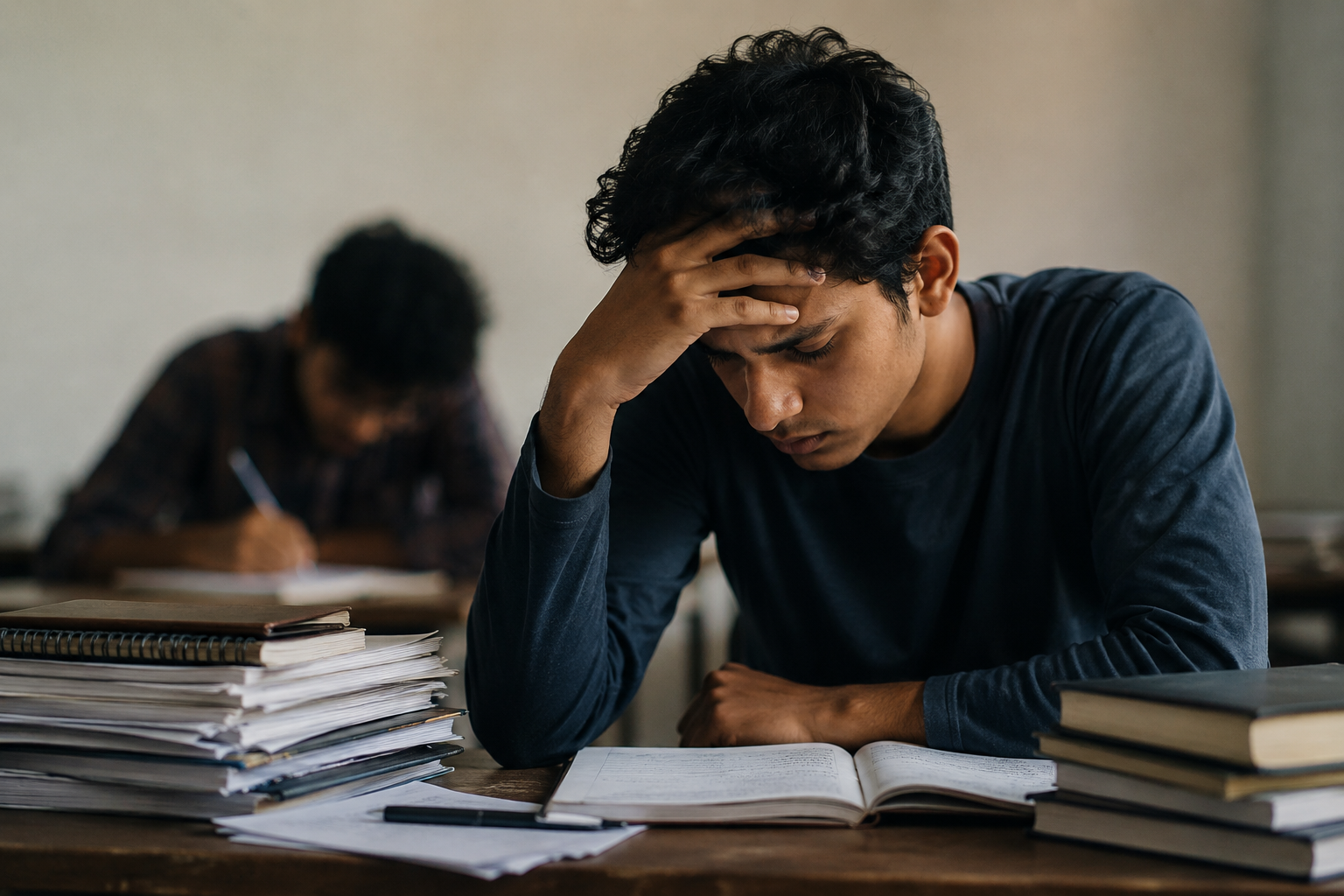
India often takes pride in calling itself the world’s youngest nation. Political speeches, policy documents, and government campaigns repeatedly describe the country’s youth as its greatest strength and its most valuable demographic advantage. From the promise of “Amrit Kaal” to the dream of a “Viksit Bharat,” the future of India is consistently projected through the aspirations of millions of young students preparing for examinations, degrees, and careers. Yet behind these ambitious slogans lies a growing crisis that is steadily damaging the confidence of an entire generation. The recent controversy surrounding the alleged leak of the NEET examination paper and discussions over re-examinations have once again exposed the fragile condition of India’s educational and examination system. More importantly, they have forced the country to confront an uncomfortable question: how long can a nation continue to speak of progress while repeatedly failing to protect the future of its youth?
The issue is no longer limited to one examination or one institution. Over the last several years, India has witnessed repeated paper leaks in recruitment tests, entrance examinations, teacher eligibility tests, police recruitment exams, and professional admissions. What was once considered a rare administrative failure has now begun to resemble a recurring structural disorder. Every few months, another examination is cancelled, another investigation committee is formed, another group of students is asked to wait again, and another generation is told to remain patient. But patience, especially among young people whose lives are defined by deadlines and age limits, cannot be demanded endlessly.
The tragedy of paper leaks is not simply administrative. It is deeply human. Behind every examination form is a family carrying expectations, sacrifices, and emotional burdens. In villages across India, farmers sell portions of their land to pay for coaching classes. Daily wage labourers skip personal needs so that their children can study in cities. Mothers save every possible rupee to afford hostel fees and books. Students themselves isolate from social life for years, spending sleepless nights preparing for examinations that are often portrayed as gateways to dignity and stability. For these young people, an examination is not merely a test; it is frequently the only visible path toward social mobility.
When a paper leak occurs, what collapses is not only the secrecy of a question paper but the belief that hard work alone can still change one’s destiny. That psychological damage is perhaps more dangerous than the leak itself. A society survives on trust — trust in institutions, trust in fairness, and trust that merit will eventually be rewarded. Once students begin believing that success depends more on money, political connections, corruption, or access to leaked papers than on effort and talent, the moral foundation of the system starts weakening from within.
The concern becomes even more serious in a country like India where competitive examinations are closely tied to economic survival. Unlike many developed societies where multiple career pathways exist, Indian students often grow up believing that a single examination can define the direction of their entire life. The pressure surrounding exams such as NEET, JEE, UPSC, SSC, or various state-level recruitment tests is therefore immense. Failure is not treated merely as an academic setback; it is frequently interpreted as personal defeat, social embarrassment, or financial disaster. In such an environment, repeated paper leaks and examination cancellations intensify anxiety and hopelessness among the youth.
At the same time, another uncomfortable reality has been silently deepening alongside these examination controversies — the rapidly rising cost of private education. Quality education in India is increasingly becoming expensive beyond the reach of ordinary families. Private schools charge enormous fees, coaching industries have transformed preparation into a commercial marketplace, and professional education, especially medical and technical education, has become financially inaccessible for a large section of society.
The situation in medical education is particularly alarming. Government medical colleges continue to have limited seats compared to the massive number of aspirants. As a result, lakhs of students compete intensely for a few thousand affordable opportunities. Those unable to secure government seats are pushed toward private institutions where the cost of an MBBS degree can range from tens of lakhs to over a crore rupees. For a middle-class or poor family, such figures are unimaginable. Consequently, education, which should ideally function as an instrument of equality, is gradually becoming a privilege determined by economic background.
This growing commercialization of education creates a dangerous contradiction. On one hand, India speaks of becoming a global knowledge economy requiring skilled doctors, engineers, researchers, scientists, and innovators. On the other hand, access to quality education is becoming increasingly unequal. Students from financially strong backgrounds can afford elite coaching, expensive study material, better schooling, and private colleges. Meanwhile, talented students from poor or rural backgrounds are forced to fight structural disadvantages from the very beginning. When paper leaks occur within such a system, the frustration becomes even more intense because students feel they are being defeated not only by inequality but also by corruption.
The expansion of the coaching industry further reflects deeper weaknesses in the education system. Cities such as Kota, Delhi, Patna, Prayagraj, and Hyderabad have become symbols of India’s exam-centric culture. Lakhs of students migrate to these cities every year, often living in cramped hostels under extreme psychological pressure. For many families, coaching expenses consume years of savings. Yet despite this enormous financial and emotional investment, there is no guarantee of fairness in the final process.
The emotional burden carried by students today is perhaps one of the least discussed dimensions of this crisis. Young people preparing for competitive exams already experience enormous mental stress due to academic pressure, social expectations, uncertainty about jobs, and fear of failure. When examinations are cancelled after months or years of preparation, the emotional consequences can be devastating. Many students experience depression, anxiety disorders, emotional exhaustion, and feelings of helplessness. India has repeatedly witnessed heartbreaking incidents of student suicides linked to academic pressure and examination-related stress. Yet discussions around educational reform often remain limited to policy language and political statements, ignoring the emotional realities of the students themselves.
The government frequently highlights technology as the solution to systemic inefficiencies. Digital India initiatives, AI-based monitoring systems, online surveillance mechanisms, biometric verification, and cybersecurity frameworks are presented as signs of modernization and transparency. However, repeated leaks in highly sensitive national examinations raise an obvious question: if the systems are technologically advanced, why do such breaches continue occurring?
The answer lies in recognizing that technology alone cannot solve problems rooted in administrative failure and institutional corruption. A digital system is only as reliable as the people operating it. If accountability mechanisms remain weak, if corruption penetrates institutional structures, and if political seriousness toward reform remains inconsistent, technological tools cannot guarantee integrity. Paper leaks of such magnitude are unlikely to occur without internal collusion or organized criminal networks operating within or around examination systems. Therefore, the issue is not merely technological but deeply structural.
Another disturbing aspect is the normalization of examination failures within public discourse. There was a time when cancellation of a major exam would trigger national outrage and immediate institutional accountability. Today, such incidents are becoming frighteningly routine. Recruitment examinations are cancelled, entrance tests are postponed, investigations are announced, and eventually public attention shifts elsewhere. But for students, the consequences do not disappear. An aspirant preparing for government jobs often spends the most productive years of youth waiting for examinations, results, or re-examinations. Delays in recruitment cycles not only waste time but also create long-term psychological and economic instability.
India must recognize that the youth crisis is no longer only about unemployment. It is equally about uncertainty. Young people today are not simply struggling to find opportunities; they are struggling to trust the systems meant to provide those opportunities fairly. That erosion of institutional trust is dangerous for any democracy. Nations remain stable when citizens believe that institutions function impartially and that individual effort can produce meaningful outcomes. Once that belief weakens, frustration gradually transforms into alienation.
The implementation of the New Education Policy was projected as a transformative moment for Indian education. The policy introduced important conversations around multidisciplinary learning, skill development, flexibility, and modernization. However, policy transformation alone cannot rebuild public confidence unless foundational issues are addressed simultaneously. A student does not judge the education system only by curriculum reforms or policy announcements. Students judge the system by whether examinations are fair, whether admissions are transparent, whether degrees lead to opportunities, and whether merit is genuinely respected.
Similarly, the discussion around higher education also requires deeper attention. The discontinuation of M.Phil., limited PhD seats, shrinking academic opportunities, delayed recruitments in universities, and increasing contractual employment have created uncertainty among research scholars and academically inclined students. Many talented young Indians now feel trapped between expensive education and uncertain career prospects. The result is intellectual frustration, brain drain, and growing cynicism toward public institutions.
At this critical moment, the government must move beyond symbolic responses. Investigation committees and temporary suspensions are insufficient when the credibility of the system itself is under question. What India requires is a comprehensive and transparent reform process focused on rebuilding trust.
First, examination systems must become institutionally autonomous and professionally secured. Independent examination authorities insulated from political and bureaucratic interference could help improve credibility. Second, advanced encryption systems and decentralized digital distribution of question papers should be implemented to reduce leak vulnerabilities. Third, paper leak cases must be treated as serious crimes against national development, with fast-track judicial mechanisms ensuring swift punishment for those involved.
At the same time, reforms must extend beyond examinations. Government investment in public education infrastructure must increase significantly. Strong public schools, affordable universities, and expanded medical and technical institutions are essential to reducing inequality. Regulation of private educational fees also deserves urgent consideration. Education cannot become entirely market-driven in a country where millions still struggle for basic economic stability.
Mental health support for students must also become a national priority. Schools, universities, and coaching institutions should have structured counselling systems and psychological support services. India cannot continue discussing youth development while ignoring the emotional collapse experienced by many students under extreme academic pressure.
Most importantly, policymakers must begin listening to students not merely as voters but as citizens carrying the future of the country. Young Indians do not seek endless political slogans. They seek reliability, fairness, and dignity. They want assurance that years of hard work will not be destroyed by corruption or systemic negligence. They want a system where opportunity is determined by merit rather than privilege.
The future of a nation is not built only through highways, digital platforms, or economic statistics. It is built through the confidence of its youth. If young people begin believing that institutions cannot protect fairness, then even the most ambitious national visions lose moral strength.
India today stands at an important crossroads. It can either continue normalizing examination failures, expensive education, and institutional distrust, or it can treat this moment as an opportunity for serious reform. The choice will determine not only the future of students but also the credibility of the nation itself.
Because ultimately, the issue is not merely about one leaked examination paper. It is about an entire generation trying to build its future through honesty, effort, and hope. If that generation repeatedly feels defeated by corruption, inequality, and indifference, then the dream of a developed India risks becoming only a political slogan rather than a lived reality. And history, when it looks back at this period, may ask a difficult question: when millions of young people were losing faith in the system, did the nation truly listen?



[[comment.comment_text]]