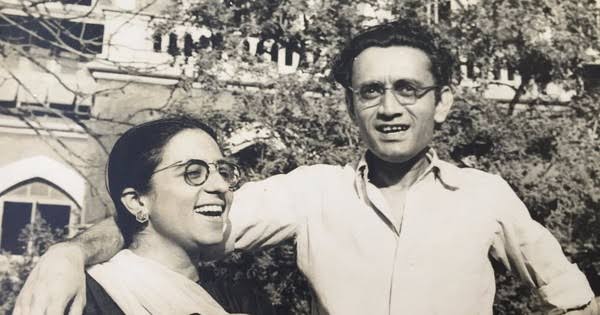
Manto Defends Women Vilified by a Male Chauvinist Social Order

 1 year, 2 months ago
“If you can not bear these stories, then society is unbearable. Who am I to remove the clothes of this society, which itself is naked. I don't even try to cover it, because it is not my job, that's the job of dressmakers.”
—Saadat Hassan Manto
Urdu fiction would have ended up as the stories churned out from dislodged houses, devastated trains, besmirched streets, blood-stained conscience, linguistic frenzy and communal hatred following the 1946 massacre. It would have further revolved around the likes of Kaali Raat or Aisi Bulandi Aisi Pasti or Basti or Khuda Ki Basti, or Udas Naslain or the fire ignited by Angaare in 1932 by a cluster of so called progressive writers. But in terms of creating a genuine tradition of fiction with an eye on the mores of the time and society and the circumstances both social and political had much to owe to the great genius of Sadat Hassan Manto despised early on as skin flick writer or condemned to ostracism as the one who wrote the issues that raised the eyebrows of the bourgeoisie kinfolk. The spiritual, the physical and the moral tract, the doctrine of equality, dignity, marginality, alienation, and the subaltern as the hobos caught the fancy of the writers like Sajjad Zaheer, Rashid jehan, Mahmudurzaffar and Ahmad Ali who through Angaare tolled the warning bell with élan and initiated the social transition at least professed only to end up as the farrago of pointless chit chat or ended with a celebrated whimper.
The much trumpeted claim of the progressive writers to raise the proletariat to social dignity which to an extent Rajinder Singh Bedi or Krishna Chander did through Lajwanti, Apne Dukh Muje de do, kokhjali, Kallu Bhangi, Ek Gadhe ki Sarghuzhast and Mahaluxmi ka Pul . The plight of the humbled and the social stigma attached to their existence did not witness any dramatic acceptance or recognition rather the cry remained the desperate scream of a bunch of writers who sounded more ideological and less pragmatic but the rest of the progressive writers did not go beyond the high- falutin Marxist canon. Premchand, though, went for the realistic portrayal of the outcaste and the poverty ridden classes without idealizing hunger or misery.
Manto was a class act, a reader of the human gloom with a special concern for the doom a woman eventually was condemned to in a society that lived the colours of life and ostracized the ones they used and abused. Manto investigates the tormented psyche of a class of woman who regaled men by nullifying their carnal fires and still faced the ire of the same men who turned them into objects of pleasure and gave them names defying dignity.
One of the great features of Manto’s art is the representation of the grotesque about a human society that practiced a host of contradictions, particularly with regard to the position of woman. He exposed the duality of the men’s character by weaving stories based on the subversive sexual slavery of the hapless women who surrendered their dignity to the pretentious but hollow nature of the man’s world. The darkness of the human psyche presides over his imagination and he finds nothing wrong in the representation of the bodies for he believes that a woman is subservient to the man’s interest and her position is determined by them even though they themselves push the same condemned creatures into the cesspool of prostitution.
Manto was a literary psycho-analyst who could read the mind of the characters and pit them against circumstances that would indeed suggest the intensity of thought or the feeling involved in the representation of characters drawn from what Gorki calls 'people of lower depth'. It’s the same people of lower depth that finds continued sympathy and favour with Manto as girls of the downtrodden or the girls from the besmirched streets would act as harlots and the silk scarved sophisticates would be regaled by the odour of the same.
Let us consider some of his stories that have been instrumental in building his reputation as pornographic writer. Das Rupai, Babu Gopinath, Sarkandon ke piche, Shanti, Hitak, Janki, Kali Shelwar Khol Do, Thanda Gost, Dhuan and Boo. These are fascinating stories told by a sensitive thinking mind who probed the dimensions of the problems the fair sex was generally up against.
Prostitution is a sport for men and stigma for women. The term prostitution catches the fancy of the young men while the woman remains in coercive sexual slavery.
Manto was more concerned with analyzing the factors that led to the rise of the flesh trade and the dirty game of sexual abuse induced by the same men who denounced it only to remain a constituent of it. The contradiction Manto laments is the paradox of human society. Das Rupai, Babugopinath, Sharda, Burmi Larki, and Hitak are based on the most despised and disliked subject of prostitution. They are women though billed as whores but the question is whether a woman when transformed into a whore ceases to be a woman, a living, thinking woman, tormented Manto most and he was keen to look into the heart of a woman who was called a prostitute. The term as we know is derogatory is without the grace a society generally accords to its members simply because she has been into something that pleases the depraved men’s psychology. For example, Sarita of Das Rupai is a young woman without the resources, up against adverse circumstances but retains her youth, her womanhood, and her feminine impulses, wears Georgette Sarees, uses lipstick but fails to find the youthful exuberance for a longer period and every time she sleeps with a man, she gets ten rupees. Physically, she is under duress, and the intense biological pressure subdues or dismantles her feminine features. Sex is the only relevant factor in her life. Here. Manto leaves nothing for the readers to comment because in the creation of Sarita, he has inflicted a serious jibe at the phallic structure.
Consider this extract from Hitak:
She was standing alone in the bazaar. The flowery saree she wore only on special occasions was rustling with the soft, late night breeze. She detested its silken swishing. She wanted to tear it off and shred it to pieces because the saree waving in the breeze, and with each swish she could hear it utter ‘hunh ,hunh’. She had applied rouge on her cheeks and lipstick on her lips. When she realized she had put on makeup to make herself appear attractive, she broke out in a sweat. So deep was her shame. What excuses could she offer to lessen her shame? I didn’t get decked up to please that idiot! it’s my habit, and it’s not just me, everybody does it ….but….but…it was 2 at night and Ram Lal, that pimp,and this market, and that car and the harshness of that flashlight. With these thoughts, bright spots of light began to swim before her eyes as far as she could see, and once again, she heard the groaning engine of the Seth’s car in the night breeze. (Naqoosh Manto Number49-50, p106)
Hitak has a special place in the realm of Manto’s art. One incident can awaken a besmirched conscience like Sugandhi to the reality of her own being, the discovery of womanhood and how it hurts the very woman who never thought of her individuality Here Manto’s art achieves new dimension as it closes in on the perception that even a whore at times can be hurt and hurt to the extent that she begins to hate man and thus her rejection by one seth also culminates into the rejection of the pimp, Ram Lal. Hitak is a revelation of a simple fact that a woman is always a woman and could well be an assertive individual, even a whore can do. Needless to say Manto writes on sex.
Remarks Nikhat. M.Gandhi
"Sugandhi’s character and its many redeeming aspects, in feminist theologian, Mary Grey’s words’ encapsulates the yearning of the whole universe for integrity and healing’Sugandhi’s intention to help her neighbour despite her own grinding poverty , the genuineness she offers and expects from her relationship with her current lover, Madho and her past lovers, the love she has for her pets-through all of these carefully , delicately chosen character traits,Manto imbues Sugandhi with what Mary Grey refers to as ‘a sense of cennectedness with the natural world, a special form of mysticism –we might call ‘feminist mysticism". (Grey, 1999, p 43).
We can take the argument Manto presses home that the rage of Sugandhi allows her the audacity to rise in revolt against the imposed sense of existence and settle down to a night of sedate fury.
Manto saw women as living human beings and behaved accordingly. The stories of Manto are as much relevant today as they were in his times. I believe the people of his stories are the ones living on the margins, and we can conveniently hate them. He is past, but the literature he produced represents the present. They are as much relevant today as they were before and after the partition.
Even today, Sugandhi is breathing in the Red Light Area.
Sultana of Kali Shalwar, who just wanted a black trouser to wear during the month of Muharram and yet there is another woman who wants a bunda. There is one man, khuda Baksh using them and interacting with the two whores. He is the kind of man who does not spend money on prostitution, rather uses his intelligence to abuse both of them physically. Sultana understands the ulterior motif of Shankar but the material gains blind her to the non existent element of love. The two men khuda Baksh and Shankar are the sordid faces of the society who unleash physical assaults on the feminine body without realizing the emotional cravings Sultana at times longed for. Shankar being a non paying client has nothing to do with the existential loneliness of Sultana and like most men he is focused on the abuse of the body.
Sultana thinks she is smart and manipulated the ways to garner the black trouser but in fact its she whose conservative idea of happiness makes the two men make merry with her. In fact Sultana’s desperation for the black trousers is construed in terms of an emotional longing for love and it is difficult to find a moral category for her. The story is ingeniously told and here Manto scales new boundaries for the way he unfolds the situations and incidents using the innocence of Sultana to suggest that every woman whatever she may be is primarily a woman with all her pristine innocence intact. Call it obsession or fixation, Manto does look beyond the predicament of a harlot and thereby the problems of women in totality being satirical of the ways the men treat women in a given society.
Shanti is another figure in Manto’s schemes of things almost a rehash of those fallen and outcaste. In fact she is a bit different from Sugandhi and Sultana for she is insensitive and detached. She is a genuine whore engaged in flesh trade, where sex is banal, sterile and dwindle to the stretching of legs. But with the advent of Siraj in her life she is tossed up in the garden of bliss and begins to find the rhythm of life. This minor shift in her life transforms her character and she turns into a livewire, a humming individual ignited by a fragile flame of love.
For a moment Shanti’s love might appear to be unrealistic but it is to the credit of Manto’s deft hand that love finds expression as a rare ray of sun breaking through the cordon of clouds. Janki is an antithesis to Shanti. Not possessed by the conviction to rebel and a tamed submission to the violent physical fires, she still has a sense of recognition for the human love, first with Aziz and then with Narayan. Janki is a subdued, chained and perplexed version of a woman who sans the abthemity to combat the brewing angst within her to take on the splendid indifference of the male bastion.
Allahdata is also evidence of Manto’s bold and audacious penetration into the forbidden realms akin to that of D.H. Lawrence whose Sons and Lovers raised a veritable storm in the then conservative England. Paul Morel’s relationship with his mother is a transgression of serious ethical code; Manto does it here in Allahdata where a father is having physical relations with her daughter, indeed a courageous move to reflect it through the aesthetics of his imagination. Zainab’s wilful submission to her father’s sexual advances illustrate fully that a woman’s role is not fixed and cannot be seen in a specific milieu. May be, this is a story that raises a few questions about the value ridden society though Zainab does not abound in any kind of guilt complex. But she is aware of the values of the human relations for she acts as a wall between her husband’s lascivious advances towards her daughter and stops from taking the same liberty. This sense itself speaks volumes about the values that are revered and the ones discarded. Allahdata is a fine piece of art that touches upon the taboo with a deliberate intent to write the contradictions of the human relations.
Thanda Gost, Khol Do, Boo are some of the finest gems that reveal a profound sense of value and the duplicity of the human society that treat women with utter disdain, where men obtain the license to inflict misery and pathos on the wretched existence of women and still determine the meanings of relationship. Manto castigates thdouble-faceded society and calls for the redemption of the ills plaguing the world and the society that adores the values and contradicts them with impetuosity.
Manto it must be said is a radical male feminist like Samuel Richardson though he was confined to Clarissa Harlow. Manto creates many Clarissa Harlows with authenticity. Ismat Chugtai, Wajda Tabassum, Jilani Bano, Gholam Abbas , Rajinder Singh Bedi pale into insignificance given Manto’s faithful and coruscating portraits of women in distress. He has the psychological subtlety, the perspective of experience, the ability to transcend time and geography. In a short life of 42 years he wrote prolifically as his living depended on it, thrice questioned by the Courts for the seeming obscenity in his language or the profanity in thoughts. Was there any obscenity or profanity in Manto’s thoughts today is a commonsense interpretation. He was an artist imbued with the sense of beauty that was used to dislodge the beast from the same society that despised him as devil only to be embraced as an exponent of spirituality later on, years later.
Even the Progressive writers with tall claims to Marxist cannons refused the authentic space that he so richly deserved. Thus he pushed the frontiers of Urdu fiction to unimaginable heights and delved the depths of the soul of humanity with rare gift of creative energy and human understanding. This is why; he lives on in the hearts of millions of people, though died six decades ago. As he once said, “...and it is also possible, that Saadat Hasan dies, but Manto remains alive.”
(Author is a faculty member in the Department of English at the College of Commerce, Arts & Science, Patna)




[[comment.comment_text]]