A New Political Map: Delimitation Could Transform the Face of Parliament

 17 minutes ago
- Expansion of the Lok Sabha from 543 to 815 seats and the implementation of women’s reservation could mark a defining moment in India’s parliamentary democracy, but questions of federal balance and equitable representation must be addressed.
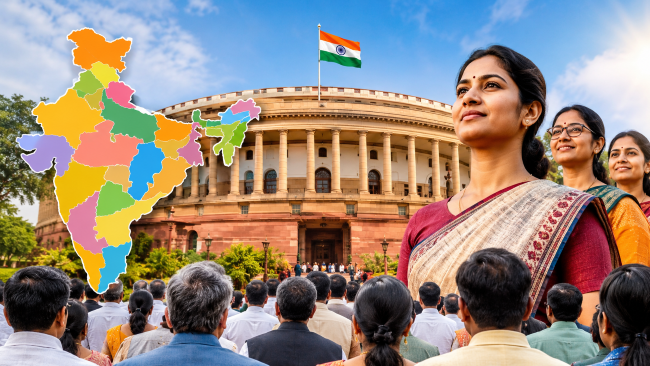
India’s parliamentary democracy may be approaching one of its most consequential structural changes since Independence. The proposed delimitation exercise, coupled with the implementation of 33 per cent reservation for women, could fundamentally alter the composition, size and political dynamics of the Lok Sabha. The number of elected seats, currently 543, is projected to rise to 815, representing an expansion of nearly 50 per cent. If implemented as proposed, this would be more than an administrative exercise in redrawing constituencies; it would reshape the country’s political landscape.
The most visible outcome could be a substantial increase in women’s representation. At present, approximately 75 women are members of the Lok Sabha. Under a 33 per cent reservation arrangement in an expanded House of 815 members, around 269 seats could be reserved for women. This would represent a significant advance in a political system where women’s presence in Parliament has historically remained below their share of the population. The proposed change, therefore, carries the promise of making India’s representative institutions more inclusive.
However, the implications of delimitation extend well beyond the question of gender representation. It raises fundamental issues concerning federalism, population distribution, political equality and the relationship between demographic change and parliamentary representation. The challenge will be to ensure that an exercise intended to strengthen democracy does not create new regional imbalances.
Delimitation: An overdue constitutional exercise
Delimitation refers to the redrawing of boundaries of parliamentary and Assembly constituencies to reflect changes in population and ensure equitable representation. The exercise is undertaken by an independent Delimitation Commission established under the law. India has constituted such commissions in 1952, 1963, 1973 and 2002.
The constitutional framework has historically sought to balance the principle of population-based representation with the need to protect states that successfully pursued population control. The 42nd Constitutional Amendment in 1976 froze the allocation of seats among states and the delimitation of constituencies until 2001. This arrangement was subsequently extended through the 84th Constitutional Amendment in 2001, which continued the freeze on inter-state allocation of Lok Sabha seats until the first Census after 2026. The boundaries of constituencies, however, could be adjusted within states without changing their overall parliamentary strength.
The underlying rationale was straightforward: states should not be penalised politically for implementing national population-control objectives. States that invested in education, healthcare and family planning should not lose their relative influence in Parliament merely because their population growth had slowed.
With the constitutional freeze approaching its end, the country must now confront the difficult task of reconciling demographic realities with the principles of cooperative federalism.
The federal question cannot be ignored
One of the most contentious aspects of the proposed exercise is its potential impact on the relative political weight of different states. India’s population growth has been uneven. Several northern and central states have experienced higher population growth, while many southern states have made considerable progress in controlling fertility rates.
If parliamentary representation is determined primarily by population, states with larger and faster-growing populations could gain a greater share of seats. Uttar Pradesh, Bihar, Madhya Pradesh and Rajasthan, for instance, may see substantial increases. By contrast, states such as Kerala, Tamil Nadu and Karnataka fear that their relative influence could diminish, even if their absolute number of seats increases.
This concern is not merely political. It touches the heart of India’s federal structure. States that have performed well on social indicators, education, healthcare and population stabilisation may reasonably question whether their achievements should result in a relative reduction in their voice in national decision-making.
The principle of one person, one vote is fundamental to democracy. Yet India’s constitutional structure also recognises the importance of balancing the interests of its constituent states. Delimitation must therefore be approached with sensitivity to both principles.
The government’s responsibility will be to explain how the proposed formula will protect federal equity while ensuring that citizens enjoy fair representation. A transparent and consultative process is essential to building confidence among all states.
Women’s reservation: A historic opportunity
The proposed expansion of the Lok Sabha is closely linked to the implementation of the 33 per cent reservation for women under the Constitution (106th Amendment) Act, 2023. The legislation represents a landmark recognition that India’s democratic institutions cannot claim to be fully representative without adequate participation of women.
Despite their growing presence in public life, women remain underrepresented in Parliament and several state legislatures. Their participation in local self-government institutions has demonstrated that constitutional guarantees can create opportunities for women to emerge as political leaders and decision-makers.
The proposed reservation could bring a comparable transformation to national politics. With approximately 269 seats potentially reserved in an 815-member Lok Sabha, women would have a much stronger institutional presence. Their participation could influence debates on education, public health, employment, social security, gender justice and economic development.
Nevertheless, reservation alone cannot guarantee meaningful empowerment. Political parties must also provide women with opportunities to contest from winnable constituencies, develop leadership skills and participate in organisational decision-making. The objective should be to move beyond numerical representation towards substantive political equality.
There is also a need to ensure that women from marginalised communities receive fair opportunities within the proposed framework.
A changing electoral map
The projected expansion of parliamentary seats could substantially alter the electoral map. Uttar Pradesh, which currently has 80 Lok Sabha seats, could see its strength rise to around 120. Maharashtra may increase from 48 to 72, while West Bengal could move from 42 to 63. Bihar’s representation may rise from 40 to 60.
Tamil Nadu could have approximately 58 or 59 seats compared with its present 39. Madhya Pradesh may increase from 29 to 43 or 44, while Karnataka could move from 28 to 42.
Other states are also expected to gain seats. Rajasthan’s representation could rise from 25 to around 37 or 38, Gujarat’s from 26 to 39, Andhra Pradesh’s from 25 to approximately 37 or 38, and Odisha’s from 21 to 31 or 32. Kerala could move from 20 to 30 seats, while Telangana may increase from 17 to 25 or 26.
Among other states, Assam and Jharkhand could each see their representation rise from 14 to 21. Punjab may increase from 13 to 19 or 20, Chhattisgarh from 11 to 16 or 17, and Haryana from 10 to 15. Delhi could move from seven to approximately 10 or 11 seats.
These figures remain projections rather than final allocations. The actual distribution will depend on the legal framework, the applicable population data and the decisions of the Delimitation Commission.
Consensus is essential
The government has argued that women’s reservation should not be delayed indefinitely and that linking its implementation with the proposed expansion of Parliament could facilitate its introduction in the 2029 general elections. The Union Cabinet’s approval of the revised proposal on November 27, 2026, has brought the issue into sharper political focus, with legislation expected to be taken up in the parliamentary session beginning November 30.
Opposition parties, however, have raised concerns about the timing, methodology and possible political consequences of the exercise. Their apprehensions deserve serious consideration. Delimitation is too consequential to become a partisan contest or an instrument of short-term electoral advantage.
The process must be governed by transparent criteria, constitutional safeguards and meaningful consultation with political parties and state governments. It is equally important that the public be given access to the proposed methodology and the rationale behind state-wise allocations.
The new Parliament building, with seating capacity for 888 Lok Sabha members, has already been designed to accommodate a larger House. This physical infrastructure may facilitate expansion, but the real test lies in ensuring that institutional growth translates into stronger democratic representation.
Beyond numbers: The test of democratic maturity
India stands at a critical juncture. An expanded Lok Sabha and greater representation of women could strengthen the country’s democratic foundations. A Parliament that reflects the aspirations of a larger and more diverse population would be better positioned to address the challenges of a rapidly changing society.
But the success of delimitation will not be measured simply by the number of additional seats or women members entering the House. It will depend on whether the exercise strengthens public trust, preserves the federal balance and ensures that every region feels fairly represented.
The country needs a Parliament that is larger in size, broader in social representation and stronger in institutional credibility. Women’s reservation offers an opportunity to correct a long-standing democratic deficit, while delimitation provides an occasion to reconsider the architecture of representation.
The two objectives must advance together, but neither should come at the expense of constitutional fairness. A national consensus, rather than political expediency, must guide this historic transition. Ultimately, the purpose of parliamentary reform should not merely be to redraw India’s political map, but to deepen the democratic promise of the Republic.
Editorial note: The article has been recast with a more analytical, balanced edit-page approach, giving greater emphasis to federalism, population control, women’s political empowerment and constitutional consensus. The projected state-wise seat figures and the proposed legislative timetable should be independently verified before publication, as they are not final allocations.
(The writer is a senior Delhi-based journalist and political analyst. Views are personal.)







[[comment.comment_text]]