India Commissions INS Mahendragiri: Indigenous Stealth Frigate Boosts Navy's Blue-Water Capability
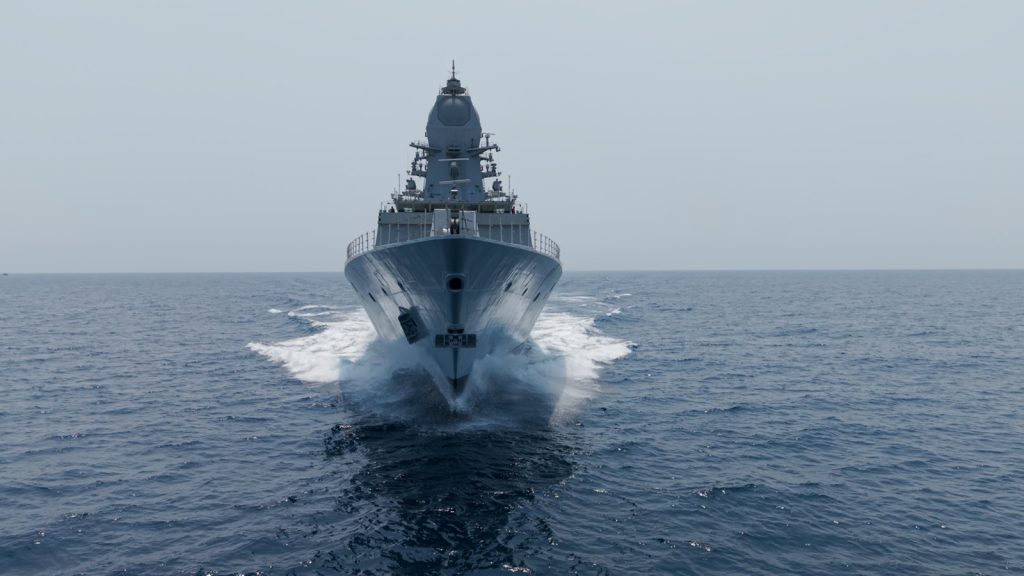

Navy Commissions Indigenous Stealth Frigate INS Mahendragiri, Strengthening India's Blue-Water Maritime Strategy


Visakhapatnam, EW-NN: India on Saturday significantly enhanced its maritime combat capability with the commissioning of the indigenously built stealth frigate INS Mahendragiri, the sixth warship under the Project 17A programme, as the government underlined that military preparedness now requires a blend of advanced technologies and robust conventional capabilities. 


Commissioned by Defence Minister Rajnath Singh at Visakhapatnam, the 6,670-tonne frontline warship carries more than 75 per cent indigenous content and is equipped with advanced stealth features, supersonic surface-to-surface missile capability, medium-range air defence systems, anti-submarine warfare weapons, electronic warfare suites and network-centric combat systems. Designed by the Indian Navy's Warship Design Bureau and built by Mazagon Dock Shipbuilders Ltd, the vessel is capable of undertaking fleet air defence, anti-surface and anti-submarine operations, maritime surveillance, interdiction missions and humanitarian assistance. 


The induction of INS Mahendragiri reflects the accelerating pace of India's naval modernisation, with six Project 17A frigates entering service within just 18 months. Navy officials said the programme has also achieved major production efficiencies, including a nearly 50 per cent reduction in the launch-to-delivery timeline and a substantial cut in overall construction time, signalling growing maturity in India's indigenous defence manufacturing ecosystem. 


Addressing the ceremony, Rajnath Singh argued that while artificial intelligence, cyber warfare, drones and hypersonic weapons are reshaping future conflicts, conventional military strength remains the foundation of national defence. He described INS Mahendragiri as a symbol of India's commitment to a technologically advanced and combat-ready Navy capable of safeguarding national interests across the Indian Ocean Region.


The commissioning also carries strategic significance amid heightened geopolitical competition in the Indo-Pacific. Singh reiterated India's role as a "net security provider" and cited the Navy's recent escort operations protecting merchant shipping during the West Asia crisis as evidence of its expanding regional responsibilities. With its enhanced endurance, advanced weapon systems and blue-water capability, INS Mahendragiri is expected to strengthen India's maritime deterrence while reinforcing the government's broader push for defence self-reliance and regional security leadership.




When Citizens Become Guinea Pigs

Can governments introduce sweeping policy reforms without adequate public consultation? This opinion piece examines the democratic implications of E20 ethanol, governance, accountability, and citizen participation, arguing that lasting public trust depends on transparency, evidence-based policymaking, and meaningful consultation rather than one-way administrative decisions.

NIRAJ KRISHNA   |  10 hours ago

Ethanol in India's Fuel Tank: A Green Revolution or a Growing Dilemma?

An analytical look at India's ethanol blending programme, examining its impact on energy security, farmers, fuel prices, food security, water resources and the country's clean energy transition.

Sanjay Pandey @ EW•NN   |  1 day, 2 hours ago

The Changing Standards of Societal Morality: A Critical Look at Contemporary Ethics

Fourteen points Memorandum of understanding (MoU) signed between US President Trump and Iranian President Masud Pezeshkian on 18th June had temporarily halted the military operations and opened the transit of commercial vessels through Strait of Hormuz, without any fee, till final agreement is reached within 60 days. A few rounds of negotiations at Qatar and Pakistan to obtain final reaffirmation from Iran that it shall not procure or develop nuclear weapons and dispossess enriched stockpile on mutually agreed terms took place without any outcome.

B. K. Singh   |  1 day, 23 hours ago

Taj Mahal, Truth and the Temptation of Myth: History, Law and the Politics of Manufactured Memory

As fresh litigation seeks to reopen the Taj Mahal’s past, the debate is no longer merely about a monument—it is about whether historical evidence or political mythology will define India’s civilisational inheritance. Few monuments in the world command the reverence, recognition and emotional appeal of Agra’s Taj Mahal. A UNESCO World Heritage Site and one of the Seven Wonders of the Modern World, it has stood for nearly four centuries as an architectural masterpiece and a symbol of India’s rich and diverse cultural heritage. Yet, increasingly, it has become the object of relentless attempts to recast history through litigation and ideology.

Hasnain Naqvi   |  1 day, 23 hours ago

The Price of Recklessness: The Severe Economic Toll of Resumed U.S.-Iran Strikes

With Iran targeting commercial tankers and the U.S. moving to revoke oil sanctions waivers, energy infrastructure is once again a primary battlefield. A prolonged conflict threatens to choke off nearly a fifth of the world's petroleum supply and vital liquefied natural gas (LNG) transits. If these vital shipping lanes remain heavily contested, a permanent risk premium will bake into energy costs, driving oil prices to levels that could trigger a global industrial slowdown.

Dinesh Dubey @ EW•NN   |  2 days, 6 hours ago

De-siloing Administrative Tribunals Appointments

As a country we move ahead on the path of democratic governance since independence and adopted the British system of parliamentary form of governance. Since then, we had amended the constitution for more than 100 times as and when required to meet the changing aspiration of the society.

VK Bahuguna   |  3 days, 3 hours ago

Comments

YOU MIGHT ALSO LIKE

View More