Interfaith Leaders Gather for ZFI-ICP Eid Milan at IIC, New Delhi
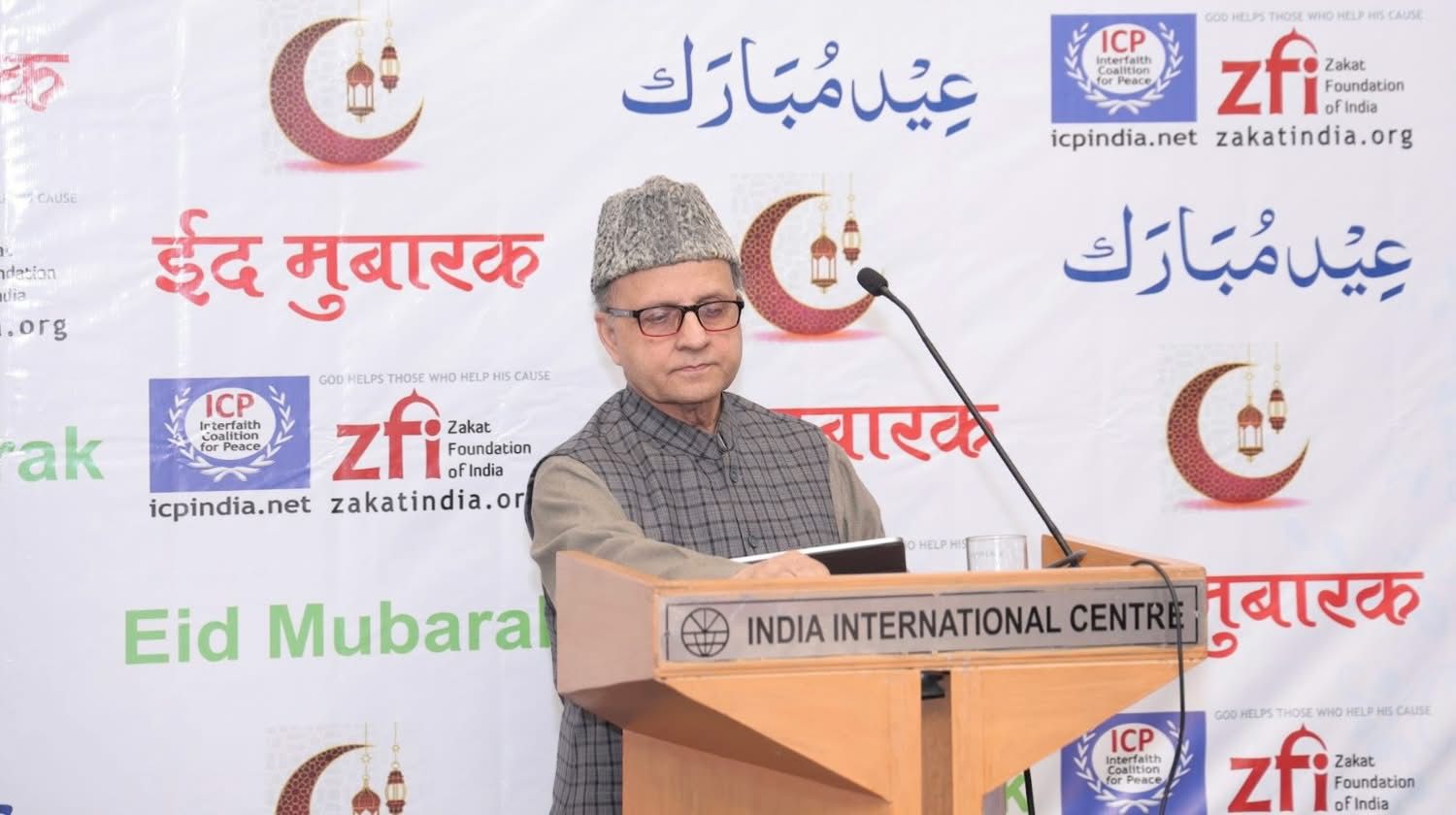



 In a vibrant display of communal harmony and cultural integration, the Zakat Foundation of India (ZFI), in collaboration with the Interfaith Coalition for Peace (ICP), hosted an Eid Milan Lunch at the India International Centre.


The event, held at the Kamla Devi Block of India International Centre, brought together a diverse panel of religious leaders, civil society activists, academics, and former diplomats to celebrate the spirit of Eid and reinforce the bonds of unity across different faiths.


The proceedings were presided over by Rev. Fr. Dr. Packiam Samuel, Director of the Henry Martyn Institute (Hyderabad) and Vice President of the ICP, who served as the Master of Ceremonies. The opening segment featured a multi-faith perspective on peace, with remarks from Dr. Deepali Bhanot, Vice President of the ICP (Delhi University), Sardar Ajmer Singh Sahab, Vice President of the ICP, and Rabbi Ezekiel Isaac Malekar, representing the Jewish community.


The program transitioned from spiritual reflections to broader societal commentary, featuring insights from prominent public figures. Ambassador Suresh Goel, a veteran diplomat with extensive international experience, and Parliamentarian Udit Raj shared their perspectives on the universality of religions and role of interfaith cooperation in modern society. Ms. Bulbul Sarkar, former Chief Commissioner, also added her voice to the brief commentary session, emphasizing the administrative and social pillars of peacebuilding.


The event reached its emotional and intellectual crescendo with a profound address by Dr. Syed Zafar Mahmood, the visionary founder of the Zakat Foundation of India and the driving force behind the Interfaith Coalition for Peace. Dr. Mahmood delivered a masterful discourse on the "Unity of Being," articulating a universalist vision where the divine attributes of mercy and beneficence transcend religious boundaries to embrace all of humanity (Rabb-ul-Aalameen). He underscored that a true Islamic perspective necessitates the recognition of the thousands of messengers sent across all ages and geographies, a concept he elegantly harmonized with the Vedic philosophy of “Eko Sad Vipraah Bahudha Vadanti”—the belief that while the Supreme Reality is one, scholars perceive and name it differently. By weaving together these spiritual threads with the ethical framework of the Directive Principles of State Policy in the Indian Constitution, Dr. Mahmood illustrated a seamless alignment between religious pluralism and constitutional governance, offering a compelling roadmap for national and communal solidarity.


The gathering concluded with a formal Vote of Thanks delivered by Mr. S. M. Shakil, Vice President of the ZFI, who expressed gratitude to the attendees for their commitment to fostering a culture of mutual respect and coexistence.


The luncheon served as a platform for strengthening interfaith ties within the capital. Participants emphasized the importance of such gatherings in fostering mutual respect and understanding across different communities. A coffee table book “Taj Mahal’s Spiritual Message”, authored by Dr Syed Zafar Mahmood, was also available for gift on the occasion.

*
The Fluidity of Conviction: Trinamool’s Fracture and the Era of Post-Ideological Politics

The sudden, tectonic shift within the Trinamool Congress (TMC)—where a 20-strong rebel faction of Lok Sabha MPs has engineered a merger with a little-known, Tripura-based outfit to leap into the National Democratic Alliance (NDA)—is more than just a localised mutiny. Led by veteran Kakoli Ghosh Dastidar and backed by seasoned faces like Sudip Bandyopadhyay, this splintering offers a masterclass in modern political survival. More profoundly, however, it serves as a glaring obituary for ideological consistency in contemporary governance.

Dinesh Dubey   |  3 days, 10 hours ago

The Wedding Circus: Why is the Bride’s Father Still the Ringmaster's ATM?

Every single girl out there needs to have a checklist. Seriously, write down 10 to 12 hard questions about compatibility before you even think about looking at guys in an arranged marriage setup. Figure out exactly what you want first, so when you ask your questions, they cut straight to the point. I used this strategy recently. There was this guy I had already rejected before, but he came back crawling, asking for "just one chance to prove himself." I thought, fair point, let's see what you’ve got. During our conversation, I dropped one of my standard questions: "Will you take dowry?"

Khushboo Jha   |  3 days, 10 hours ago

India's labour force: The Invisible Hands That Keep India Running

The importance of this acknowledgment cannot be overstated. Every household depends on a wide range of activities that are essential for daily life. Meals have to be prepared, children have to be cared for, elderly family members need support, homes need to be cleaned and maintained, and countless small responsibilities must be managed every day. These tasks consume time, energy, and skill. If families were required to hire separate workers for each of these responsibilities, the financial cost would be enormous. Yet when these same services are provided by a homemaker, society often assumes they have no economic value simply because no money changes hands. This contradiction has allowed one of the largest forms of labour in the country to remain hidden in plain sight.

Samridhi   |  3 days, 11 hours ago

Beyond Tenure: Why Comparing Modi and Nehru Requires Historical Context

For centuries, Eurocentric frameworks dominated intellectual discourse, producing comparisons that subtly reinforced Western superiority. Thus, Kalidasa became the “Shakespeare of India,” while Chanakya was described as the “Indian Machiavelli.” Such characterisations appear flattering, but they implicitly position Western figures as the universal benchmark against which all others must be measured. In reality, Kalidasa and Chanakya emerged from independent civilizational traditions whose significance does not require validation through foreign parallels.

Seema Joshi   |  3 days, 11 hours ago

Modi’s Record Tenure as Prime Minister

Narendra Modi’s upcoming milestone on June 10, which will mark 4,399 consecutive days in office and surpass Jawaharlal Nehru as India's longest-serving democratically elected leader, raises a fundamental question: does political longevity guarantee effective governance?

Hasnain Naqvi   |  1 week, 2 days ago

The Politics of Pedestals!

India is a diverse country. We have different religions, different cultures, different languages, and different ways of life. Yet there is one thing that seems remarkably common across all of them our tendency to place women, mothers, daughters, rivers, and even the land itself on a divine pedestal while simultaneously taking them for granted in everyday life.

Khushboo Jha   |  1 week, 5 days ago

Comments

YOU MIGHT ALSO LIKE

View More

By Hasnain Naqvi   |   1 week, 2 days ago
Modi’s Record Tenure as Prime Minister
By Khushboo Jha   |   1 week, 5 days ago
The Politics of Pedestals!
By VK Bahuguna   |   2 weeks, 1 day ago
Delhi Gymkhana Club: The flashpoint of dispute