UPI MDR: A New Funding Model for India’s Digital Payments Ecosystem

 1 month, 1 week ago
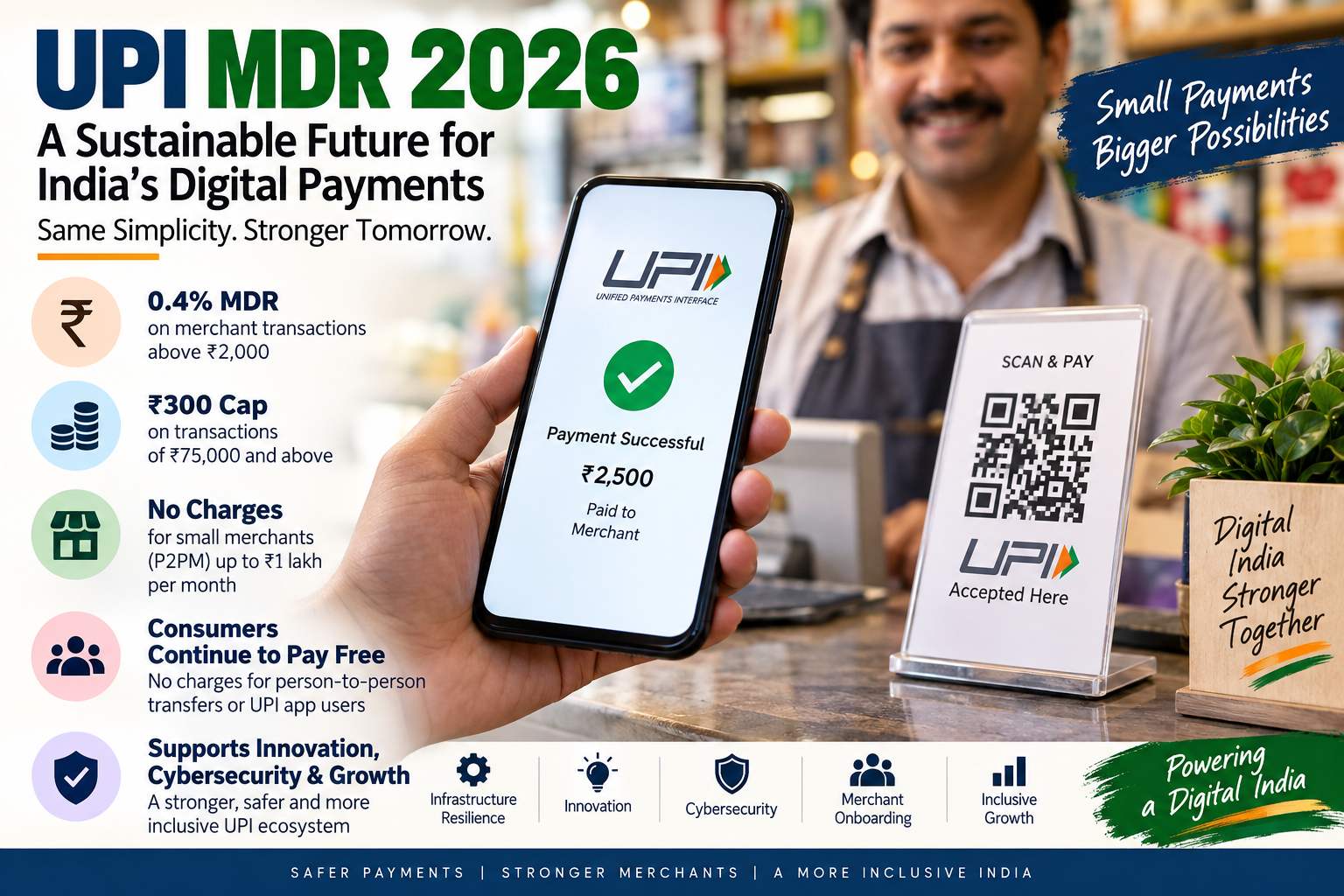
India’s Unified Payments Interface (UPI) is entering a new phase with the introduction of a Merchant Discount Rate (MDR) on selected Person-to-Merchant (P2M) transactions. The proposed framework, scheduled to take effect from 15 October 2026, seeks to create a more sustainable financial model for the rapidly expanding digital payments infrastructure while keeping routine and small-value transactions free for consumers and micro-merchants. According to the information provided in the official FAQ, the central objective is to generate resources for infrastructure resilience, cybersecurity, innovation and customer support without compromising UPI’s accessibility.
Under the new framework, an MDR of 0.4 per cent will apply to P2M UPI transactions above ₹2,000. For transactions of ₹75,000 and above, the fee will be capped at ₹300 per transaction. This means that a merchant receiving ₹3,000 through an eligible UPI transaction would pay ₹12 as MDR, while a ₹50,000 transaction would attract ₹200. For a transaction of ₹1 lakh, although 0.4 per cent would ordinarily amount to ₹400, the applicable fee would be restricted to the ₹300 ceiling. Transactions of ₹2,000 or below will remain outside the MDR framework.
A significant feature of the policy is that ordinary consumers will not be charged for using UPI. Person-to-person transfers, including sending money to family members, friends or between an individual’s own bank accounts, will continue to be free. UPI applications will also not be permitted to impose a separate platform fee on payments. Thus, the proposed MDR is principally a charge associated with eligible merchant acceptance rather than a consumer transaction fee.
The policy also attempts to protect the smallest businesses. Small merchants operating under the P2PM framework, with UPI collections of up to ₹1 lakh per month, will continue to enjoy zero MDR. The framework is intended particularly for small and informal businesses, including street vendors and micro-retailers. Importantly, a small merchant receiving an individual payment above ₹2,000 would not automatically become liable for MDR if the merchant remains within the applicable exempted P2PM classification.
Existing QR codes will also continue to function. Small merchants will not be required to replace their QR infrastructure, re-register their payment arrangements or make a special visit to their banks merely because of the MDR changes. Eligibility for the P2PM category will be monitored through transaction patterns, with merchants whose UPI receipts exceed ₹1 lakh per month consecutively for three months being moved into the P2M category, according to the FAQ.
The framework contains special provisions for certain sectors. Railways, telecommunications, insurance and fuel, among other designated categories, will attract a flat MDR of ₹5 for transactions above ₹2,000 instead of the standard 0.4 per cent rate. Utility payments such as electricity, water and piped natural gas will similarly have a ₹5 flat fee above the threshold. Educational fee payments are also placed under designated industry categories, with provisions intended to prevent large educational payments from attracting a full percentage-based charge.
Capital-market transactions receive a separate treatment. Payments involving mutual funds, securities, stockbrokers and dealers will carry an MDR of 0.02 per cent, subject to a maximum of ₹300. The separate rate is intended to distinguish investment-related transactions from ordinary commercial purchases and maintain relatively low digital payment costs in regulated financial markets.
One of the most important elements of the proposed system is a dedicated fund for small merchants and digital-payment expansion. The fund is intended to support digital-payment infrastructure in Tier 3 to Tier 6 centres, including the Northeast, Jammu and Kashmir and Ladakh. It may also cover notified Central Government schemes in Tier 1 and Tier 2 centres. Financial assistance is proposed for merchant onboarding and for encouraging greater UPI usage among existing small businesses, particularly in rural and semi-urban markets. The detailed framework is expected to be finalised in consultation with the Reserve Bank of India within three months.
The rationale for moving towards a commercial model is linked to the enormous scale of UPI. The FAQ states that UPI processed 2,451 crore transactions worth ₹29.9 lakh crore in August 2026 alone. Such a system requires substantial investment in servers, telecommunications, banking software, fraud prevention and cybersecurity. The document estimates that maintaining the operational infrastructure costs the payment industry around ₹20,000 crore annually. It argues that dependence exclusively on annual government incentives creates uncertainty and can constrain long-term investment by banks and fintech companies.
Cybersecurity is another major consideration. As digital transactions expand, so do the requirements for fraud detection, encryption, infrastructure protection and continuous monitoring. The FAQ states that MDR-generated revenue can help finance cybersecurity infrastructure and AI-based fraud-detection systems. The policy also links a predictable revenue model with greater competition, arguing that sustainable commercial revenues could make it easier for smaller fintech companies and technology firms to enter the market rather than leaving long-term payment operations primarily to heavily capitalised companies.
The broader significance of the policy therefore lies beyond the introduction of a transaction fee. It represents an attempt to balance affordability, merchant protection and financial sustainability in a payment network that has become deeply embedded in India's economic activity. Consumers retain free access to UPI, micro-merchants receive specific protection, while larger commercial users contribute towards the cost of maintaining the infrastructure.
For users and businesses, however, understanding the distinction between consumer charges, merchant MDR and exempted transaction categories will be important. The FAQ specifically advises citizens to rely on official communications from the Ministry of Finance, RBI and NPCI rather than unverified social-media messages concerning UPI charges.
The proposed MDR framework consequently marks a significant shift in the economics of India's digital-payment infrastructure. Its longer-term impact will depend on how the detailed rules are implemented, how the dedicated merchant fund operates, and how banks, fintech companies and merchants respond. What remains clear from the proposed framework is that the objective is to preserve free and convenient consumer access while creating a more predictable source of funding for the infrastructure on which India's rapidly expanding digital-payment economy depends.









[[comment.comment_text]]