Sinking Cushions, Rising Vulnerabilities: Unpacking India’s Foreign Exchange Decline

 3 weeks ago
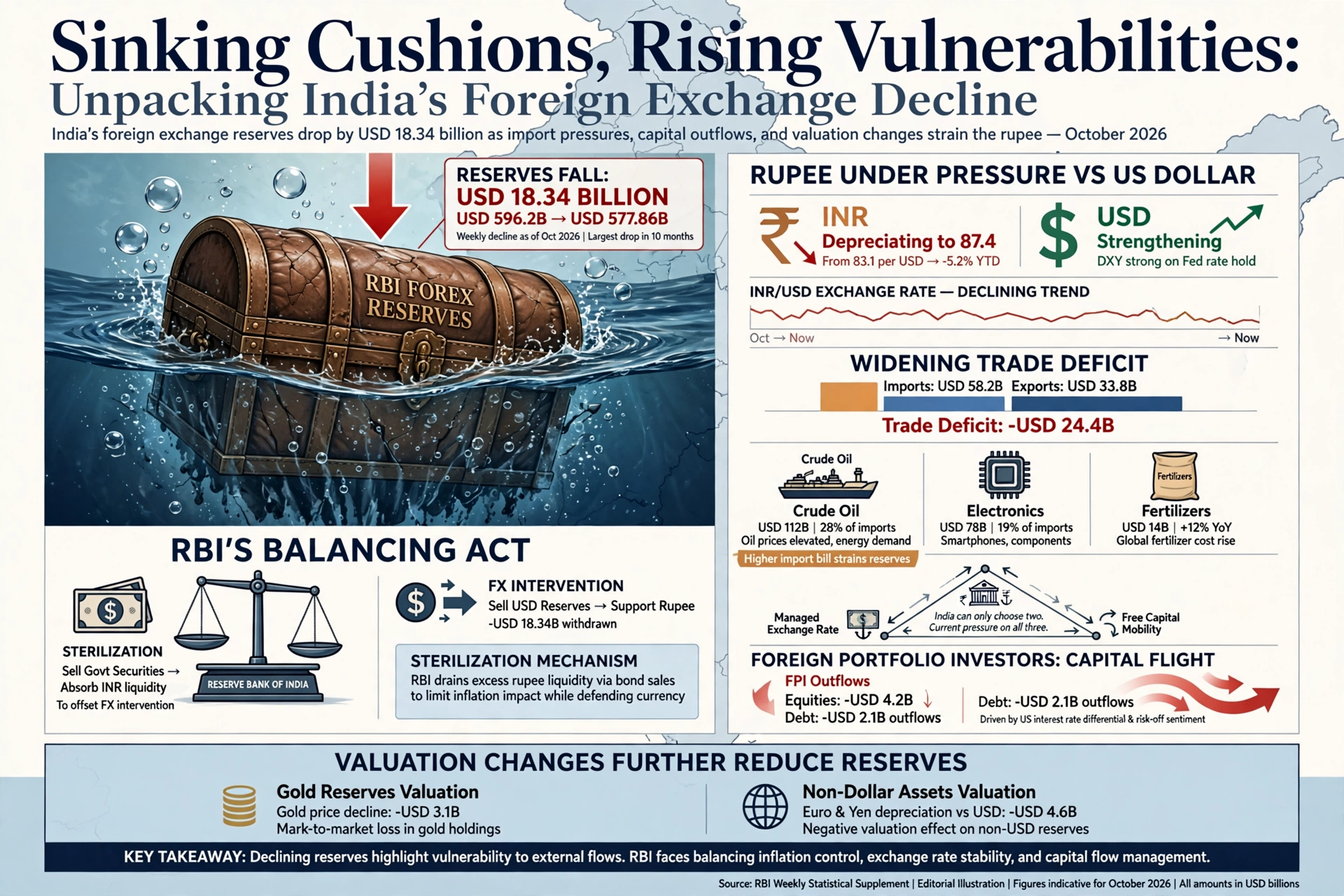
The recent drop of USD 18.34 billion in India’s foreign exchange reserves has drawn intense attention, serving as a stark reminder that these financial buffers are most visible when under strain. While headline fluctuations are often exaggerated by valuation changes across non-dollar assets and gold rather than pure foreign exchange intervention, a movement of this magnitude warrants scrutiny. It highlights the immediate pressures moving through India’s external accounts and brings the Reserve Bank of India’s (RBI) delicate balancing act into sharp focus.
At the heart of this pressure lies a familiar structural vulnerability: India’s persistent trade deficit in price-inelastic essentials like crude oil, fertilizers, and electronics. While robust services exports and steady remittances traditionally temper this deficit, these buffers remain vulnerable to broader global economic slowdowns. When a heavy import bill coincides with a softening global appetite for tech spending or sudden capital flight by foreign portfolio investors, the demand for dollars spikes rapidly. Foreign exchange reserves allow the RBI to step in as a shock absorber, smoothing sudden currency fluctuations without eliminating the underlying global forces driving them.
Managing this cushion, however, introduces complex domestic monetary trade-offs. When the central bank sells dollars to support the rupee, it absorbs local currency liquidity from the banking system, often requiring active sterilization to prevent unintended tightening of domestic financial conditions. This dynamic reflects the classic "impossible trinity"—the macroeconomic constraint of balancing an independent monetary policy, a managed exchange rate, and capital mobility. Even with partial capital account convertibility, today’s interconnected markets mean self-reinforcing market behaviors, such as importers rushing to cover unhedged dollar liabilities, can quickly amplify exchange rate momentum.
Moreover, headline reserve numbers offer an incomplete picture of a central bank's true operational stance, as they omit off-balance-sheet commitments like forward market liabilities. While international precedents demonstrate the risks of defending a currency against persistent capital outflows, India enters such periods from a position of relative strength, backed by a substantial reserve chest. Yet, as international experience demonstrates, the velocity of capital movement matters just as much as total reserve volume. A large buffer buys valuable time, but it cannot substitute for economic adjustment if external pressures persist over a longer horizon.
Foreign exchange reserves are macroeconomic insurance meant to be utilized during periods of global turbulence. Suppressing volatility entirely can distort risk perceptions and delay necessary real-economy adjustments, whereas allowing a gradual, orderly depreciation can help rebalance import costs and export competitiveness. Foreign reserves can comfortably protect against temporary market turbulence, but true long-term stability relies on deepening structural resilience—diversifying exports, reducing dependence on imported energy, and building domestic production capabilities.










[[comment.comment_text]]