Digital Speed, Human Struggle: The Unequal Battle for a Train Ticket in India

 5 months, 1 week ago
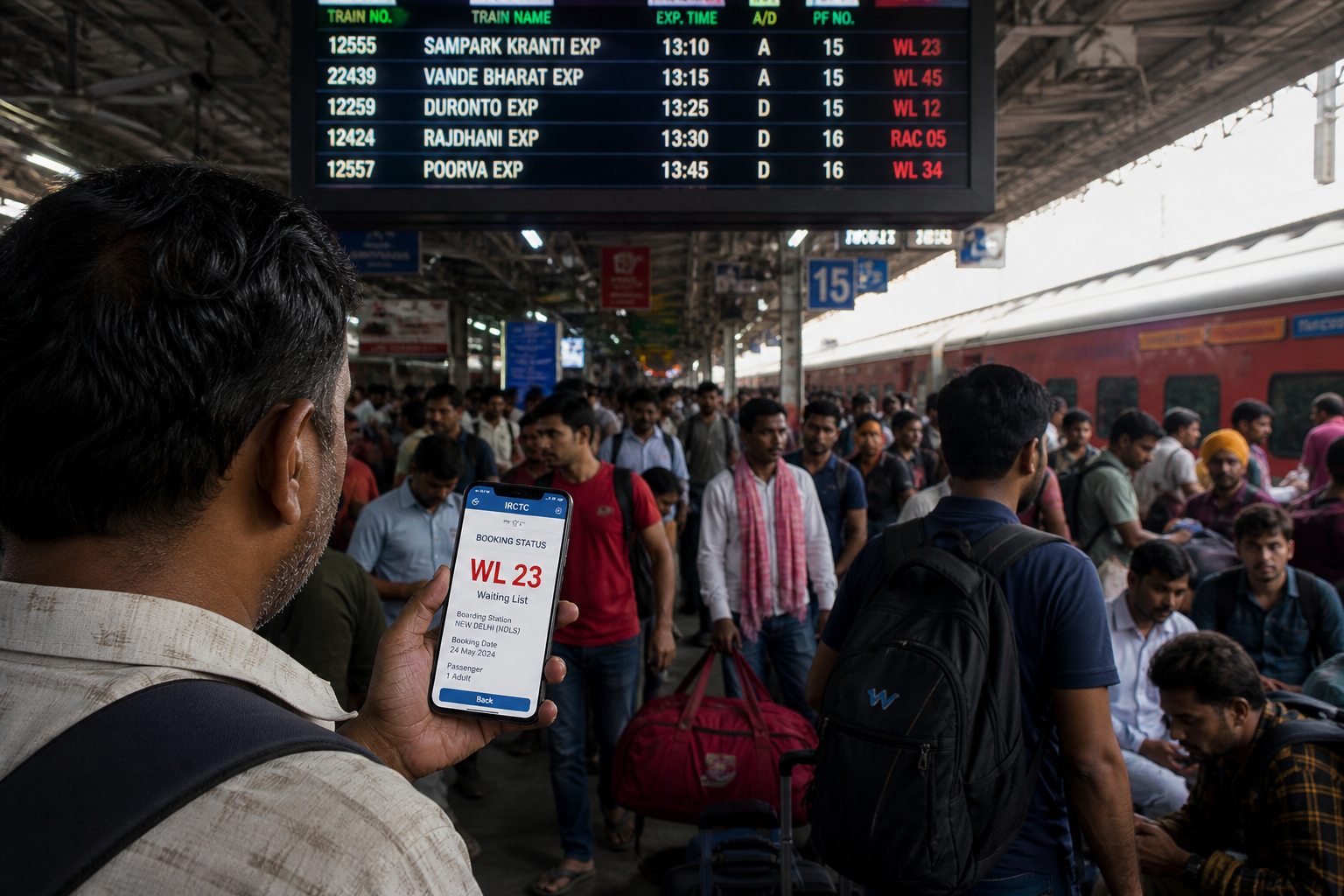
On a humid afternoon at New Delhi Railway Station, the transformation of Indian Railways appears both visible and persuasive. Clean platforms, bright LED lighting, improved signage, and the steady flow of passengers through escalators and foot overbridges present a picture of efficiency that would have been difficult to imagine a decade ago. The station environment reflects a deliberate shift in administrative priorities—one that emphasizes infrastructure, passenger amenities, and a more organized public interface. For many, this transformation is tangible proof that India’s railway system is evolving.
However, this visible progress represents only one layer of the railway experience. Beneath this surface lies a more complex and less visible reality, one that begins not at the station but at the point of accessing the system itself. For millions of passengers, the railway journey now starts with a digital interaction—an attempt to secure a ticket in a system where availability is uncertain, outcomes are unpredictable, and access is unevenly distributed.
Across multiple regions, including Delhi, Uttar Pradesh, Bihar, Jharkhand, Orissa conversations with passengers reveal a consistent pattern. The improvements in infrastructure have not been matched by equivalent improvements in the systems governing access. While trains may run more efficiently and stations may appear more modern, the process of booking a ticket remains fraught with uncertainty. This disconnect between physical modernization and procedural inefficiency has become one of the defining characteristics of the current phase of railway reform.
The scale of demand is central to understanding this issue. Indian Railways carries over 23 million passengers daily, making it one of the largest transportation networks in the world. Despite operating thousands of trains across an extensive network, the demand on key routes consistently exceeds available capacity. On major corridors such as Delhi to Bihar, eastern Uttar Pradesh, and parts of Jharkhand—regions that also serve as major migration belts—waiting lists frequently extend into the hundreds. Even during relatively lean travel periods, confirmed tickets remain difficult to secure on several high-density routes.
This structural imbalance has effectively normalized uncertainty within the system. Booking a ticket no longer guarantees travel; it merely initiates a process whose outcome remains unclear until the final hours before departure. For passengers, this introduces a layer of unpredictability that affects planning, decision-making, and, in many cases, financial expenditure. The railway system, rather than absorbing this uncertainty, transfers it to the user.
Digitalization was expected to address many of these challenges. The expansion of online booking platforms, particularly through IRCTC, was intended to simplify access, eliminate intermediaries, and improve transparency. In terms of operational efficiency, the system has succeeded. It handles massive transaction volumes daily and has significantly reduced reliance on manual booking counters. Yet, the benefits of this efficiency are not uniformly distributed.
The Tatkal booking system illustrates this imbalance most clearly. Designed to facilitate urgent travel, it has evolved into a process where success depends heavily on technological advantage. Passengers with faster internet connections, better familiarity with the booking interface, and quicker payment options have a clear edge. Tickets are often sold out within minutes, leaving others with no realistic chance of securing a confirmed seat. What was intended as a mechanism to address urgency has become, in practice, a competitive digital exercise.
This shift introduces a form of exclusion that is less visible but equally significant. Access to a public service becomes contingent not on need but on digital capability. For passengers in rural areas, older individuals, or those less familiar with technology, the system becomes inherently disadvantageous. While digitalization has improved efficiency, it has also introduced a new layer of inequality.
Compounding this issue is the opacity of the ticket allocation process. The system operates through a complex combination of quotas, dynamic pricing, and algorithmic distribution. However, for the average passenger, these mechanisms remain difficult to understand. There is limited clarity on how tickets are allocated, how waiting lists move, or why certain bookings are confirmed while others are not. Even predictive tools that estimate confirmation probabilities often fail to provide reliable guidance, as outcomes can change due to factors beyond the user’s visibility.
This lack of transparency has broader implications. In large public systems, trust is closely linked to clarity. When outcomes appear inconsistent or unexplained, users begin to question the fairness of the process. Even if the system is functioning as designed, the absence of clear communication creates space for doubt. Over time, this perception gap can erode confidence in the system as a whole.
Passengers have adapted to this uncertainty in ways that reveal the system’s underlying inefficiencies. It is increasingly common for individuals to book multiple tickets across different trains or dates to improve their chances of confirmation. Others rely on agents who, despite the push for digitalization, continue to play a role in navigating the system more effectively. In some cases, passengers opt for higher-priced booking options in an attempt to secure certainty. These behaviors indicate that the system’s unpredictability is not merely an inconvenience—it has direct economic consequences.
The issue of refunds further reinforces this perception. When a waiting list ticket fails to get confirmed, deductions are applied before the remaining amount is returned. From an administrative standpoint, these charges may be justified as service fees. However, from the passenger’s perspective, the logic is less convincing. If the service was not delivered, the expectation of a full refund is both reasonable and intuitive. The presence of deductions, even if relatively small, creates a sense of imbalance between the system and the user.
At this point, it becomes necessary to move beyond diagnosis and examine the most practical and impactful solution—capacity expansion. While technological reforms, transparency measures, and policy adjustments are important, they address only the symptoms of a deeper issue. The root problem remains a mismatch between demand and available seats. As long as this gap persists, uncertainty will continue to define the passenger experience.
Increasing the number of trains, particularly on high-demand routes, is therefore not just a long-term objective but an immediate necessity. In this context, expanding affordable and high-capacity train categories such as Garib Rath Express and Amrit Bharat Express could play a decisive role. These trains are specifically designed to cater to the needs of middle- and lower-income passengers—segments that constitute the majority of railway users.
Garib Rath trains, with their higher berth density and relatively lower fares in the air-conditioned category, offer a model that balances affordability with efficiency. Similarly, Amrit Bharat trains, which focus on non-AC travel with improved design and capacity, are aligned with the realities of long-distance migration routes where cost remains a critical factor. Expanding the frequency and coverage of these trains on routes such as Delhi–Bihar, Delhi–Eastern UP, and Mumbai–North India corridors would directly address the pressure on waiting lists.
Field observations suggest that wherever such trains operate with adequate frequency, the pressure on conventional express trains reduces marginally, and passengers experience better chances of confirmation. However, the current number of such trains remains insufficient relative to demand. A targeted policy push to increase their numbers—supported by optimized scheduling and faster turnaround times—could significantly ease the burden on the system.
In addition, introducing seasonal or corridor-specific trains during peak migration periods, festivals, and examination seasons would provide immediate relief. These interventions do not require entirely new infrastructure but rather more efficient utilization of existing assets.
Interestingly, the absence of sufficient capacity has also begun to influence travel behavior. With the expansion of India’s road infrastructure, alternative modes of transport have become more accessible. Improved highways and expressways have made road travel faster and more predictable. For those who can afford it, this predictability becomes a decisive factor.
However, this shift away from rail is not necessarily desirable. Railways remain the most energy-efficient and cost-effective mode of long-distance transport. If passengers are choosing roads due to uncertainty rather than preference, it reflects a systemic inefficiency that needs urgent correction.
Returning to New Delhi Railway Station, the contrast becomes clear. The physical transformation of Indian Railways is evident and commendable. The system looks modern, organized, and capable. Yet, the experience of accessing this system tells a different story—one marked by uncertainty, competition, and, at times, frustration.
For the average passenger, the railway journey is defined not only by the train they board but by the process that allows them to board it. If that process remains unpredictable, the broader gains of modernization risk being overshadowed.
The evolution of Indian Railways is not incomplete, but it is uneven. The infrastructure reflects progress; the systems governing access require recalibration. Most importantly, the capacity of the system must expand in proportion to its demand.
Because ultimately, no algorithm, no interface, and no policy adjustment can substitute for a simple reality—when there are more passengers than seats, uncertainty becomes inevitable.
Bridging this gap requires not only better systems but more trains—especially those designed for the common passenger. Until that happens at scale, the promise of accessible and equitable rail travel will remain only partially fulfilled.




[[comment.comment_text]]