5-year low - Factories Sans Jobs, GROWTH WITHOUT DEMAND

 1 month, 4 weeks ago
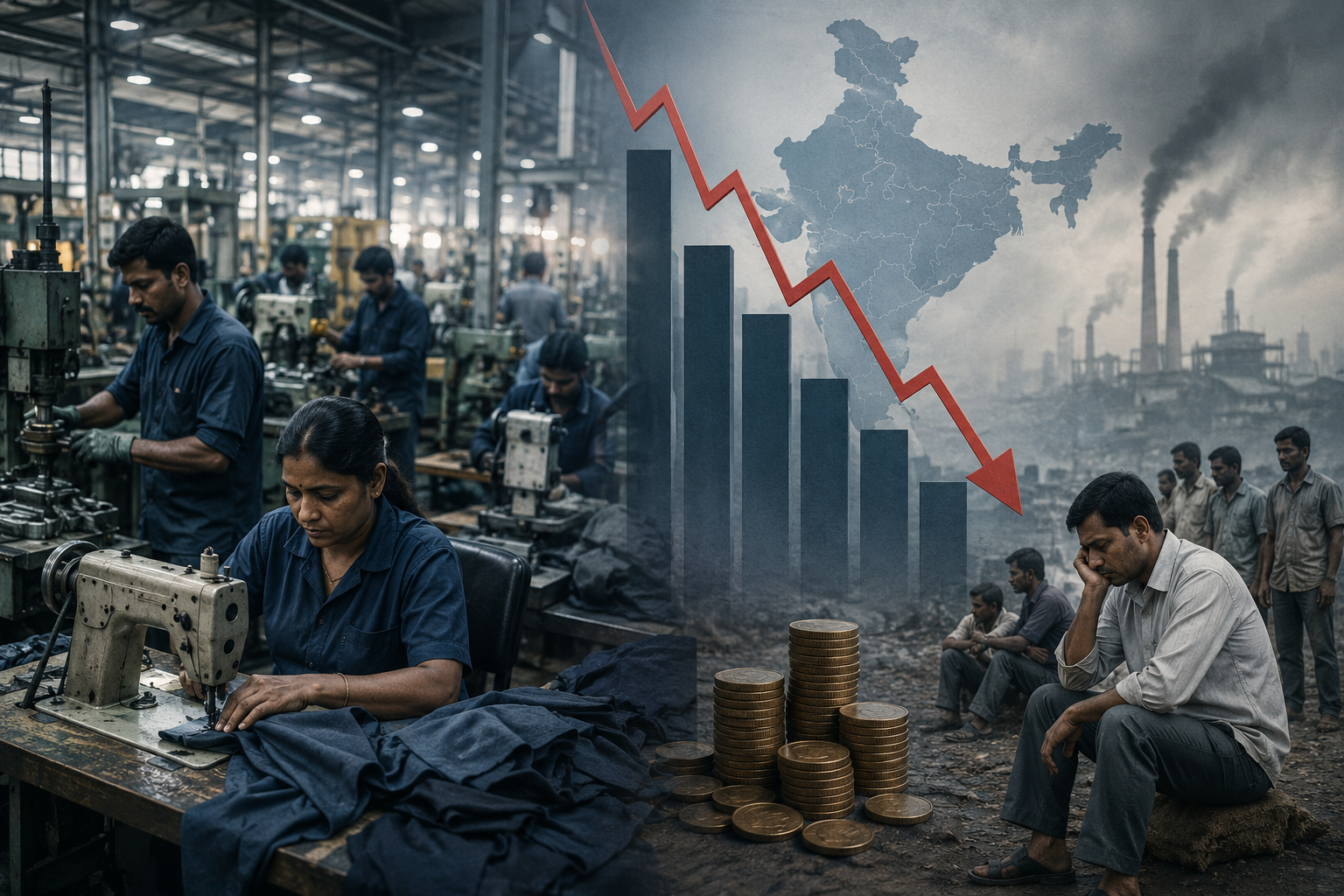
India’s manufacturing, services sector growth continues to hit lows amid falling demand and poor wage rises.
Manufacturing remains low around 14 percent while it needs manufacturing base around 25–30percent of GDP.
A country with such a huge population needed mass job creation outside agriculture and informal work decades ago. Instead, too many workers remain stuck in low-paying jobs with limited opportunities. A stronger manufacturing sector could have absorbed rural workers, boosted exports, increased incomes, and reduced pressure on agriculture.
India's labour-intensive manufacturing sectors—including textiles, apparel, leather, footwear and wood products—continue to underperform, while even basic metals and capital goods face cyclical slowdowns. The key constraints are high logistics costs, weak research and development, limited access to affordable credit for MSMEs, and persistent supply-chain bottlenecks. These structural weaknesses have reduced global competitiveness, slowed job creation and prevented manufacturing from becoming the broad-based engine of growth needed to absorb India's expanding workforce. This indicates that overall demand deficiency is bogging the manufacturing growth.
The seasonally adjusted HSBC India Services PMI Business Activity Index – based on a single question asking how the level of business activity compares with the situation the month before – remained above the neutral mark of 50 and therefore signalled another expansion in output. At 53.4 of PMI in July, the lowest since August 2021, it simply means demand contraction has put down sales as the pace of growth has hit its slowest rate in nearly five years.
New business growth slowed to its weakest pace since February 2022, amid intense competition, softer demand and postponed orders. Job creation improved modestly in July after hitting a six-month low in June, but only 6percent of firms increased payrolls while 92percent reported no change. Meanwhile, input costs continued to rise, driven by higher fuel, labour, materials, technology and transportation expenses.
Stagnant Decade
National sample data show that annual wage growth near 7percent from 2010 to 2016 dropped to near zero between 2015-16 and 2022-23. Job creation across India's manufacturing industry weakened for the third straight month in July. The rate of increase in employment was the slowest in the current 29-month period. The labour-intensive and traditional manufacturing sectors like textiles, apparel, leather, and wood products have experienced low or stagnant production growth relative to high-tech fields.
Traditional garment and fabric production has faced long-term deceleration due to high logistics costs, and stiff regional competition. Export-oriented leather goods have struggled with sluggish global demand and domestic supply chain hurdles.
Sub-sectors like wood and wood products have recorded negative long-term labour productivity growth. Basic metals and capital goods segments frequently register cyclical lows and slow output growth in factory data or Index of Industrial Production due to volatile domestic investment.
Keeping domestic petroleum fuel costs high for revenue mopping has proved counter-productive. It may have got revenue to the government but the policy is lopsided. It increases transportation and operational costs, including production costs of many petroleum bases products, including plastic and a host of other items. It has hurt the industrial production as costs multiply, Logistics cost increase lead to low demand and low growth. costs. Expensive transport and complex last-mile freight make local production less competitive globally.
Construction vs Other Sectors
Policy planners with the dilution of the Planning Commission are less heard. There is more stress on the construction and building industry without realising that subsidising buildings don’t make a manufacturing and overall productive nation.
Another aspect that is overlooked is the stress on the land being used for construction of roads or other structures. The paucity of land is jacking up the land prices causing manufacturing and other activities expensive.
Manufacturing and various other aspects of production in any sphere require R&D, including the leather industry. As overall costs rise whether marketing or product research suffers.
Limited spending on innovation restricts a successful shift into high-margin precision manufacturing.
Credit constraints also hit small and medium enterprises struggle to secure formal, low-cost working capital. One of the major reasons of credit lag is more bank and financial institution stress for long-term debt, some at least up to 17 years, blocking finances for other sectors. As per official data about Rs 10 lakh crore a year was being apportioned for the construction sector for the last over five years.
Policy Change
It calls for critical policy change to boost diversified growth of the industrial sector. The banks, as various RBI, reports indicate are short of funds for jacking up the growth of various other sectors. Even agricultural expansion is compromised as products do not get the right prices and shift of arable land to constructions has reduced farm production. It tells on the wages, rural or urban.
Former chief economic advisor, Arvind Subramanian, in one of his recent observations drew a distinction between the wages in the private sector and the public sector (PSU). The PSU wages are fixed to neutralise the inflationary aspect and keep it at a realistic level. The private sector on the contrary despite earning 16-17 percent to 45 percent profits have been miser in sharing the profits.
The low wages create not only an artificial wedge but also hit the market. The purchasing power of the working class remains low. This does not create the required demand. This turns into a disincentive for the goods produced as the workers lack the capacity to buy.
The sector remains 15–17percent of India's GDP below the long-standing 25percent GDP target, originally envisaged for 2025 but now pushed towards longer-term horizons.
A slowdown or loss in India's manufacturing sector directly reduces credit demand and increases stress on micro, small, and medium enterprise (MSME) loan portfolios. Interest Coverage Ratio (ICR) data of RBI showed that the ICR for manufacturing companies dropped to 7.6 in the December quarter, falling 30 basis points due to lower earnings. (ICR measures a company's ability to pay interest on its debts using operating earnings.)
Higher raw material expenses have occasionally squeezed profit margins, making debt repayment tighter for select mid-sized manufacturing units.
Interestingly, it is just not manufacturing, the IT sector is also contracting. India's IT sector is slowing due to weaker global demand, particularly from the US and Europe.
The country has to look deeper, work out industrial and banking policies for revving up the economy and global standing.
Ends



[[comment.comment_text]]