From IPC to BNS: Workplaces Yet to Fully Catch Up with New Criminal Law Framework

 1 month, 4 weeks ago
Nearly three years after India replaced the Indian Penal Code (IPC) with the Bharatiya Nyaya Sanhita (BNS), questions are being raised about whether workplaces have updated their internal systems in line with the new law—especially in cases related to sexual harassment.
The transition to BNS in 2023 was projected as a major legal reform aimed at making criminal law more modern and victim-focused. While the change sparked widespread discussions at the time, experts now say that implementation at the workplace level remains uneven.
PoSH Framework Still in Place, But Linkages Outdated
The Sexual Harassment of Women at Workplace (Prevention, Prohibition and Redressal) Act, 2013—commonly known as the PoSH Act—continues to govern how organisations handle complaints of sexual harassment.
Most organisations today have Internal Committees (ICs), inquiry procedures, and compliance mechanisms in place. However, PoSH is closely connected with criminal law in cases involving serious offences such as sexual harassment, stalking, and voyeurism.
Earlier, these offences were linked to IPC provisions like:
- Section 354A (sexual harassment)
- Section 354D (stalking)
Under the new BNS framework, the corresponding provisions are:
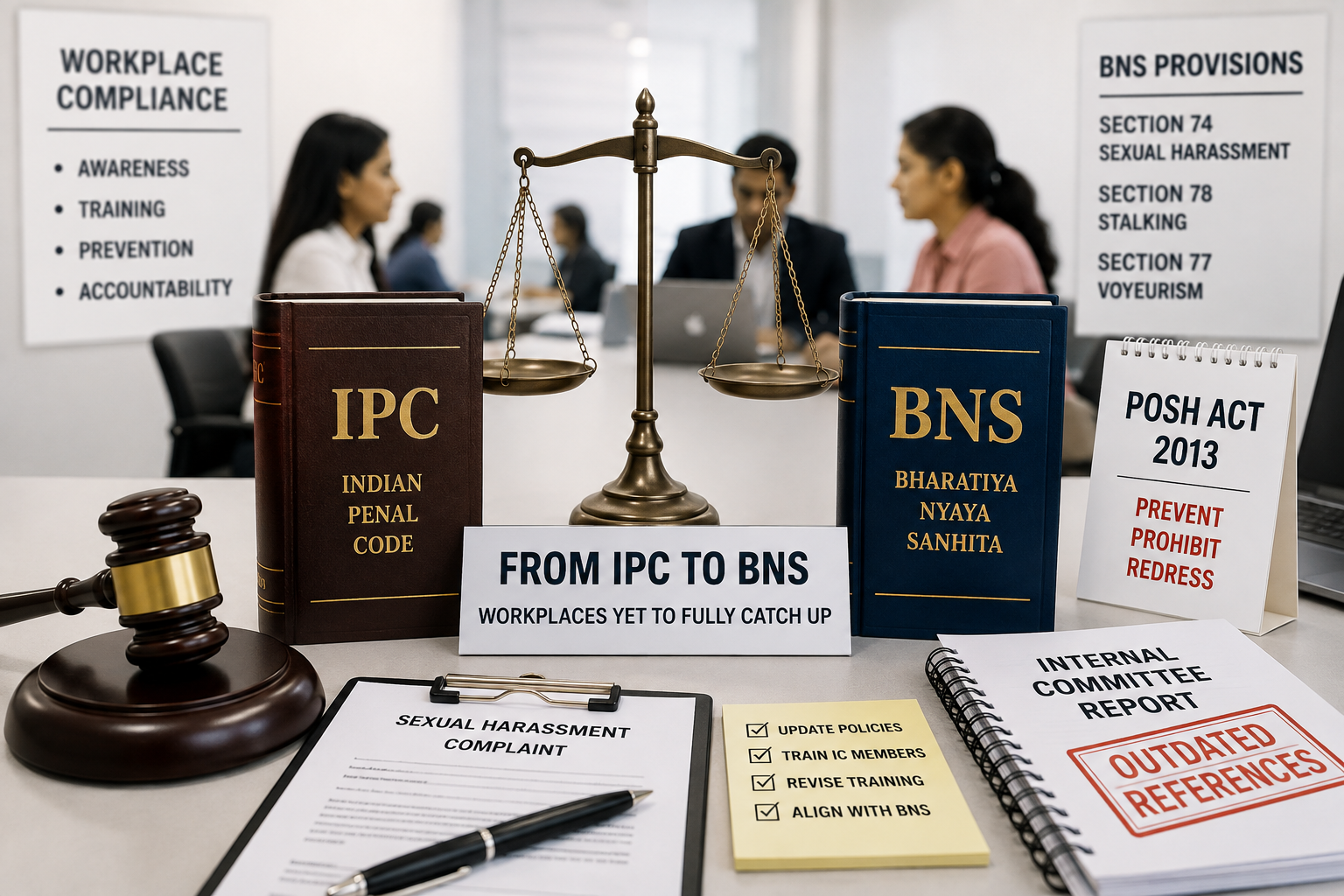
- Section 74 – Sexual harassment
- Section 78 – Stalking
- Section 77 – Voyeurism
Despite this shift, many organisations are still referring to outdated IPC sections in their processes.
Ground Reality: Policies and Practices Lag Behind
Inputs from HR professionals, legal practitioners, and PoSH experts indicate a consistent trend across sectors:
Internal Committee reports continue to cite IPC provisions
PoSH policies have not been revised post-2022
Training materials remain outdated
Awareness of BNS among IC members is limited
Experts say this gap is largely due to the absence of structured systems within organisations to track and implement legal changes.
Legal and Practical Risks Emerging
While some may consider the use of old legal sections a minor issue, legal experts caution otherwise.
“Accuracy in legal references is important. If an Internal Committee relies on repealed provisions, it can weaken the credibility of the inquiry,” said a workplace compliance advisor.
Such gaps can create challenges if a case is legally contested. Respondents may question the validity of findings, and employers may face difficulty defending their processes.
There is also a trust factor involved. For complainants, errors in legal referencing may reduce confidence in the system meant to protect them.
BNS Brings Structural Changes, Not Just Renumbering
Experts emphasise that BNS is not merely a renumbered version of IPC. While many provisions remain similar, there are structural and drafting changes that require fresh understanding.
For Internal Committees, this has three key implications:
Identifying when workplace behaviour amounts to a criminal offence
Deciding when cases should be referred to the police
Ensuring inquiry reports reflect current legal provisions
A simple replacement of section numbers in templates is not considered sufficient.
Checklist Approach to Compliance Under Scrutiny
The issue also highlights a broader concern regarding how PoSH compliance is approached.
In many organisations, compliance is treated as a checklist exercise:
Formation of IC
Conducting annual training
Having a written policy
However, experts point out that regular legal updates, active participation of external members, and periodic policy reviews are often missing.
Given that PoSH operates at the intersection of employment law and criminal law, a superficial approach can lead to serious gaps.
Steps Suggested to Bridge the Gap
Experts recommend several practical measures for organisations:
Updating PoSH policies to align with BNS provisions
Conducting focused training for IC members on legal changes
Reviewing recent cases for outdated references
Increasing coordination between HR and legal teams
Some organisations have started adopting periodic review meetings between IC members and legal advisors to stay updated.
A System Still Catching Up
The shift from IPC to BNS reflects a broader attempt to modernise India’s legal system. However, its success depends on how effectively institutions adopt these changes.
Workplaces, often being the first point of redress for victims, play a critical role in this process.
As experts note, ensuring that internal systems are legally updated is not just about compliance—it is about maintaining trust and credibility.
Time to align
While India’s criminal law framework has moved forward, many workplaces are still in transition. The gap between law and implementation remains a concern, particularly in sensitive areas like sexual harassment.
As organisations continue to strengthen their compliance frameworks, aligning with the Bharatiya Nyaya Sanhita may no longer be optional—but necessary.










[[comment.comment_text]]