The Shadow of the Ballot: How Form 7 and SIR Risk Creating a Voteless Citizenry
 2 weeks, 6 days ago
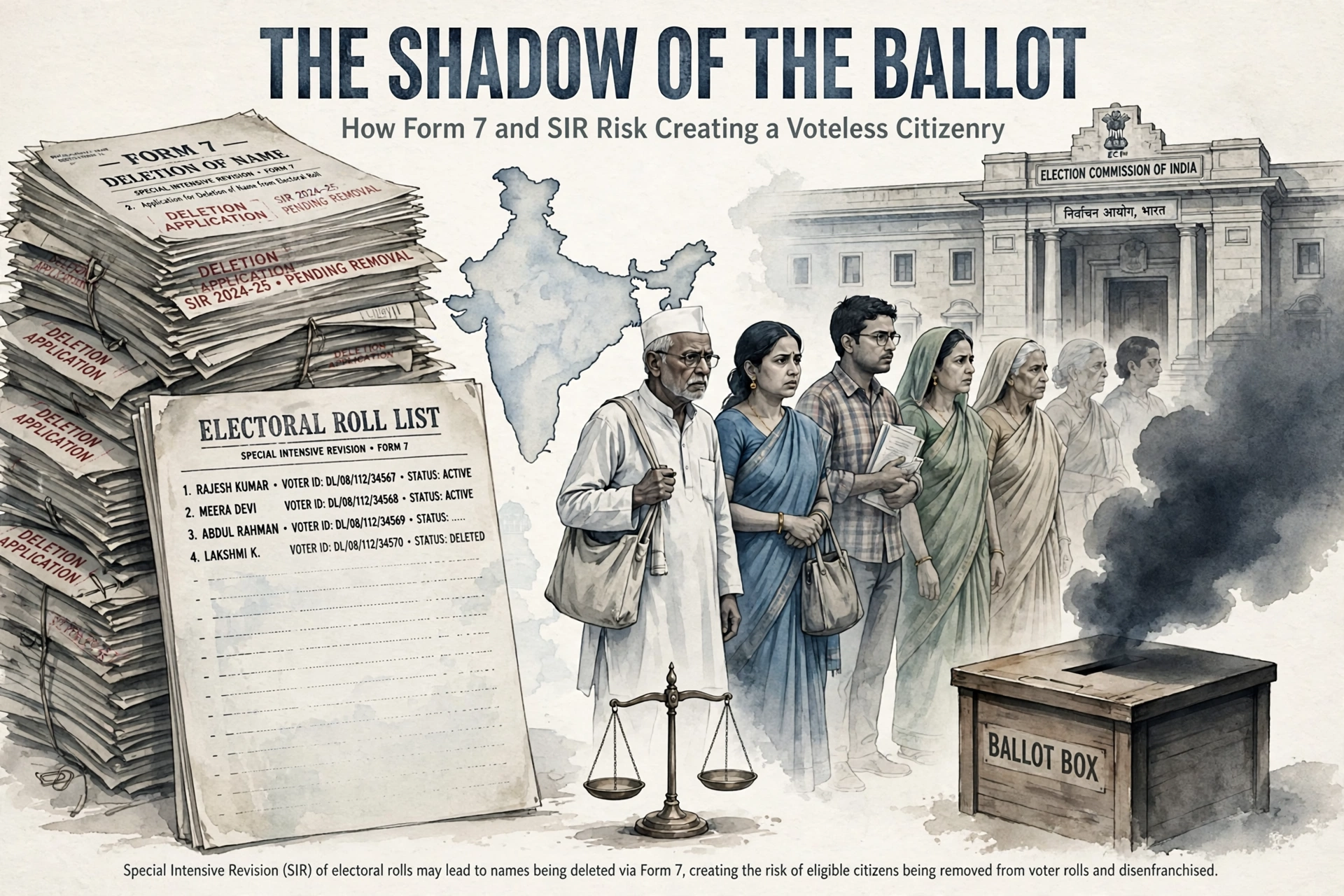
The Special Intensive Revision of electoral rolls, launched by the Election Commission of India in phases from 2025, was presented as a long-overdue cleansing of India’s voter lists. Officials described it as a rigorous house-to-house enumeration to remove the names of the deceased, those who had permanently shifted, and duplicates, while adding eligible new voters. Draft rolls in multiple states and Union Territories have shown substantial reductions—sometimes exceeding 10 per cent of the pre-revision electorate. Yet reports from Karnataka, West Bengal, Uttarakhand, Odisha and elsewhere have raised a more troubling question: is this exercise purifying democracy or selectively silencing sections of it?
Investigations by independent outlets and mainstream newspapers have documented a pattern of bulk Form 7 applications—statutory objections seeking deletion of names—disproportionately directed at Muslim voters. The cumulative effect, critics argue, is the quiet manufacture of a voteless citizenry whose formal exclusion from electoral rolls may carry consequences far beyond a single election.
Cleaning Rolls or Targeting a Community?
Form 7 allows any registered elector to object to another’s inclusion on grounds of death, permanent shift, or ineligibility. In principle it is a safeguard. In practice, its recent use has looked more like a tool of mass exclusion.
In Karnataka, during the claims-and-objections window of the ongoing SIR, more than 4,000 Form 7 applications were filed in a short span. In the Babaleshwar Assembly constituency alone, 1,373 applications arrived on a single day; 1,363 of them came from just ten individuals and largely targeted Muslim names, citing “absent/permanently shifted.” Similar concentrations appeared in Basavakalyan and Belthangady—constituencies represented by the BJP—where single applicants filed dozens of objections exclusively against Muslim electors in one or two polling stations. The Hindu’s examination of statutory records made the communal tilt unmistakable.
Parallel reporting from Uttarakhand revealed even starker numbers. In Kichha, one objector—identified as a BJP booth-level agent—filed 4,855 deletion requests; virtually all targeted Muslim voters. In Jhabrera, 1,657 forms seeking removal of Muslim names listed 31 applicants who turned out to be BJP booth agents; several later claimed their signatures and EPIC numbers had been misused. Ground verification done by some credible media outlets has left little room for coincidence.
In Odisha’s Bhadrak constituency, The Reporters Collective documented digitally pre-filled Form 7 applications submitted by BJP booth-level agents that systematically flagged Muslim voters. State officials ordered re-verification only after the pattern was exposed; the senior administrative officer implicated faced no serious consequence.
West Bengal presented a different statistical anomaly. Of roughly 6.39 lakh Form 7 applications received, nearly 90 per cent were accepted—an unusually high rate compared with inclusion claims under Form 6, of which only about one in five succeeded. Opposition parties and petitioners before the Supreme Court have called the disparity evidence of selective pressure rather than neutral housekeeping.
The Election Commission has ordered inquiries in Karnataka after protests by the state government and has repeatedly insisted that every Form 7 triggers field verification and that no name is deleted without due process. Yet the sheer volume of bulk filings by a handful of individuals, the pre-printed or digitally prepared forms, and the consistent communal skew documented across states strain the claim of routine administrative error.
Electoral Advantage Through Exclusion?
The timing and geography of these objections invite a harder question: is a particular community being removed from the rolls to alter electoral arithmetic? In several BJP-held or closely contested seats, the deletions have clustered in minority-heavy booths. In Karnataka’s Bhalki and Babaleshwar, applications focused on Muslim localities. In earlier Newslaundry investigations of constituencies in Uttar Pradesh and Delhi, higher deletion rates appeared in areas with substantial Yadav, Muslim, Dalit and other marginalised populations compared with upper-caste neighbourhoods. The pattern is not uniform across every constituency, but its recurrence is difficult to dismiss as random.
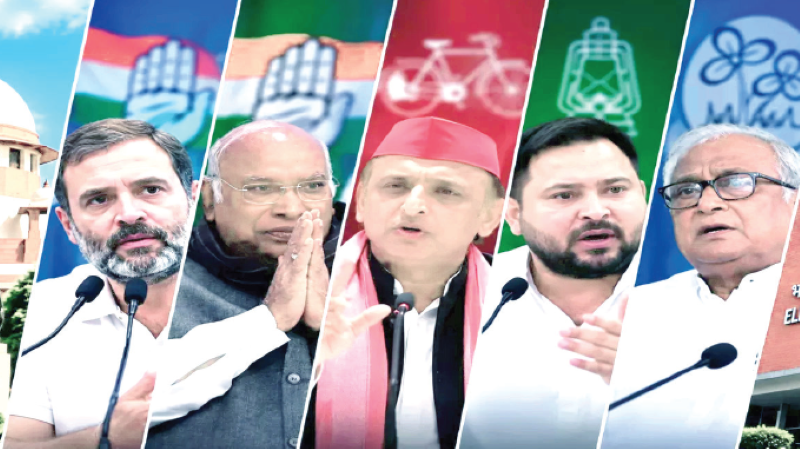
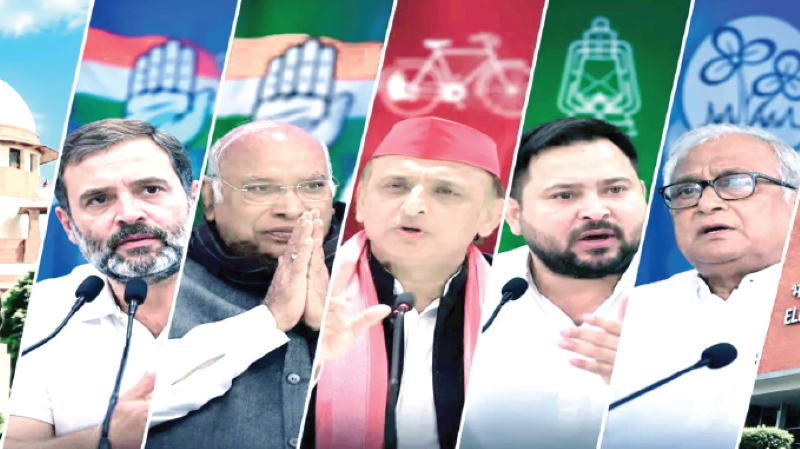
Political parties have long appointed booth-level agents precisely to scrutinise rolls. The BJP has defended the filings as legitimate efforts to flag non-genuine voters. Opposition leaders, including Karnataka Chief Minister D.K. Shivakumar and Congress general secretary K.C. Venugopal, have described the exercise as coordinated “vote chori,” pointing to pre-printed forms distributed to party workers and the concentration of objections against minorities, Scheduled Castes and Other Backward Classes. FIRs have been registered in some districts under general criminal provisions, though the Election Commission itself has been cautious about invoking the Representation of the People Act against objectors.
Whether the net effect tilts electoral outcomes remains contested. In many seats the absolute numbers deleted exceed recent victory margins; in others the difference is marginal. What is clear is that the burden of proving continued eligibility has fallen heaviest on communities already under socio-economic pressure, and that the process has amplified existing asymmetries of political organisation and documentation access.
Citizenship, Not Just the Franchise
Does the SIR aim to strip Muslims and other minorities of citizenship itself? Officially, no. The exercise is confined to electoral rolls under the Representation of the People Act and the Registration of Electors Rules. Citizenship determination remains the domain of the Citizenship Act and any future National Register of Citizens process. The Supreme Court has upheld the legal framework of the SIR while emphasising the need for procedural fairness.
Yet the practical consequences blur the line. Once a name disappears from the electoral roll, obtaining or renewing other official documents—passports, ration cards, property registrations—can become significantly harder.
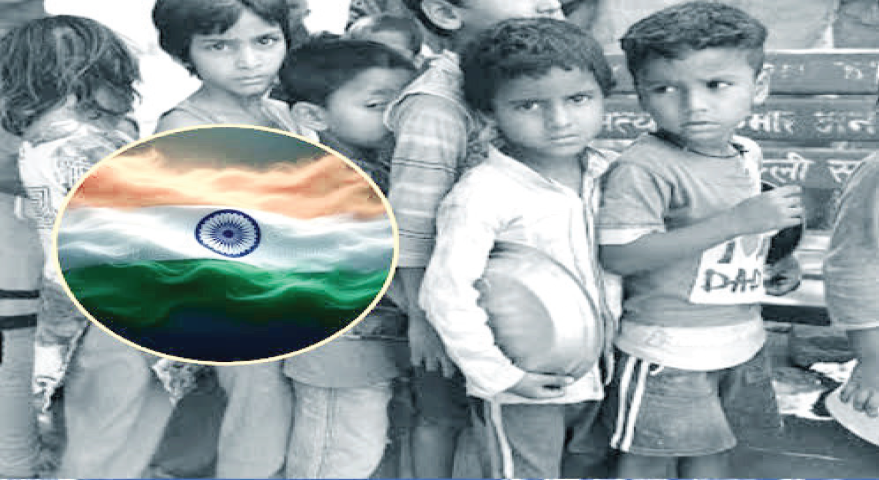
The large-scale deletions create a class of citizens who remain residents and taxpayers but find themselves administratively invisible when they seek state services. For communities that already face higher rates of documentary irregularity because of migration, poverty or historical exclusion, the SIR can function as a de facto citizenship filter even if it carries no formal legal power to revoke nationality.
Historical parallels with Assam’s NRC experience and the rhetoric that has accompanied some Form 7 drives—equating certain Muslim voters with “illegal immigrants”—have deepened these anxieties. When senior political figures publicly link voter-list purification with the detection of “Bangladeshis,” the distinction between electoral cleanup and citizenship surveillance begins to collapse in public perception.
From Voter List to Shadow NRC?
Could the post-SIR electoral rolls become, in effect, India’s National Register of Citizens? Not in a legal sense. An NRC requires a separate statutory process, documentary thresholds, and appeals mechanisms distinct from electoral revision. The Election Commission has no mandate to declare anyone a non-citizen.
Functionally, however, the risk is real. A cleaned electoral roll that systematically under-represents certain communities can become the default reference list for other databases. Banks, employers, welfare schemes and future digital identity systems often cross-check against voter data. When millions of names vanish without transparent, publicly accessible reasons—as the Association for Democratic Reforms has repeatedly pointed out in petitions seeking disclosure of deletion lists and justifications—the resulting register acquires quasi-official authority. ADR’s interventions in the Supreme Court during the Bihar phase underscored the opacity: large numbers of deletions lacked clear categorisation as deceased, shifted or duplicate, and political parties were not always given complete lists with reasons.
If the final post-SIR rolls are treated by state and central agencies as the authoritative record of legitimate residents, the distinction between electoral exclusion and citizenship exclusion becomes administrative rather than constitutional. That is the quiet danger critics identify: not a sudden declaration of non-citizenship, but the gradual construction of a parallel population of the documented and the undocumented.
The Larger Architecture: What, then, is the bigger plan?
The most charitable reading is that the Election Commission is executing a constitutionally mandated duty with imperfect tools and under intense political pressure, and that bulk Form 7 filings represent the predictable excesses of competitive politics. The less charitable reading, advanced by opposition parties, independent journalists and civil-society groups, is that a powerful political formation has discovered in Form 7 an efficient, low-visibility mechanism to shrink the electorate of communities it regards as unfavourable, while the institutional referee has been slow to impose meaningful costs on the abusers.
Either interpretation leaves Indian democracy diminished. An electoral roll that is accurate only for some communities is not accurate at all. A process that requires ordinary citizens—especially the poor, the migrant and the minority—to re-prove their eligibility every few years while party agents can file thousands of objections with minimal scrutiny tilts the balance of power away from the voter and toward organised political machinery.
The Election Commission retains the authority, and the obligation, to restore balance: by publishing complete deletion lists with reasons, by capping or scrutinising bulk Form 7 filings, by prosecuting demonstrably false objections under the Representation of the People Act, and by ensuring that every deleted elector receives actual notice and a real opportunity to be heard. Until those safeguards are visibly enforced, the suspicion will persist that the SIR is less a cleaning of the rolls than a selective pruning of the electorate—and that the voteless citizenry being created is not an accidental by-product but a structural feature of the exercise.
Democracy does not survive on the elegance of its statutes alone. It survives on the lived certainty that every eligible adult can cast a vote without first having to fight for the right to remain on the list. That certainty is now under strain.
(Author, a well-recognised senior journalist and commentator, has served as a Professor & Dean at the capital-based IIMC.)




[[comment.comment_text]]