Fueling India's Future: Why the Australia Uranium Partnership Matters

 3 months, 1 week ago
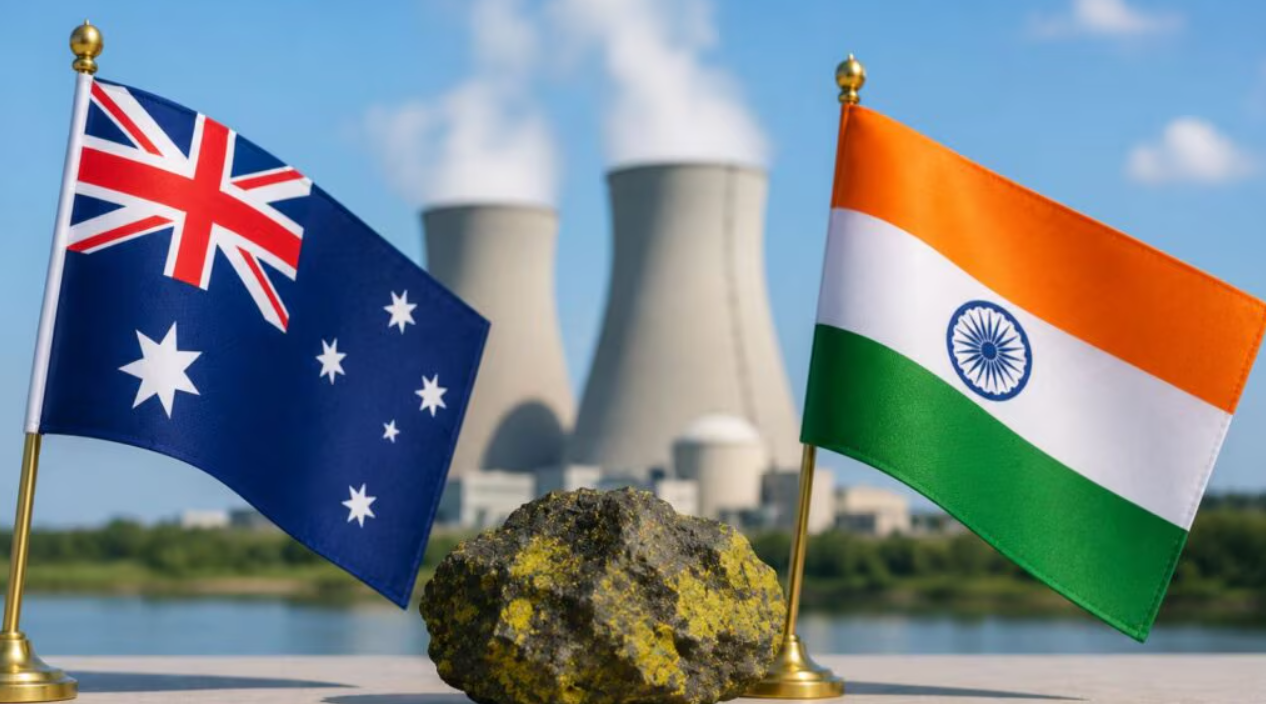
There are moments in international diplomacy that quietly reshape a nation's future. They may not command the same public attention as military agreements, blockbuster trade deals or high-profile political summits, yet their impact is felt for decades. India's expanding uranium partnership with Australia is one such moment. While headlines have largely focused on Prime Minister Narendra Modi's engagements in Canberra, the most consequential outcome of the visit may well be the renewed momentum in civil nuclear cooperation. At a time when global energy markets are increasingly volatile, geopolitical conflicts threaten vital oil supply routes, and India faces the dual challenge of sustaining economic growth while meeting ambitious climate goals, the agreement is far more than a bilateral commercial arrangement. It is a strategic investment in India's long-term energy security.
The timing could hardly have been better. Over the past few years, energy has emerged as one of the defining issues of global politics. Wars, sanctions, supply chain disruptions and geopolitical rivalries have repeatedly demonstrated how fragile the world's energy architecture has become. The latest tensions involving the United States and Iran have once again brought the Strait of Hormuz into sharp focus. This narrow waterway carries nearly one-fifth of the world's traded crude oil. Even the possibility of military confrontation in the region is enough to send international oil prices soaring. For India, which imports the overwhelming majority of its crude oil, such developments immediately translate into higher import bills, increased transportation costs, inflationary pressures and a heavier burden on households and industries alike.
Energy insecurity is no longer a distant theoretical concern discussed only in policy circles. It has become an everyday economic reality. Rising fuel prices influence the cost of almost everything—from vegetables transported across states to airline tickets, electricity bills and industrial production. Household budgets feel the pressure through higher cooking gas prices, while businesses struggle with rising logistics expenses. These cascading effects illustrate why energy policy has become inseparable from economic policy.
At the same time, India has been pursuing an ambitious programme to reduce dependence on imported petroleum. One of its most visible initiatives has been the expansion of ethanol blending in petrol. The policy aims to reduce crude oil imports, lower carbon emissions and provide better income opportunities for sugarcane farmers. Considerable progress has already been made, and India has emerged as one of the few major economies to achieve significant ethanol blending targets ahead of schedule. Yet the policy has also generated public debate. Questions regarding engine compatibility, long-term maintenance, mileage, and suitability for older vehicles continue to circulate among consumers. While many automobile manufacturers have adapted to higher ethanol blends and several concerns are either overstated or being addressed through technological improvements, the discussion itself highlights an important lesson. No single energy source can meet India's rapidly expanding needs.
Similarly, fluctuations in LPG prices continue to remind policymakers that affordability remains as important as availability. India cannot simply replace one dependence with another. The answer lies in diversification—building an energy ecosystem in which renewable energy, nuclear power, domestic hydrocarbons, natural gas, biofuels and emerging technologies complement one another rather than compete. It is within this broader framework that the Australia uranium partnership acquires strategic significance.
India today stands at an extraordinary stage of economic transformation. It is already the world's fastest-growing major economy and is widely expected to become the third-largest economy within this decade. Such growth demands enormous quantities of reliable electricity. Every new manufacturing unit, metro rail project, semiconductor plant, data centre, electric vehicle charging network and digital infrastructure initiative increases electricity demand. Urbanisation, rising living standards and industrial expansion are accelerating consumption at a pace few countries have experienced in recent history.
Meeting this demand presents a complex challenge. Coal continues to dominate India's electricity generation and will remain an important component of the energy mix for years to come. However, coal also presents environmental challenges and exposes India to increasing international pressure regarding carbon emissions. Renewable energy has expanded rapidly, making India one of the world's largest producers of solar power, yet renewable sources remain intermittent. Solar panels cannot generate electricity after sunset, while wind farms depend entirely on weather conditions. Large-scale battery storage technologies are improving but remain expensive and technologically demanding.
This is precisely where nuclear energy becomes indispensable. Unlike solar or wind, nuclear reactors provide uninterrupted baseload electricity throughout the year. They occupy relatively little land, emit virtually no greenhouse gases during operation and require comparatively small quantities of fuel. A single shipment of uranium can sustain electricity production for extended periods, making nuclear fuel far easier to store than oil or natural gas. For a country seeking both energy security and climate responsibility, nuclear power offers a rare combination of reliability and sustainability.
India has long recognised this potential. Successive governments have invested in developing indigenous nuclear capabilities, and the country possesses considerable scientific expertise in reactor technology. However, domestic uranium reserves have remained a limiting factor. Although uranium deposits exist in several Indian states, they are generally insufficient to support the large-scale expansion envisioned under India's long-term nuclear programme. Imported uranium therefore becomes essential not because India lacks nuclear expertise, but because it requires dependable fuel supplies to maximise the utilisation of its reactors.
Australia occupies a unique place in the global uranium landscape. The country possesses nearly one-third of the world's known uranium reserves, making it one of the richest repositories of nuclear fuel anywhere on the planet. Yet its production has historically remained below its geological potential due to domestic political debates, environmental considerations and fluctuating international demand. India represents one of the most promising long-term markets capable of changing that equation.
For Australia, exporting uranium to India creates fresh economic opportunities. It encourages exploration, supports mining investment, generates employment and strengthens Australia's position as a reliable supplier of strategic minerals. As global interest in nuclear power experiences a resurgence driven by climate concerns, Canberra's willingness to expand uranium exports sends a strong signal to international markets that it intends to play a larger role in the clean energy transition.
For India, however, Australia's importance extends beyond geology. Australia is a politically stable democracy with transparent institutions, strong regulatory systems and an increasingly close strategic partnership with New Delhi. Both countries are members of the Quadrilateral Security Dialogue, or Quad, alongside the United States and Japan. They share concerns regarding maritime security, freedom of navigation, resilient supply chains and a stable Indo-Pacific region. These shared strategic interests make Australia not merely a supplier but a trusted long-term partner.
Trust has become an increasingly valuable commodity in international relations. The pandemic exposed vulnerabilities in global supply chains. The Russia-Ukraine conflict disrupted energy markets across Europe. Continuing instability in West Asia repeatedly threatens shipping lanes and commodity prices. Against such a backdrop, securing energy partnerships with politically reliable countries becomes an essential component of national security. In this context, uranium imports from Australia represent strategic resilience rather than simple commercial procurement.
The transformation in India-Australia relations over the past decade further reinforces this conclusion. For many years, the relationship was often described as one of unrealised potential. Despite being democratic nations with complementary economies and shared Indo-Pacific interests, bilateral engagement remained surprisingly limited. Australia's earlier reluctance to export uranium to countries outside the Nuclear Non-Proliferation Treaty effectively constrained deeper nuclear cooperation with India.
That position gradually changed following international recognition of India's impeccable non-proliferation record and the growing acceptance of its civil nuclear programme after the Nuclear Suppliers Group waiver in 2008. Since then, bilateral ties have expanded dramatically. Defence cooperation has intensified through joint military exercises and maritime coordination. Trade has grown steadily. Educational exchanges have flourished, making Australia one of the preferred destinations for Indian students. Collaboration in critical minerals, cybersecurity, digital technologies, agriculture and clean energy has gathered remarkable momentum. Australian Prime Minister Anthony Albanese's observation that bilateral relations before 2014 had been "underdone, under-explored and under-examined" accurately captures the transformation that has since taken place.
The outcomes of the recent visit further demonstrate that the relationship is becoming increasingly multidimensional. Australian Super's decision to invest an additional US$346 million in India's National Investment and Infrastructure Fund reflects growing confidence among global institutional investors in India's long-term growth story. Such investments help finance highways, logistics networks, renewable energy projects, urban infrastructure and industrial corridors that are essential for sustaining economic expansion. They also indicate that international investors increasingly view India not merely as a large consumer market but as a long-term destination for strategic capital.
Yet the significance of the uranium partnership should not lead to complacency. India still faces important policy challenges in expanding nuclear power generation. Nuclear power plants require substantial capital investment, sophisticated technology, rigorous safety protocols and lengthy construction timelines. Land acquisition remains politically sensitive. Environmental clearances often take years. Public apprehensions regarding nuclear safety, although understandable, continue to influence project implementation. Unless these structural bottlenecks are addressed through institutional reforms, streamlined approvals and sustained public engagement, imported uranium alone will not translate into significantly higher nuclear generation.
Equally important is the need to avoid viewing nuclear power and renewable energy as competing alternatives. India's future energy architecture must be based on complementarity. Solar energy will continue to dominate daytime electricity generation. Wind power will expand where geographical conditions permit. Hydropower, battery storage, green hydrogen and improved transmission networks will each contribute to grid stability. Nuclear energy should serve as the dependable backbone that ensures continuous electricity supply irrespective of weather conditions. Such a balanced approach is essential if India hopes to simultaneously achieve energy security, industrial competitiveness and climate commitments.
The government must also continue investing in research and development. Advanced reactor technologies, including Small Modular Reactors (SMRs), next-generation fuel cycles and thorium-based systems, hold considerable promise for the future. India possesses one of the world's largest thorium reserves, and long-term investments in indigenous nuclear technology could eventually reduce dependence on imported uranium even further. The Australia partnership should therefore be viewed not as a substitute for domestic capability but as a catalyst that enables India's broader nuclear ambitions.
Ultimately, the India-Australia uranium partnership reflects a deeper truth about the changing nature of global power. In the twenty-first century, national strength will depend not only on military capability or economic size but also on the ability to secure resilient supply chains for energy, technology and critical resources. Countries that diversify their strategic partnerships will be better positioned to withstand future geopolitical shocks. Those that remain dependent on a narrow range of suppliers will face increasing vulnerability.
India's relationship with Australia exemplifies how modern diplomacy increasingly integrates economics, security, energy and technology into a single strategic framework. The agreement strengthens India's energy resilience, supports its clean energy transition, reinforces bilateral trust and contributes to a broader Indo-Pacific partnership rooted in shared democratic values. It also reminds us that effective foreign policy is measured not merely by the number of agreements signed but by their ability to shape national development over generations.
In the years ahead, the success of this partnership will not be judged solely by the volume of uranium shipped from Australian mines to Indian reactors. It will be measured by whether it helps India build a more secure, affordable and sustainable energy future—one capable of powering factories, cities, innovation, digital infrastructure and the aspirations of 1.4 billion people. If managed with foresight and complemented by sound domestic reforms, the India-Australia uranium partnership could become one of the defining pillars of India's energy strategy in the decades to come. In a world increasingly defined by uncertainty, that is not merely good diplomacy. It is sound statecraft.











[[comment.comment_text]]